
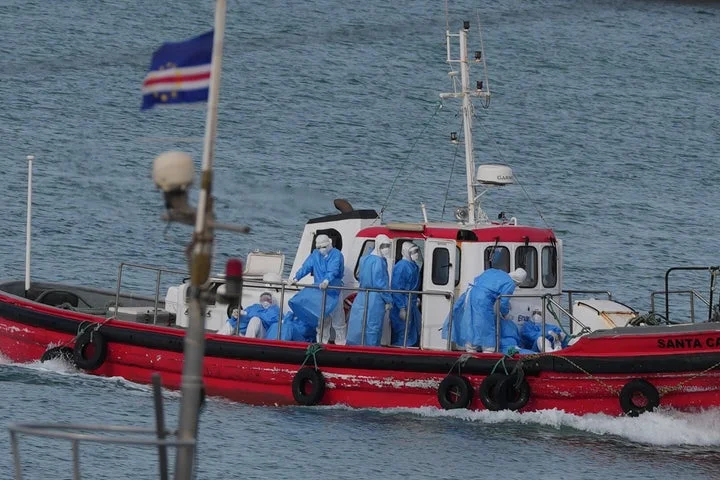
The British passengers will have to self-isolate for 45 days
Britons on board the MV Hondius cruise ship where there is a Hantavirus outbreak are set to return to the UK.
The 22 passengers are expected to reach Tenerife on Sunday, with the hope of flying them back to the UK the same day.
They will be tested on the ship before they disembark, it is understood, and they will then be taken directly from the ship to the plane.
The transfer is expected to take place on the same day, although transfer time to the UK could be impacted by the time the ship lands and the weather.
They will self-isolate for 45 days.
It comes after a woman in Spain is the latest person to be tested for a suspected hantavirus infection following an outbreak on a cruise ship .
The suspected case involves a woman who was a passenger on the same flight as a patient who died in Johannesburg after travelling on the MV Hondius and contracting the virus, Spain’s health secretary said on Friday.
WHO reacts to fears of a COVID-style hantavirus pandemic
What happens when the MV Hondius arrives in Tenerife?
The hantavirus-stricken cruise ship is due to dock in Tenerife on Sunday, and with it, the 140 passengers who have been stuck on the boat for weeks.
Health officials have said they will perform careful evacuations, and passengers will be taken to a “completely isolated, cordoned-off area.”
Both the UK and the US are sending planes to evacuate their citizens from the ship.
Once the vessel reaches Tenerife, passengers will be evacuated in small boats to buses only after their repatriation flights are ready to take them, Spanish officials said Friday.
Passengers will be transported in isolated and guarded vehicles, and the parts of the airport they travel through will be cordoned off.
Their impending arrival has been met with protest on the island, as residents fear for their safety.
But officials have sought to reassure the public in the Canary Islands about possible exposure to the virus among the general population.
Christian Lindmeier, a WHO spokesman, said: “The risk remains absolutely low,” adding: “This is not a new Covid.”
In pictures: Protestors in Tenerife take to the streets to oppose the arrival of the Hantavirus ship
WHO says risk of contagion from cruise ship 'absolutely low'
The World Health Organisation considers the risk to the wider public from the outbreak as low.
On Friday, the WHO said a flight attendant on a plane briefly boarded by an infected cruise passenger has tested negative for hantavirus.
Her possible infection had raised concerns about the virus’ potential transmissibility.
The flight attendant’s negative result should ease concerns among the public, said Christian Lindmeier, a WHO spokesman.
“The risk remains absolutely low,” he said.
“This is not a new Covid.”
Hantavirus is usually spread by the inhalation of contaminated rodent droppings and isn’t easily transmitted between people.
But the Andes virus detected in the cruise ship outbreak may be able to spread between people in rare cases.
Symptoms usually show between one and eight weeks after exposure.
Health authorities across four continents were tracking down and monitoring more than two dozen passengers who disembarked the ship before the deadly outbreak was detected.
They were also scrambling to trace others who may have come into contact with them.
Passengers fear being ostracised after disembarking
In interviews with The Associated Press, two Spanish passengers — speaking on condition of anonymity because of fears they’ll be ostracised once on land — said that despite the outbreak, their days aboard have passed with relative tranquility.
“We’re scared by all the news that’s coming out, by how people are going to receive us, by how people see us,” one said.
“We’re just normal people.
We’ve heard that this is a millionaires’ cruise, and it’s the complete opposite of reality.
And we’re scared by this.”
Spanish authorities prepare to receive virus-stricken ship
Spanish authorities on Friday were preparing to receive more than 140 passengers and crew members on board a hantavirus-stricken cruise ship headed for the Canary Islands, where health officials have said they will perform careful evacuations.
The vessel is expected to arrive Sunday at the Spanish island of Tenerife, off the coast of West Africa, and passengers will be taken to a “completely isolated, cordoned-off area,” said the head of Spain's emergency services, Virginia Barcones.
Both the US and the UK have agreed to send planes to evacuate their citizens from the cruise ship.
What to know about hantavirus as illness linked with three deaths on Atlantic cruise ship
What to know about hantavirus as illness linked with three deaths on cruise ship
Measures to contain spread of hantavirus could be take from 'measles or Elbola', expert says
Krutika Kuppalli, associate professor of medicine at the University of Texas Southwestern Medical Center in the US, who formerly worked on mpox protocols at the World Health Organization, said measures to contain the spread of hantavirus could be taken from previous outbreaks.
“It’s the same principle as for measles, or Ebola.
Contact tracing doesn’t change,” she said.
Soldiers deployed to help island of St Helena
Our health editor Rebecca Thomas reports:
British military personnel and equipment have been deployed to the islands.
As officials trace contacts from the MV Hondius and those who disembarked the ship, it is understood that British military personnel have been deployed to the islands with equipment to provide support to those on the ground.
Officials are ensuring that members of the population on the islands who did come into contact with passengers are appropriately graded to understand their level of risk with passengers.
It is understood that the virus spreads through close contact.
Join thought-provoking conversations, follow other Independent readers and see their replies
Related Stories

Source: This article was originally published by The Independent
Read Full Original Article →
Comments (0)
No comments yet. Be the first to comment!
Leave a Comment