
As people who receive a lot of packages, we at the WIRED Reviews team have a foolproof way of making sure an important delivery shows up: step into the shower.
If you’re sitting at your desk with your shoes on, waiting and ready, I guarantee that every knock or ring will be from someone trying to sell you something or convert you to an obscure and weirdly expensive religion.
Even if you’re working in your backyard or hungover in bed, the best video doorbell can help you tell which knocks are worth lunging for and which ones can wait until next time.
We've tested these smart doorbells for months, peering at Instacart deliveries and stray raccoons from the safety and comfort of our couches.
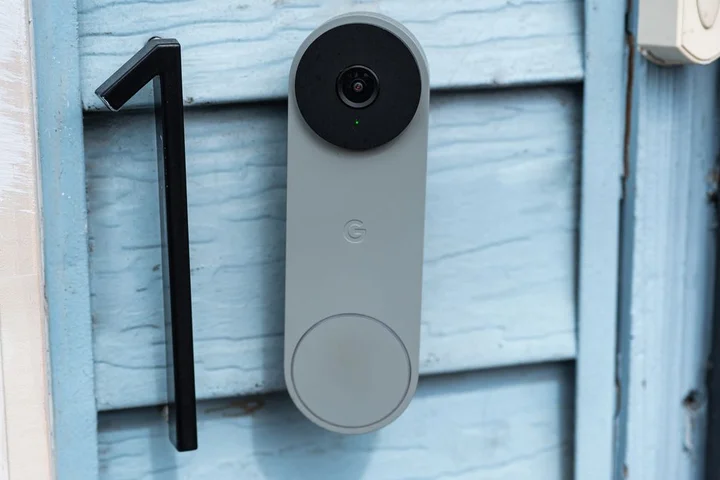
The Nest Doorbell is our current favorite, but you'll find plenty of alternative picks that might work better for some folks.
Don’t see anything you need here?
Check out our other guides, including the Best Indoor and Outdoor Security Cameras and the Best Personal Safety Devices and Alarms .
Updated March 2026: I added the Nest Doorbell (Wired, 3rd Gen) and Aqara G410, mentions for other doorbells from Aqara, Philips Hue, Wyze, and SwitchBot, reorganized this guide to slim down our recommendations, removed discontinued doorbells, and updated prices.
I used the predecessor for a few years, and while it did the job, I ran into connectivity issues more frequently; it occasionally had trouble operating in cold weather, too.
Now that I’ve been through a rather frigid winter in New York City with the third-gen Nest Doorbell, I’m happy to report that things have improved.
It’s hard to pinpoint whether some of my issues with the older model were due to my previous router, but I upgraded my mesh system to Wi-Fi 7 right around the same time I installed the latest Nest Doorbell, and I haven’t had any major connectivity problems.
Sometimes the live view takes a beat to load, and very rarely I get “live view unavailable,” which usually resolves itself after a little while.
The best upgrade is the 166-degree wider and taller field of view with the 1:1 aspect ratio.
You can see far more in the frame—including packages left at the bottom of your door—and the system intuitively zooms in on people and important subjects when the notification arrives on your phone.
The resolution is sharp at 2K, and the scene is well-exposed thanks to HDR, day or night.
The Arlo Video Doorbell 2K (2nd Gen) comes a close second.
I love the crisp video with HDR support, and this video doorbell has the widest field of view of any I tested at 180 degrees.
Alerts come through quickly, and you get useful animated previews.
You need a subscription for the best features here, including person and package recognition, activity zones, and more.
It starts at $8 a month for a single camera, jumping to $18 for unlimited cameras.
That includes a 60-day video history, and Arlo's cloud videos loaded quickly for me.
The live feed also loads quickly in Arlo's app.
Best Subscription-Free Video Doorbell
Local storage is a definite selling point for Eufy, and the E340 also has onboard AI to detect people and packages (it can even recognize familiar faces, though it’s not always accurate).
I set it to only alert me about people or packages, and it works well.
Combine that with activity zones and motion sensitivity, and it is easy to cut out false positives.
By default, the main camera offers 2K footage that is crisp and clear, but if the sun is up, it can blow out areas of the picture.
The downward-facing camera has lower resolution, but it's perfectly adequate for tracking parcels or spotting that the cat is waiting to get in.
The dual camera lights allow color footage at night, but they take a toll on the battery life.
Note : I stopped recommending this brand for a while after a few security breaches—when a security researcher identified cloud uploads from a supposedly local-only device, a report warned of video streaming without encryption, and a bug in May 2021 exposed some camera feeds to other Eufy users.
After initial denials, parent company Anker acknowledged and fixed the issues, overhauled its policies, and instituted a bug bounty program.
I spoke with third-party security researcher Ralph Echemendia, who was hired to conduct an audit, and decided to start testing Eufy cameras again.
Aqara’s G410 is one of the chunkiest doorbells I have ever tested, partly because the body needs room for a whopping six AA batteries.
Sadly, it ships with disposable batteries that fell well short of Aqara’s suggested four months (more like one), but I’ve since swapped them out for Panasonic’s rechargeable Eneloop , and they lasted a bit longer.
Testing it without HSV, it performed more reliably, with the indoor hub recording video to a microSD card and doubling as a loud chime and Wi-Fi repeater.
The G410 is not fully waterproof, so it's only suitable if you have a porch, or at least some cover at your front door.
The depth of features in the Aqara app is impressive, with options to configure loitering alerts and fine-tune detection zones.
It’s also worth mentioning that you can record 24/7 video if you hardwire this doorbell.
But as the only battery-powered option that currently supports HSV, that is its unique selling point.
The G410 is a good upgrade over the Aqara G4 ($90) , which it replaces here.
It offers a wider view that takes in more of the porch, sharper images, and enhanced connectivity that enables it to act as a hub for Matter and Aqara Zigbee devices.
If the G410 is too big for you and you can hardwire your doorbell, check out the Aqara G400 ($120) .
It is slimmer, supports PoE, and has an IP65 rating.
If you worry about how to secure your video doorbell , this local-recording Reolink doorbell can be hardwired.
It also supports Power over Ethernet (PoE) for a speedy, reliable, and secure connection.
Reolink offers a simple and steady app that will display clear (if not quite crisp) 2K video playback, and this doorbell records to a microSD card, so you're not bound to a monthly service fee.
It even includes a plug-in chime in the box instead of trying to upsell you like many competitors.
The Reolink doorbell has usable but choppy night vision (the frame rate maxes out at 20).
Built-in speakers and a microphone allow you to plead with the FedEx driver to linger for 10 seconds before disappearing into the ether.
This doorbell is not battery-powered and will require a wired connection.
You have three options: connect to your existing doorbell wires, plug into a power outlet, or connect via PoE using an Ethernet cable (ideal for NVRs).
It supports both RTSP and ONVIF.
WIRED reviewer Martin Cizmar tried the first two during his months of testing, connecting it to a power outlet on the back of his house before moving it to the doorbell wires up front.
I tried out PoE and it's your best bet if you can run a cable because it also protects your footage from Wi-Fi jammers.
Other Video Doorbells to Consider
I've tested several other video doorbells.
These are the ones that narrowly missed out on a place above.
SwitchBot Smart Video Doorbell for $100 : I don't love the design of this wide doorbell, but it does come with a wee display that you can use to view who’s there and answer.
This could be handy for folks who don’t want to rely on a phone and it lets anyone in the house check who is calling.
Video quality is decent, though the frame rate is limited to 15, and the display is low res.
You can record locally, and there’s a subscription option if you want cloud storage.
Sadly, I found the display was often slow to wake up, and sometimes I had trouble playing back recorded videos.
Nest Doorbell (Battery) for $180 : If you can’t hardwire your doorbell, the battery version of our top pick is still a great doorbell.
I tested it alongside several competitors, and it consistently outperformed them.
Alerts are swift, and notifications include animated previews that make it easy to decide whether you need to act.
While the resolution isn't the sharpest (960 x 1280 pixels), and the field of view is 145 degrees, Google compensates with HDR video at up to 30 frames per second.
SimpliSafe Video Doorbell Pro for $170 : If you’re looking for a solid security system, SimpliSafe is likely on your radar, and for folks with a SimpliSafe setup, the Video Doorbell Pro fits in neatly.
Former WIRED reviewer Medea Giordano found it sensitive at first, but, after an update, she says it worked nearly perfectly, sending swift alerts and offering a good, clear view of her porch.
Footage maxes out at 1080p, but the camera supports HDR to banish glare and has a 162-degree field of view.
It does have to be wired, and you need a subscription from $5 per month to record videos, but SimpliSafe also offers the option of professional monitoring (from $32 per month), which is a rarity for doorbells and might make sense if you have a complete security system with them.
TP-Link Tapo (D230S1) Smart Battery Video Doorbell for $106 : For folks seeking a local storage option that doesn’t require a monthly fee, Tapo's smart video doorbell is worth a look.
Notifications come through swiftly and include a still image; video quality is excellent, even at night, and the indoor hub takes a microSD card and doubles as a chime.
On the downside, it is chunky, and the onboard AI (which is supposed to recognize people, pets, vehicles, and packages) is flaky.
We didn't like every video doorbell we tested.
These are the ones we don't recommend.
Imou Doorbell 2S Kit : Aside from being large and ugly, the Imou doorbell offers crisp video recording up to 2K with a 166-degree field of view, and it has a unique trick: the lens can rotate through 30 degrees to track subjects.
The large size allows for a big battery, but this doorbell can also be hardwired.
The kit includes a plug-in chime with a microSD card slot for local storage.
Unfortunately, testing side by side with the Arlo, it failed to pick up some events.
I also had major connection issues after changing my router, despite retaining the same network name and password.
I had to reset the chime, which temporarily deleted the doorbell.
It's only available in the UK.
Reolink Video Doorbell (Battery) : We liked Reolink’s wired doorbell, listed above, so I was excited to try its first battery-powered model, but it was a disappointment.
It offers up to 2K footage with a 1:1 aspect ratio that gives you a complete view of the porch, but you must turn HDR on in the settings, and it has a relatively low frame rate (15 fps).
I like the option to go subscription-free, but it means putting a microSD card in the doorbell itself, and this is a relatively easy doorbell to remove.
Reolink suggests up to five months of battery life, but my first review unit died after less than two and refused to recharge.
Reolink sent me a replacement, which is performing better, but when it does run out, the rechargeable battery inside cannot be removed, so you have to take the doorbell off to recharge it.
Factor in the slightly confusing app, relatively slow loading times, and connection glitches, and this is impossible to recommend.
Ezviz EP3x Pro : This is a far better-looking doorbell than Ezviz’s previous models, and it’s nice to see solar panels as an option for doorbells, though you will need a porch capable of catching some rays.
The video quality is good, and you get a split view (like the Eufy above) that includes packages or waiting cats on your doorstep.
The distortion correction works well, and there is optional color night vision with a built-in light, though it only works at very close range.
I appreciate the 2FA, with fingerprint login, and 32 GB of onboard storage (cloud storage is an optional extra).
Sadly, if you use the solar panel, you can’t connect to your wired chime.
The lack of HDR is disappointing, human detection was a bit off (it frequently said I was a cat), and I had issues with alerts failing to come through on some Android phones.
(Even after following Ezviz’s instructions, they never worked reliably on my Xiaomi 14 Ultra.) This model is not yet available in the US.
Botslab Video Doorbell 2 Pro : The flaky setup procedure required a couple of restarts, and physical installation was no better, as the screws supplied were so cheap that one of the heads broke off.
The camera has a fisheye effect, but you can correct it with different views.
I liked the VR mode, which provides a 180-degree view of your front porch.
It comes with a handy plug-in chime, alerts seem reliable, there is an HDR option, and you can record locally (32 GB included) or in the cloud.
You can also set a detection range, which could be handy for street-facing cameras.
But the app is confusing, with an AI tab that lists various skills available for purchase.
There is a login history and a limit of two devices signed in at once, but no 2FA, which makes this impossible to recommend.
It is versatile but also relatively expensive.
Swann SwannBuddy Video Doorbell : This doorbell comes with a wireless battery-powered chime and the option of local storage, but the positives end there.
The video quality is poor, the app is painfully slow to load and glitchy, and the doorbell frequently fails to register motion.
I found the battery life disappointing.
I must also question the decision to provide local storage via a microSD card inserted in the doorbell (the chime would make more sense and be more secure).
What Features Should I Look for in a Video Doorbell?
Here are a few factors that you might want to think about when shopping for a new video doorbell.
Resolution and HDR: The higher the resolution, the clearer the picture you get, but consider that higher-resolution video also requires more bandwidth to stream and takes up more storage space.
If your front porch is in direct sunlight or strong shade, I strongly recommend opting for a video doorbell with HDR support, as it helps to prevent bright areas from appearing blown out or shadowy areas from being too dark to see.
Field of view and aspect ratio: If you want a head-to-toe view of the person at your front door, then think about the field of view and aspect ratio offered by your prospective pick.
A wider field of view will take more in but can cause a fish-eye effect.
Rather than a traditional landscape aspect ratio, you may prefer a square or portrait view to ensure you can see a visitor’s face and any packages that might be on your porch.
Advanced features: The best doorbell cameras offer features like package detection and person recognition.
These features can be handy for filtering alerts, so you only get useful notifications.
Bear in mind that you may need a subscription to gain access to advanced features.
Security: A couple of things I recommend looking for are two-factor authentication (2FA) to ensure that someone with your username and password cannot log into your doorbell, and encryption to ensure that anyone accessing the manufacturer’s servers cannot see your Wi-Fi login details or watch uploaded videos.
Which Is Better, a Wired or Wireless Video Doorbell?
Smart doorbells require more power than traditional doorbells.
If you opt for a wired video doorbell, you may need a new transformer, and you will likely want to hire an electrician for safe installation.
The main advantages of wired doorbells are that you shouldn’t need to touch them again after installation, and they will ring your existing doorbell chime.
Wired doorbells are usually a bit cheaper and slimmer than models with batteries, too.
Most battery-powered video doorbells can also be wired, which may be the best solution if you have concerns about power outages.
Wired doorbells are generally faster to alert and more reliable than battery-powered doorbells.
How Well Do Video Doorbells Perform?
What Is the Best Video Doorbell Brand?
Why We Hesitate to Recommend Ring
Ring is reintroducing a policy to enable local law enforcement to request footage directly from Ring users, making its camera tough to recommend.
We stopped recommending Ring a few years ago due to this policy, and that reasoning still stands.
We also have concerns about its data collection ( among other issues ), so we have decided to stop testing Ring doorbells and cameras again.
Samsung GS25+ Free With T-Mobile for Business SuperMobile
Squarespace Promo Code: 20% Off Annual Acuity Subscriptions
LG Discount Code: 10% Off Any Purchase
10% Off Dell Coupon Code for New Customers
30% Samsung Coupon - Offer Program 2026
10% Off Canon Promo Code + Up to 30% Off
Related Stories



Source: This article was originally published by Wired
Read Full Original Article →
Comments (0)
No comments yet. Be the first to comment!
Leave a Comment