
The U.S.
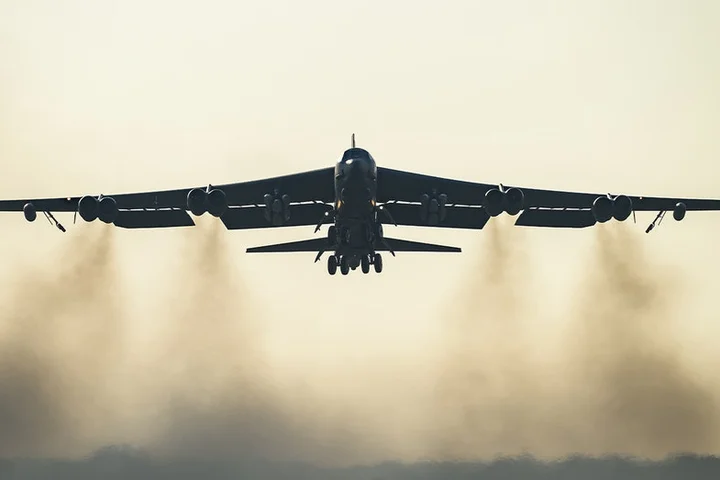
is now flying B-52 bombers over Iran — an operational shift that signals American forces have achieved air superiority inside parts of the country after weeks of strikes degraded Tehran’s defenses.
Chairman of the Joint Chiefs of Staff Gen.
Dan Caine said in a briefing Tuesday the missions began "given the increase in air superiority," as U.S.
forces expand operations inside Iranian territory.
President Donald Trump said during an address to the public Thursday night Iran’s air defenses had been "annihilated," calling U.S.
forces "unstoppable."
"We are in this military operation … for 32 days," he said.
"And the country has been eviscerated and essentially is really no longer a threat."
TRUMP SAYS IRAN ‘NO LONGER A THREAT’ AFTER 32 DAYS — OUTLINES NEXT PHASE OF US WAR
The bomber, first used during the Cold War and flown for about 70 years, allows the U.S.
to expand the pace and flexibility of its strikes.
Unlike earlier stand-off attacks focused on fixed targets, B-52s can remain over the battlefield and hit multiple targets in a single mission, including mobile systems and hardened sites, Mark Gunzinger, a retired Air Force colonel and former B-52 command pilot, told Fox News Digital.
The development signals the U.S.
has moved beyond the initial phase of degrading Iran’s air defenses and is now able to operate more freely inside the country’s airspace, allowing for sustained, higher-volume strikes as the campaign enters a potentially more intense phase.
The aircraft can carry up to 70,000 pounds of ordnance — more than any other bomber in the U.S.
arsenal — and deliver a mix of precision-guided bombs and long-range cruise missiles in a single mission.
But the bomber is slower than modern aircraft and lacks stealth, making it more vulnerable to radar and air defenses — conditions that would typically keep it out of contested airspace.
"The fact that these B-52s are now flying over Iran is clear evidence that we have air superiority — and even air dominance over parts of Iran," Gunzinger said.
Gunzinger said that level of control allows U.S.
forces to operate more freely over Iran, including remaining over the battlefield and striking targets as they emerge rather than relying solely on pre-planned, long-range attacks.
While U.S.
officials have emphasized growing control of the skies, air superiority does not eliminate all threats.
Iran still retains missile and drone capabilities, and has relied on asymmetric tactics throughout the conflict to continue attacks despite losses to its air defenses.
Early in the campaign, B-52s fired long-range cruise missiles from outside Iranian airspace.
More recently, bombers operating from U.S.-operated UK base Royal Air Force Fairford have been seen carrying precision-guided bombs — a shift that reflects growing U.S.
control of the skies and the move toward closer-range strikes.
"B-52s flying in Iran’s airspace shows America’s complete air dominance — and guaranteed, there are also F-22s and F-35s at high altitude on overwatch," Rebecca Grant, a military analyst, told Fox News Digital.
"They bring the big bomb payload for direct attacks on Iran’s drone and missile factories, plus underground targets."
The Pentagon could not immediately be reached for comment.
During the June 2025 strikes on Iran’s nuclear facilities, stealth B-2 bombers led the assault, dropping massive bunker-buster bombs on hardened sites like Fordow and Natanz.
B-52s, meanwhile, were deployed to the region as part of the broader U.S.
buildup — positioned to support sustained operations if needed.
MORE THAN 90% OF IRANIAN MISSILES INTERCEPTED, BUT A DANGEROUS IMBALANCE IS EMERGING
The latest development signals the U.S.
has moved beyond the initial phase of degrading Iran’s air defenses and is now able to operate more freely inside the country’s airspace, allowing for sustained, higher-volume strikes as the campaign enters a potentially more intense phase.
The expanded freedom of action could become more important as the campaign enters what Trump has described as its final phase, with U.S.
officials signaling that strikes could intensify in the coming weeks.
"If you really want to devastate Iran’s ability to continue to launch missiles and drones, you would want to use bombers to do that," Gunzinger said.
Gunzinger added that the U.S.
is using a significant portion of its combat-ready bomber fleet to sustain operations, underscoring the scale of the campaign as it enters what could be its most intense phase.
"Our bomber force now totals 140 aircraft," he said, referring to B-2s, B-52s and B-1Bs.
"If you scale that down to how many are ready to go to combat today, you're probably at less than 50."
"That is a dramatic change since the end of the Cold War era, where we had over 400 bombers, so we're using a good percentage — I'd say a majority — of our combat capable bombers for this fight, to sustain this fight."
Built in the early 1960s for nuclear war against the Soviet Union, the B-52 Stratofortress was never designed to operate inside modern, heavily defended airspace — making its current use over Iran a reflection of how much those defenses have been degraded.
Related Stories


Source: This article was originally published by Fox News
Read Full Original Article →
Comments (0)
No comments yet. Be the first to comment!
Leave a Comment