
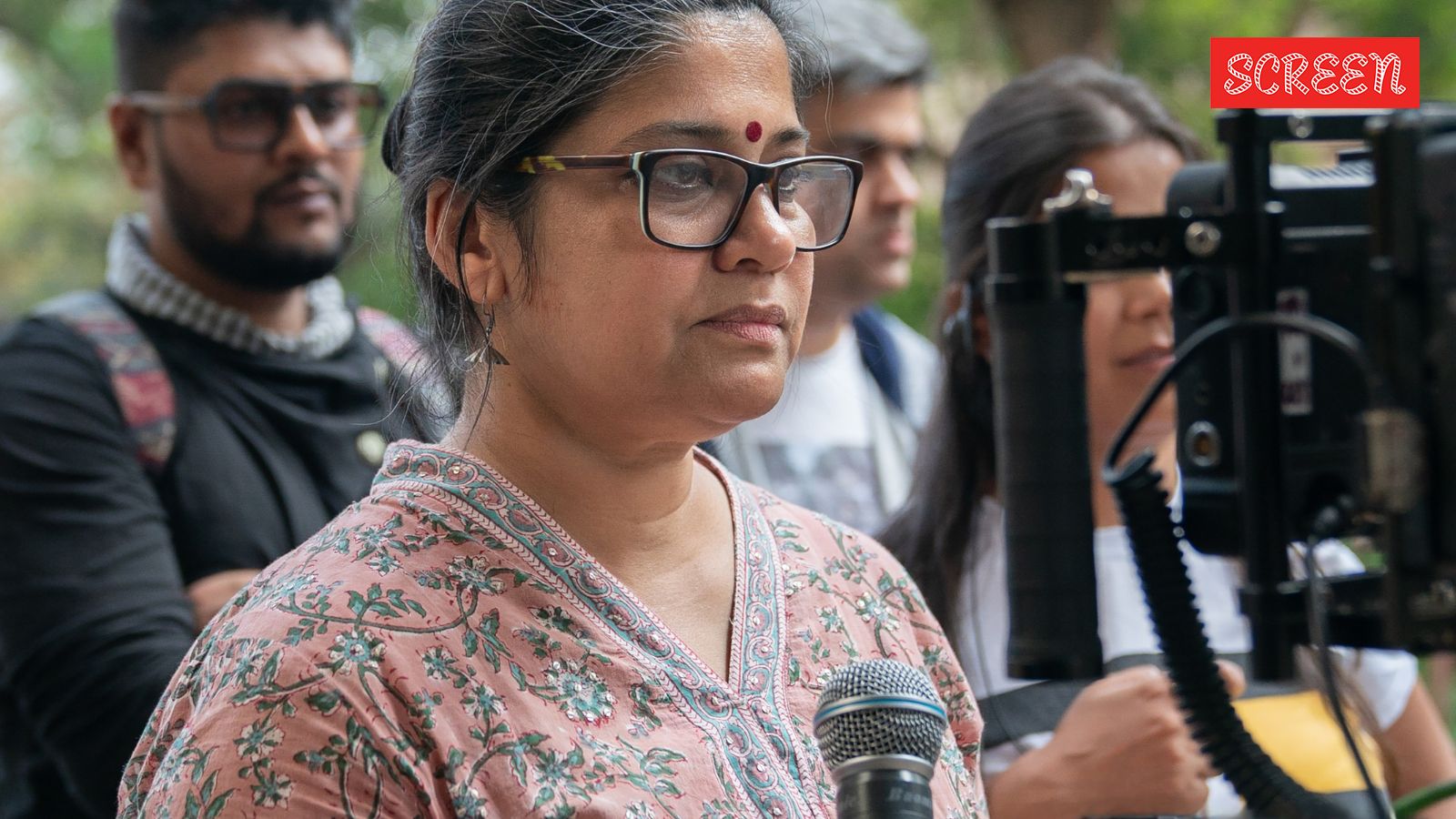
There is something extraordinarily audacious in what Renuka Shahane achieves as a director with her animated short Loop Line.Known largely for her acting chops, Shahane here turns to animation with a confidence that feels assured.
The film, scheduled to screen in Mumbai as part of the MAMI Mumbai Film Festival Independent Program on March 18 at PVR Lido, appears at first glance deceptively simple.
On the surface, it traces the life of a middle-aged housewife caught in the loop of domestic labour.
Her brief reprieves arrive through vivid, unruly fantasies, small insurgencies of the mind, that bloom in the cracks of her routine, only to end when her husband returns home accompanied by his casually sexist friends.
Yet the logline scarcely captures the experience of the film.
What stays is the way Shahane imagines this interior world through 2D animation that feels almost hand-painted into existence.
Neon hues breathe against textured surfaces; the frames seem to carry the grain of something lived-in.
The visual language gives the inner life of its protagonist a density that realism might have flattened.
Loop Line can be read as a companion piece to works such as Juice by Neeraj Ghaywan or Mrs.
by Arati Kadav, films that observe the suffocating choreography of domestic patriarchy.
In an exclusive chat with SCREEN, Renuka Shahane discusses Loop Line in detail, the creative choices she made, her foray into animation, and what lies ahead for her as a director.
Excerpts edited for clarity and brevity
How did the idea for Loop Line first come to you?
The idea had been with me for some time.
In many women-centric films, especially those dealing with repression, gaslighting, or patriarchy, the narrative usually builds towards a turning point: somewhere along the way the woman takes a step, big or small, to change her circumstances.
Often the film ends with her walking away, suggesting a life that will be freer or happier than before.
But the reality is that nearly 80% of women who face domestic emotional or physical abuse simply do not have the option of leaving.
Confidence, financial independence, and social support are often missing.
For many, walking away is not a viable choice.
I began thinking about one such woman—someone who knows she will likely have to continue living within this life.
A life marked by routine, drudgery, and the quiet pain of a relationship where respect is absent.
The question for me then became: how does such a woman find escape, even if only within the confines of the life she cannot leave?
What made you decide to tell Loop Line through animation instead of live action?
I had originally written it as a live-action film, that’s the space I come from.
But while developing it, I started thinking about presenting the fantasy elements through animation.
Then it struck me that in a short film, constantly moving between live action and animation might feel disjointed and not blend very well.
So I began considering the possibility of telling the entire story through animation instead.
I’ve always been a huge admirer of animation as a storytelling medium, and this felt like the right way to fully realise the film’s inner world.
Also Read |Bold gamble behind Kohrra 2’s shocking ending: Sudip Sharma, writers on how migration, generational trauma define Punjab
Did directing an animated film change the way you think about storytelling compared to live-action?
Oh yes, absolutely.
It was a complete learning experience for me, and for the animators as well, because most animation directors are visual artists, and I’m not.
I was approaching it from a live-action perspective.
In animation, the usual process is to record the sound first, a scratch dub with dialogue and music, and then animate to that track.
Since animation is extremely time-consuming and expensive, you have to be very precise; you can’t keep experimenting with multiple takes or camera angles the way you might in live action.
But because I come from live action, where you shoot first and dub later if needed, I suggested we try working that way.
So we storyboarded and created the animation first, and then I added the sound afterwards.
The animation itself was based on a pre-visualisation we shot with Mitali Jagtap Varadkar and Anand Alkunte, both wonderful actors from Marathi cinema.
We filmed them not in the conventional way but specifically for animation, under bright light, with minimal props, because what we really needed were their expressions and body movements so the animators could translate those into the drawings.
Every element is essentially crafted by hand.
Seeing it slowly come to life felt magical.
And I had already made peace with the fact that I might not recover the money I put into it, but it was a passion project.
I simply wanted to see Loop Line exist in this form.
How did you conceive the scene where she fries her own brain and serves it to her husband and friend while they remain oblivious?
It’s such a darkly powerful moment.
It comes from something many women have experienced at some point.
In a room full of people, even the most intelligent woman is often not taken seriously.
There’s a condescension directed at her, as if her mind, her thoughts, don’t really matter.
Sometimes you are made to almost feel as though you don’t need a brain at all; even if you stood there without one, no one would notice.
That’s the idea behind that moment.
When she stands there without her brain, they remain completely oblivious, busy eating like cavemen.
It comes from a place of deep anger but also a kind of learned helplessness.
When a casually demeaning remark is made in front of others, your dignity isn’t protected as you simply don’t matter anymore.
Your central character can almost be read as a metaphor for the circular, relentless rhythm ofMumbai’s local trains.
Yes, very much so.
She is like the lifeline, much like Mumbai’s local trains.
That’s the comparison I had in mind.
Just as the trains run in an endless loop, keeping the city moving, she too functions almost on auto-mode, sustaining the rhythm of the household.
In many ways, she is the backbone of the family life they share, however much the husband may resent or dismiss it.
The very reason he can afford to be arrogant and distant is because he knows there is this one woman who will always be there, someone he can return home to and unload all his frustrations on.
That was the emotional space I was thinking about.
Also Read |Subedaar: Anil Kapoor embodies a war-weary hero, betrayed by the very country he bled for
I love how the film opens with a local train passing a window: it instantly feels like it could be any household in Mumbai.
Was that universality something you consciously wanted to establish from the very first image?
Yes, it’s very rooted in Mumbai, and Mumbaikars recognize that immediately.
But what’s been remarkable is how widely it has connected with audiences, from Iceland to New Zealand.
The film has travelled to many festivals, and that’s been very heartening.
It shows that you can tell a story that is deeply local and still have it resonate universally.
What has surprised me is how many men and women have told me that the experience in the film feels universal.
In one sense, that makes me happy, that the film has struck such a chord.
But at the same time, it’s also quite sad that the reality it reflects is still so relevant everywhere.
However much we celebrate things like Women’s Day, the truth is that for many women, the everyday reality hasn’t really changed.
And that, to me, is the most sobering part.
What lies next for you as a director?
Would you like to explore animation further?
Yes, definitely.
I’m currently working on something, though it’s still at a very early stage, I haven’t written it out fully yet.
There are two or three ideas I’m toying with, and I’m trying to see which one I want to pursue next.
But I do know that I’d like to continue working in animation.
I don’t want to give up this new medium.
I’m also keen to experiment with other forms of animation, not just 2D, perhaps even 3D.
You were also one of the first leading ladies of Shah Rukh Khan, and you both go a long way back.
Would you ever like to direct him someday?
Oh my God, that would be quite overwhelming.
I’ve never really spoken to him about the possibility of directing him.
But I have definitely told Madhuri Dixit that I would love to direct her someday.
This article contains references to domestic abuse and emotional distress.
You are not alone — support is available.
In India, you can contact the National Commission for Women helpline at 14490.
Anas Arif is a prolific Entertainment Journalist and Cinematic Analyst at The Indian Express, where he specializes in the intersection of Indian pop culture, auteur-driven cinema, and industrial ethics.
His writing is defined by a deep-seated commitment to documenting the evolving landscape of Indian entertainment through the lens of critical theory and narrative authorship.
Experience & Career
As a core member of The Indian Express entertainment vertical, Anas has cultivated a unique beat that prioritizes the "craft behind the celebrity." He has interviewed a vast spectrum of industry veterans, from blockbuster directors like Vijay Krishna Acharya, Sujoy Ghosh, Maneesh Sharma to experimental filmmakers and screenwriters like Anurag Kashyap, Vikramaditya Motwane, Varun Grover, Rajat Kapoor amongst several others.
His career is characterized by a "Journalism of Courage" approach, where he frequently tackles the ethical implications of mainstream cinema and the socio-political subtext within popular media.
He is also the host of the YouTube series Cult Comebacks, where he talks to filmmakers about movies that may not have succeeded initially but have, over time, gained a cult following.
The show aims to explore films as works of art, rather than merely commercial ventures designed to earn box office revenue.
Expertise & Focus Areas
Anas's expertise lies in his ability to deconstruct cinematic works beyond surface-level reviews.
His focus areas include:
Auteur Studies: Detailed retrospectives and analyses of filmmakers such as Imtiaz Ali, Anurag Kashyap, and Neeraj Ghaywan, often exploring their central philosophies and creative evolutions.
Cinematic Deconstruction: Examining technical and narrative choices, such as the use of aspect ratios in independent films (Sabar Bonda) or the structural rhythm of iconic soundtracks (Dilwale Dulhania Le Jayenge).
Industrial & Social Ethics: Fearless critique of commercial blockbusters, particularly regarding the promotion of bigoted visions or the marginalization of communities in mainstream scripts.
Exclusive Long-form Interviews: Conducting high-level dialogues with actors and creators to uncover archival anecdotes and future-looking industry insights.
Authoritativeness & Trust
Anas Arif has established himself as a trusted voice by consistently moving away from standard PR-driven journalism.
Whether he is interrogating the "mythology of Shah Rukh Khan" in modern sequels or providing a space for independent filmmakers to discuss the "arithmetic of karma," his work is rooted in objectivity and extensive research.
Readers look to Anas for an educated viewpoint that treats entertainment not just as a commodity, but as a critical reflection of the country's collective conscience....
Read More
Clickhere to follow Screen Digital on YouTubeand stay updated with the latest from the world of cinema.
Related Stories



Source: This article was originally published by The Indian Express
Read Full Original Article →
Comments (0)
No comments yet. Be the first to comment!
Leave a Comment