
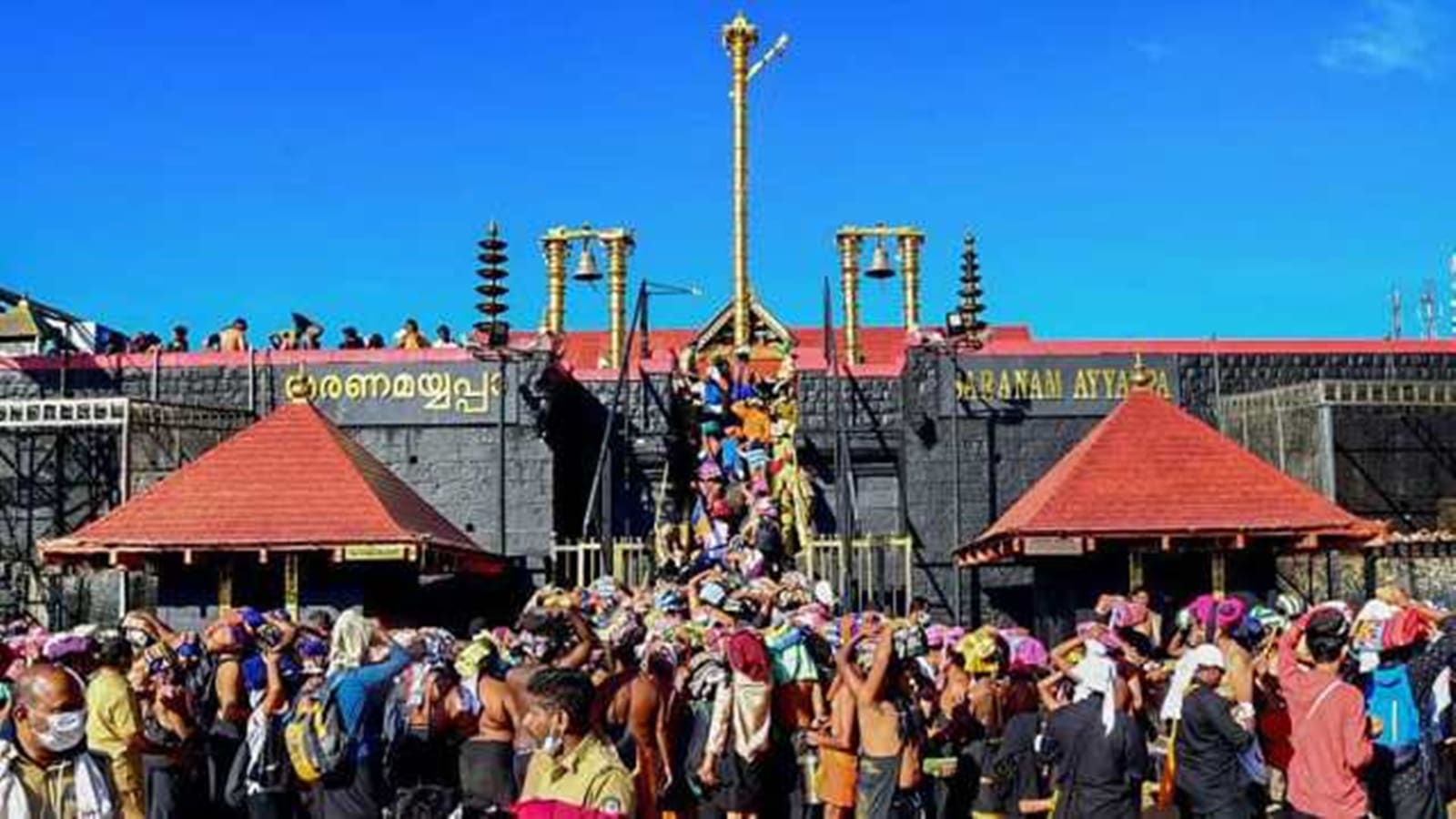
In a significant climbdown on theentry of women into the Sabarimala temple, the Left Democratic Government (LDF) government in Kerala has called for “wide consultations with and… soliciting views of eminent religious scholars and reputed social reformers of that religion” before any changes are made to the “religious practice followed for so many years”.
Earlier, the state government had supported the decision of a five-Judge Bench of the Supreme Court on September 28, 2018, to allow the entry of all women, irrespective of their age, to the temple.
In a 4-1 verdict, the Bench had held that prohibiting women between the ages of 10 and 50 years from entering the hill shrine was exclusionary and violated the right of Hindu women to freely practice their religion.
On April 7, anine-Judge Constitution Bench will beginhearing important constitutional questions arising from petitions seeking review of the 2018 judgment.
In written submissions to the SC on Saturday, the Kerala government said it “is of the considered opinion that what is to be considered by the Court, in the matter of a judicial review with regard to Article 25, should not be as to whether a particular religious practice or belief appeals to reason or sentiment, but should be as to whether the belief is genuinely and conscientiously held as part of the profession or practice of religion.”
“Therefore, it would be expedient in the interests of justice that, as stated in paragraph 4 of the counter affidavit dated 13.11.2007, inter alia, for and on behalf of the State of Kerala, any judicial review into any religious practice followed for so many years, connected with the belief and values accepted by the people, must be after wide consultations with and after soliciting views of eminent religious scholars and reputed social reformers of that religion.
A decision in this regard should be rendered by the court after assessing the opinions of social reformers and religious scholars as an impartial authority,” it said.
The submissions, filed through Senior Advocate Jaideep Gupta and Advocate Nishe Rajen Shonker, added that “previous experience in the matter of Sabarimala shrine and the response of devotees including women devotees would support the above submission.”
In an earlier affidavit on November 13, 2007, the state, also ruled by an LDF government then, had said: “Government is of the opinion that nobody should be prohibited from their right to worship, but considering the fact that the matter of entry to Sabarimala is a practice followed for so many years and connected with the belief and values accepted by the people, and since there is a binding High Court judgment in this regard, Government felt that this Hon’ble Court may be requested to appoint an appropriate commission consisting of eminent scholars with authentic knowledge in Hinduism and reputed and uncorrupt social reformers to submit suggestions/ views on the issue… whether it is open to all women, irrespective of their age to enter the temple and make worship.”
Following the SC’s 2018 verdict, the state government headed by Chief MinisterPinarayi Vijayanhad backed the decision, and the state police had even escorted some women to the shrine.
But the issuesnowballed into a controversywith women worshippers hitting the streets across the country opposing the SC’s decision.
Hearing review petitions against the 2018 decision, a five-Judge bench, by a 3:2 majority, said in November 2019 that the judgment may impinge on the affairs of other religions too and would require a more detailed examination.
It decided to keep review petitions pending until a larger bench took a call on the matter.
The matter was thereafter referred to a nine-Judge bench which formulated seven questions for consideration:
In its written submission, the state government has said: “It is no more res integra that the principle that has to be borne in mind, while interpreting Article 25, is to the effect that the real test of a true democracy is the ability of even an insignificant minority to find its identity under the country’s Constitution.” It added that “the religious freedom guaranteed by Article 25 extends to acts done in furtherance of religion and contain a guarantee for rituals and observances, ceremonies and modes of worship, which are integral part of the religion”.
On the interplay between the rights of persons under Article 25 vis-a-vis rights of religious denominations under Article 26 and the limitations on the latter, it said: “A law made under Article 25 (2) (b), on grounds of social reform or throwing open Hindu religious institutions of public character to all sections and classes of Hindus, will be binding on Hindu religious institutions of public character of denominations or sections thereof.” Therefore, “the right of Hindu denomination or section thereof to manage its own religious affairs will be subservient to the provisions of the law made by the State under Article 25 (2)(b)”.
To the query on constitutional morality, the state said: “The scope and extent of the word ‘morality’ used in Articles 25 and 26 cannot be considered to be varying according to individual or collective perceptions or ideals.
The same has to be sourced to the constitutional principles of equality, prohibition of discrimination and untouchability, protection of life and personal liberty, securing of a social order for the promotion of the welfare of the people etc.” It added that “the word morality is meant to include constitutional morality as defined in various judgments of” the court.
On judicial review, it said: “As held in Shirur Mutt case, what constitutes the essential part of a religion and as to whether a religious practice is essential or integral part of the religion has to be primarily ascertained with reference to the doctrines of the religion itself.”
The government said that “in deciding the question as to whether a given religious practice is an integral part of the religion or not, the test always should be as to whether it is regarded as such by the community following the religion or not.
However, no usage which is found to be pernicious or considered to be in derogation of the law of the land or opposed to public policy or social decency can be upheld or accepted the name of it being a religious practice.”
Ananthakrishnan G.
is a Senior Assistant Editor with The Indian Express.
He has been in the field for over 23 years, kicking off his journalism career as a freelancer in the late nineties with bylines in The Hindu.
A graduate in law, he practised in the District judiciary in Kerala for about two years before switching to journalism.
His first permanent assignment was with The Press Trust of India in Delhi where he was assigned to cover the lower courts and various commissions of inquiry.
He reported from the Delhi High Court and the Supreme Court of India during his first stint with The Indian Express in 2005-2006.
Currently, in his second stint with The Indian Express, he reports from the Supreme Court and writes on topics related to law and the administration of justice.
Legal reporting is his forte though he has extensive experience in political and community reporting too, having spent a decade as Kerala state correspondent, The Times of India and The Telegraph.
He is a stickler for facts and has several impactful stories to his credit....
Read More
Related Stories



Source: This article was originally published by The Indian Express
Read Full Original Article →
Comments (0)
No comments yet. Be the first to comment!
Leave a Comment