
A couple of hours after Tilak Varma held the catch that crowned India T20 World Cup winners for an unprecedented third time, head coach Gautam Gambhir arrived with Suryakumar Yadav, who was proudly holding the trophy, to discharge his media responsibilities.
Despite the lateness of the hour – Sunday had given way to Monday – there was no sign of restlessness or irritation amongst the usually restless and irritable media corps.
Contrary to what many, even within the team environs, might believe, journalists aren’t impervious to results; most rejoice when the team wins and are openly disappointed when the results don’t go the Indian side’s way, and this was clearly a night of celebration, a night to applaud a magnificent campaign either side of a blip against South Africa.
Gambhir carries the not unfounded reputation of being grumpy and snappy at press conferences, often not even waiting for the questioner to complete his query before launching into a reply that might not have any direct relevance to what the question would have been had the head coach been a little more patient.
Of course, one can’t entirely blame him because several questions are couched at the end of a long discourse from said questioners, but we digress.
The former opener, combative and intrepid, held forth on eschewing the fear of losing, especially when it came to T20s, adding that it was that fear which often resulted in defeats.
“The most important thing in this format was that we didn’t want to be afraid of losing, because if you are afraid of losing, you never win,” he thundered.
“I always believe that high risk, high reward is very important in this format.
I would have been happier if we had been out at 110-120.
But our target was always to make 250 runs.
But we didn’t want to play the 160-180 runs cricket.
For too long, we played cricket with 160-170 runs.
But for the last two years, it was the captain’s philosophy, the captain’s ideology – the captain himself wanted to play high risk, high reward.”
Most of what Gambhir said was indisputably correct.
But it isn’t only in the last two years that India’s philosophy has changed.
And the duo that initiated the change was the one that ended the country’s prolonged wait for a T20 World Cup crown even though India boasted the most visible and high-profile T20 franchise tournament in the universe.
Just how much importance the administrators gave the World Cup, in which India were reluctant participants almost browbeaten into confirming their entry, is evident from the grand launch of the Indian Premier League midway through the team’s campaign.
The World Cup was viewed as a mere obligation to fulfil, but it proved to be the perfect springboard from which the IPL took off because all of a sudden after the magic in South Africa, the format captured and held the imagination of new audiences while continuing to stay relevant with the pre-existing fans.
The IPL was expected to trigger a slew of title-winning runs, but that wasn’t the case, evidently.
The more India’s players became familiar with the challenges and demands of the 20-over game, the more every campaign was disappointing because it didn’t produce the right result.
India had to wait seven more years and three editions when they didn’t even make the knockouts for their next appearance in the final, in 2014 when they were hammered by Sri Lanka in Mirpur.
They thereafter continued to flatter to deceive, bowing out in the semifinal in Mumbai in 2016 to West Indies and crashing out of the delayed next edition, in the UAE in 2021, in the first round after dispiriting losses in their first two games to Pakistan and New Zealand respectively.
The desert misadventure was Ravi Shastri’s last assignment as the India head coach and Virat Kohli’s final engagement as the country’s T20I captain.
Shastri was succeeded by Dravid, Kohli by Rohit Sharma and this was the catalyst for India shedding conservatism and embracing the enterprise and fearlessness which is an absolute non-negotiable in the 20-over game.
The Gambhir quotes presented a few paragraphs previously are so easily attributable to Dravid, and perhaps with greater reason.
Clearly, in 2021, India were seized by the fear of losing.
Their batting, especially, lacked creativity and imagination; the onus was on building an innings, keeping wickets in hand and then trying to explode at the end, which might have worked wonders in 50-over cricket at one point, but which is the very antithesis of how to approach a 120-ball innings.
Gambhir said the ‘high risk high reward’ ideology was the captain’s.
Guess what?
It was his predecessor, Rohit, who was the poster boy of the ‘high risk high reward’ approach, setting the tone with his selfless assaults as an opener and therefore erasing the necessity to tell the others what to do because when you put your money where your mouth is, you don’t need to ask others to contribute, do you?
India’s scoring rates undertook a dramatic upswing in the immediacy of the Rohit-Dravid leadership group forming an unexpectedly awesome pair of opposites united by several common threads.
It’s often wrongly perceived that India’s 20-over philosophy changed dramatically after their crushing ten-wicket loss to England in the semifinal of the World Cup in Adelaide in November 2022.
But the die had been cast long before that, as Dravid told this writer a couple of months after the 2024 World Cup triumph.
“People use that semifinal as a changing point but honestly, in our first meetings itself, we were on the same page that we needed to change the way we were playing T20 cricket,” Dravid had pointed out.
“If you notice our scores from, say, the UAE World Cup to the T20 World Cup in Australia, you’d see a marked difference.
The wheels had started to turn well before that semifinal loss.
That England loss was a disappointment, perhaps the conditions suited England more.
But we were moving in that direction (of aggressive batting) well before that (Australia) World Cup.
And we continued that into the 50-over World Cup, Rohit led that beautifully.”
Gambhir was graceful in dedicating the title to, among others, ‘Rahul bhai for everything he’s done during his tenure to keep Indian cricket in such a good shape.’ At the same time, he held forth on not merely inheriting a successful team but also in creating something.
“Hopefully, we’ve created something which all of you guys could be proud of, the brand of cricket we’ve played.”
India’s brand of cricket at the 2026 World Cup was something to be proud of.
There was a 160-run innings (161/9), something Gambhir hates (his words, not ours) in the very first outing against United States, but it’s a sign of how high this side has raised the bar that subsequent efforts of 209, 175 and 193 while batting first on less than perfect batting strips were seen as underwhelming.
After the Ahmedabad meltdown (India were dismissed for 111, their lowest World Cup total), a return to flat surfaces brought the best out of the Indian batting.
In three of their last four matches, India batted first and responded with totals of 256, 253 and 255; in the virtual quarterfinal before the last two efforts of 250-plus, they scaled down West Indies’ 195 at Eden Gardens with reasonable comfort.
Now, that’s what we are talking about.
Jasprit Bumrah has shown that even two overs of exceptional bowling is more influential in deciding the outcome of a tight contest (the semifinal against England) than a string of fours and sixes, but the T20 format will continue to remain a batter’s game and that’s where India have grabbed the lead.
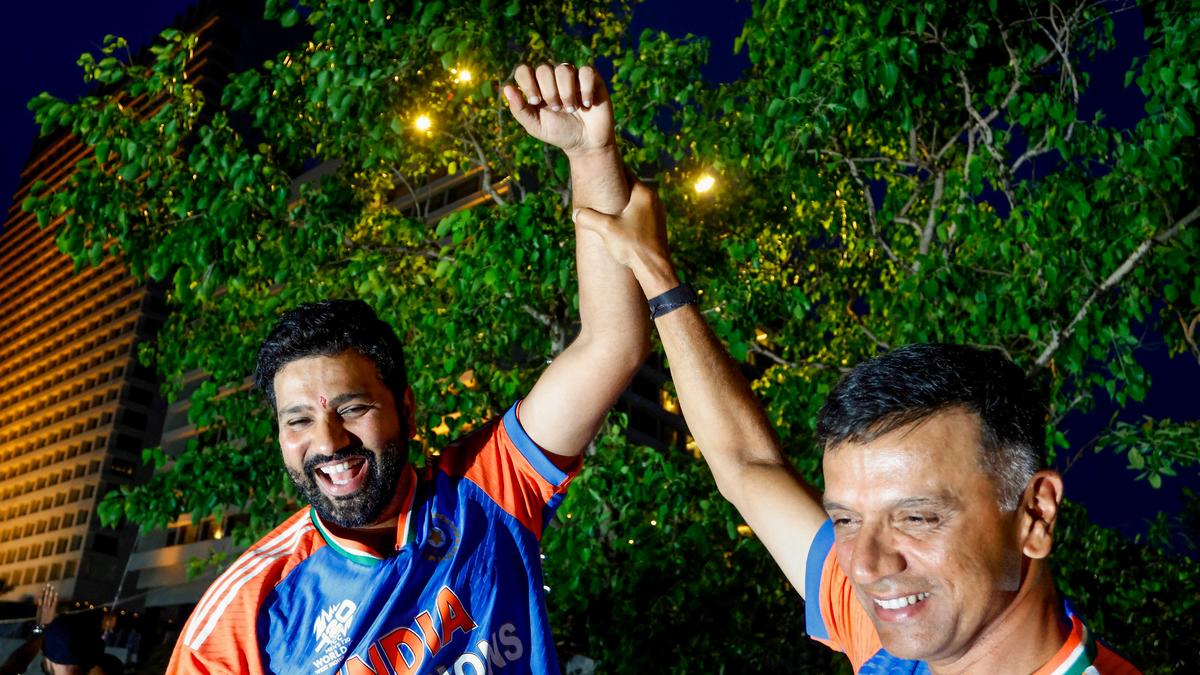
The current flavour of the season will be Suryakumar and Gambhir, as they should be, but let’s not lose sight of the fact that the ball was set rolling by Rohit and Dravid, under whom India ended their 17-year wait for a World Cup title.
Related Stories



Source: This article was originally published by The Hindu
Read Full Original Article →
Comments (0)
No comments yet. Be the first to comment!
Leave a Comment