
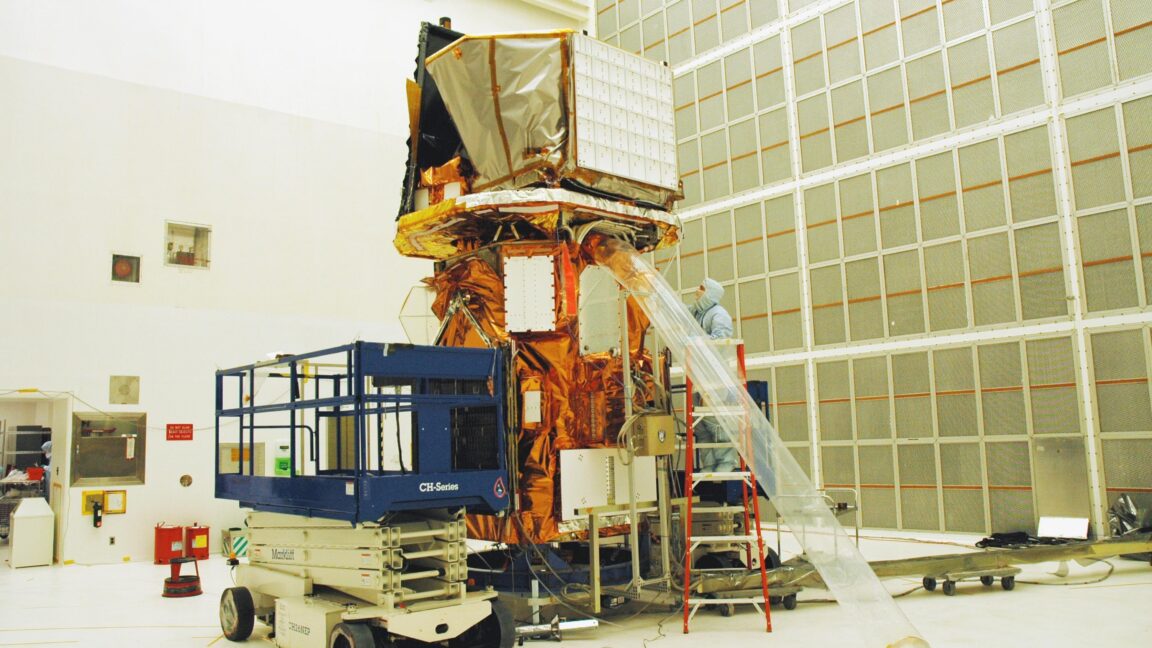
BROOMFIELD, Colorado—One of NASA’s oldest astronomy missions, the Neil Gehrels Swift Observatory, has been out of action for more than a month as scientists await the arrival of a pioneering robotic rescue mission.
The 21-year-old spacecraft is falling out of orbit, and NASA officials believe it’s worth saving—for the right price.
Swift is not a flagship astronomy mission like Hubble or Webb, so there’s no talk of sending astronauts or spending hundreds of millions of dollars on a rescue expedition.
Hubble was upgraded by five space shuttle missions, and billionaire and commercial astronaut Jared Isaacman—now NASA’s administrator— proposed a privately funded mission to service Hubble in 2022, but the agency rejected the idea.
Swift may be a more suitable target for a first-of-a-kind commercial rescue mission.
It has cost roughly $500 million (adjusted for inflation) to build, launch, and operate, but it is significantly less expensive than Hubble, so the consequences of a botched rescue would be far less severe.
Last September, NASA awarded a company named Katalyst Space Technologies a $30 million contract to rapidly build and launch a commercial satellite to stabilize Swift’s orbit and extend its mission.
The Swift observatory is flying in low-Earth orbit, where the outermost layers of the atmosphere still exert some aerodynamic influence on satellites.
The spacecraft launched in November 2004 on a mission to detect gamma-ray bursts , the most powerful explosions in the known Universe.
Despite its age, astrophysicists still rely on Swift’s multi-wavelength instruments to identify and locate gamma-ray bursts for follow-up observations by other observatories.
Gamma-ray bursts happen without warning, when massive stars die and form black holes or during mergers of neutron stars and black holes.
Their afterglow can last from a few seconds to up to a few hours.
Scientists need satellites like Swift to find and study them.
One of Swift’s unique abilities is to quickly turn to point toward gamma-ray sources before they fade, a proficiency that gave the mission its name.
Until last month, the mission remained operational and scientifically productive, and there is no other US satellite that fully replicates Swift’s capabilities.
Related Stories



Source: This article was originally published by Ars Technica
Read Full Original Article →
Comments (0)
No comments yet. Be the first to comment!
Leave a Comment