
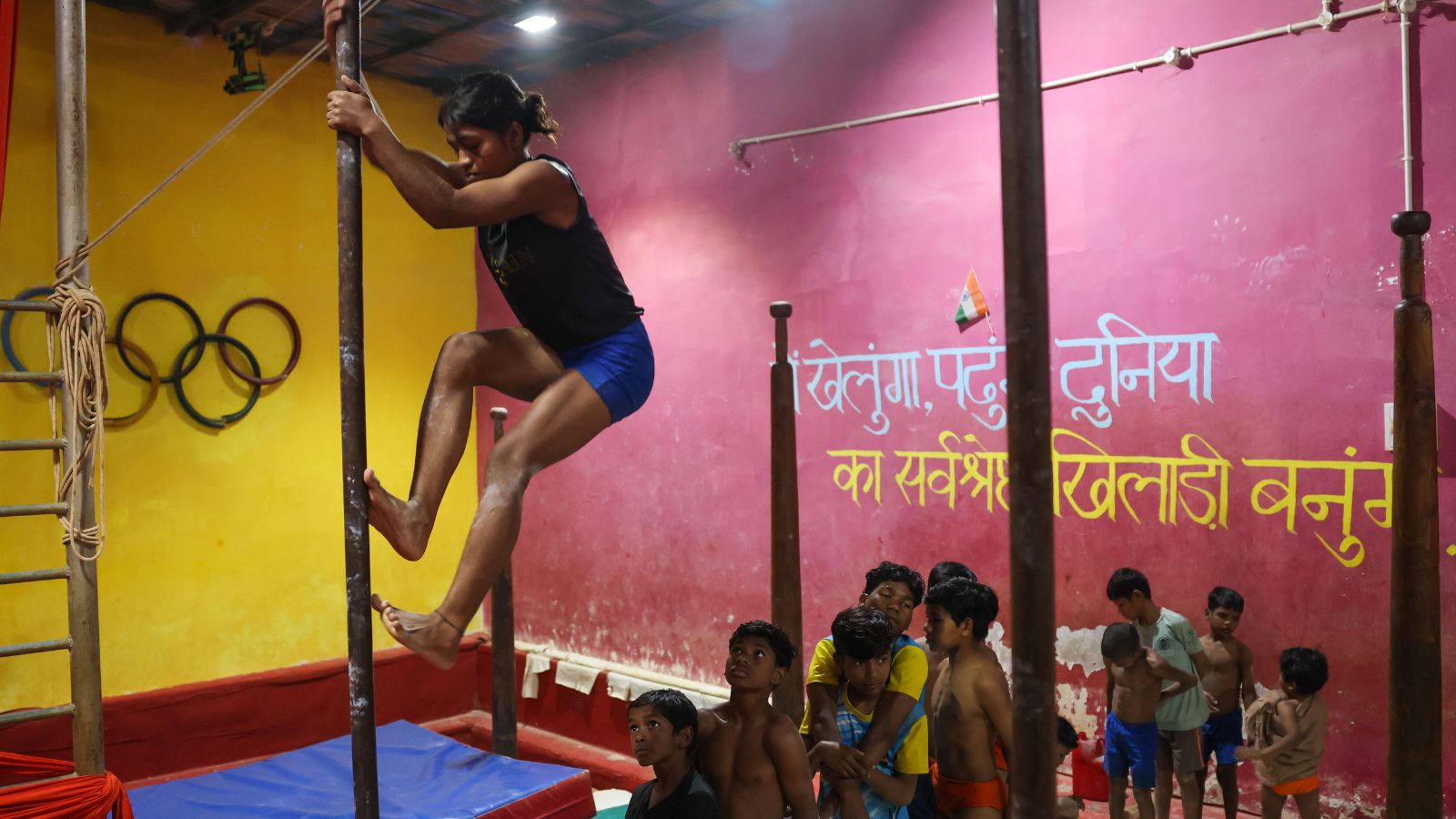
The nine-year-old stands facing an 8.5-foot wooden pole, his body covered in white chalk dust, his eyes narrowed in concentration.
It has been a long day of studying and practice, but Yujit Manjhi is determined to land his routine.
Around him, the music starts.
It’s a medley of ‘Ganesh Vandana’, KGF’s ‘Sultan’ and Dhurandhar’s ‘Fa9la’, a cue for Yujit to clamber onto the pole, dive downwards and execute a backflip, wedging himself precariously into a groove.
Then comes an eye-popping manoeuvre — a deft spin around the pole, foot locked in, his body now parallel to the ground.
As cheers erupt all around, he acknowledges with a winning smile, and returns to finish the rest of his routine.
Located in a corner of the vast Parade Ground in Chhattisgarh’s Narayanpur town, the AbujhmadMallakhamband Sports Academy is all of two ramshackle single-storey structures.
This has been Yujit’s world since the summer of 2022, when he left his home in Farasgaon village, in neighbouring Kondagaon district, and moved into the academy to train in mallakhamb, a traditional gymnastic sport.
Last year, the academy’s trainees were invited to perform at America’s Got Talent, two years after lifting the winner’s trophy in the 2023 Indian edition of the talent show.
The invitation marked a milestone not only for the group but for Abujhmad, or Maad, an area at the heart of the Maoist conflict.
As the central government’s March 2026 deadline to end the Maoist insurgency approaches and security operations intensify in Chhattisgarh, for these youngsters, the conflict is far more personal.
“Most students here come from villages affected by insurgency,” says their coach Manoj Prasad, a 29-year-old former commander with Chhattisgarh’s anti-insurgency Special Task Force (STF) unit.
With roots dating back to the 12th century, mallakhamb was primarily a preparation workout for wrestlers.
The sport, which tests agility, balance and core strength, has been included in military and law enforcement training drills in several European nations, though Germany took the most interest in nurturing it.
Recognised by the Sports Authority of India, the first competitive national mallakhamb event was organised during the national gymnastics championships at Paharganj stadium inDelhiin 1958, while the first national mallakhamb championships were held in Gwalior in 1962 as part of the national gymnastics championships.
Although it has largely remained an exhibition sport at global events, it has become more structured over the years — featuring as a medal event at the 38th National Games in Uttarakhand last year.
Since it was set up in 2017, the Narayanpur academy’s trainees, most of them tribals, have swept up around 400 medals at district-, state- and national-level games.
Much of this is down to academy founder Prasad, a man with a ready smile and a quick word of praise.
Originally from Ballia district in Uttar Pradesh, Prasad was with the STF when he was sent toMumbaifor a 15-day mallakhamb training to help colleagues take up the endurance sport.
But it wasn’t his colleagues he ended up training.
Upon his return from Mumbai, Prasad was sent to a camp in Chhotte Dongar in the Maoist-affected Narayanpur.
Here, an IPS officer, Santosh Singh, chanced upon his performance and invited him to an Independence Day function.
Soon, schools began calling.
“I was obsessed with teaching mallakhamb and would pay for the equipment myself,” he says.
“I would go to various schools during my leave to teach mallakhamb free of cost.”
It was around this time that he met wife Poonam, who was then working as a volunteer nutritionist with UNICEF.
“She would help me set up mallakhamb poles and we got talking.
We are now married and have two children,” Prasad says, smiling.
For Prasad, his early mallakhamb training offered respite from the trauma of his STF days.
“I’ve faced many encounters and have seen my colleagues and friends die.
Sometimes, I felt dead on the inside.
But I think I’m alive to serve a greater purpose,” he says.
Among his early students was Rajesh Korram, then six, the son of a Kosa silk seller from Ansar village deep inside Maad.
“When our team won gold at the national mallakhamb championship in Bilaspur [in 2020], I got a cheque of Rs 50,000 and gave it to my father.
My father was confused and asked me, ‘Chori toh nahi kiya na [I hope you didn’t steal this]’,” Korram, now 14, says, laughing.
Then there is 26-year-old Shyamlal Pottai.
From Gumiabeda village in Abujhmad’s Kohkameta tehsil, Pottai, then 19, had only cricket on his mind when Prasad showed up at his porta-cabin school in Narayanpur’s Devgaon in 2017 and screened videos of mallakhamb.
Pottai was hooked.
“I loved cricket but I thought mallakhamb would be good for my health,” he says.
“When I started, I used to get hurt because it’s a difficult sport.
But I’m proud that my efforts paid off.”
But the journey wasn’t smooth.
A police commando teaching tribal children drew suspicion, and inquiries soon began from Maoists.
Says 16-year-old athlete Rakesh Kumar Werda: “They (Maoists) would contact my parents and siblings back in my village and ask them to call me back, but I never went.
I heard they surrendered last year.”
“Once the boys started winning medals, our intentions were clear and the Maoists never bothered us again,” adds Prasad.
By 2020, just as Prasad’s dreams for an academy of his own were taking wing, the pandemic struck.
The timing could not have been worse.
Prasad, by then the father of one, had set up the academy at the Parade Ground.
Curfews were imposed, schools shut, and the academy suffered.
The biggest blow came when Prasad was posted to a remote camp in Abujhmad.
“My dreams were shattered.
I requested a transfer back to Narayanpur,” he says.
Months later, he was reposted to Narayanpur town and began searching for his wards in the remotest corners of Abujhmad, tracking them from as far as Orhha and Kutul, some 40 km away, and urging them to return.
“The children wanted to come and their parents wanted them to do better, so there was no trouble getting them back,” he says.
“Some of them were grazing animals, some were farming.
I brought all 25 children back to Narayanpur town and kept them in my two-bedroom home for the remainder of the pandemic.”
It wasn’t easy.
The house was too small for 25 people, and food bills mounted.
“We would take surplus food rations from those who didn’t need them, have gud chana for breakfast and mostly dal, rice and sabzi for lunch and dinner.
His [Prasad’s] salary would run out in a week,” says Saurabh Pal, 30, an assistant coach at the academy.
As bills rose, so did disagreements at home.
“But in the end, my wife understood,” Prasad says.
Back at the academy, the students are hard at work.
Prasad watches as a young woman does her stretches.
As the opening bars of Fa9la start to play, she clambers up an aerial rope and performs a graceful backflip, swinging midair with her body arched, arms reaching down and a leg stretched upward.
On the wall — between the slogans ‘Main khelunga, padhunga aur duniya ka sarvashreshth khiladi banunga [I will play, study and become the best athlete in the world]’ and ‘Utho, jaago aur lakshya prapti tak ruko matt [Get up, wake up and don’t stop till you’ve reached your goal]’ — is the pride of the place: Olympic rings made of repurposed cycle tyres.
The Mallakhamb Academy currently has 100 students, including 30 girls, all between ages 4 and 22, three coaches and one cook.
The academy is self-funded, meeting its running costs of approximately Rs 1 lakh a month from winnings, supplemented by a goods transport business run by Prasad.
To ensure they don’t lose out on education, students are enrolled in nearby government schools.
Practice starts at 6.30 am and lasts a few hours.
Then it’s time for school.
Evenings are also dedicated to practice — until 5 pm for younger kids and even until midnight for senior students.
Next to the training centre stands a makeshift pine-green shed, sparkling in red, green and purple fairylights put up a few months ago.
It’s the academy’s residential quarters.
It’s 9 pm, and practice is over.
Inside the quarters, with its three-tiered bunk beds, students sit poring over schoolwork under overhead bulbs, some in groups and some alone.
“These children and I built this place from scratch.
From welding the bunk beds to painting, we did everything ourselves,” Prasad says.
“We had little money to spare and saved whatever we could to buy food or tiny items for decoration.”
Initially, Prasad had his students perform at little-known shows.
“We did multiple performances, including a Bengali talent show, just to get exposure,” he says.
As the academy grew, Prasad had little time for anything else.
“From 2016 until 2023, I didn’t even meet my parents back in Ballia.
I told them I was busy,” he says.
Now, Prasad and his staff are considering a second academy.
“We have also had aspirants from Odisha, Gujarat, Delhi and Haryana come to us for advanced training,” trainer Pal says.
In 2023, after the group’s India’s Got Talent victory catapulted it to national recognition, they received a hero’s welcome in Narayanpur as hundreds lined the streets to greet them.
“As a pole artist, I want to perform in America’s Got Talent and put Abujhmad on the world map,” says 16-year-old Ramesh Kumar Werda.
“But my dream is to someday perform mallakhamb at the Olympics.”
Jayprakash S Naidu is a Principal Correspondent for The Indian Express, currently serving as the state correspondent for Chhattisgarh.
With an extensive career in frontline journalism, he reports on the political, security, and humanitarian landscape of Central India.
Expertise and Experience
Specialized Conflict Reporting: Jayprakash is a leading voice on the Maoist/Naxalite conflict in the Bastar region.
His reporting provides a critical, ground-level view of:
Internal Security: Tracking high-stakes encounters, surrender programs for senior Maoist leaders, and the establishment of security camps in formerly inaccessible "heartland" villages.
Tribal Rights & Displacement: Investigative reporting on the identity and land struggles of thousands of displaced tribals fleeing conflict zones for neighboring states.
Governance & Bureaucratic Analysis: He consistently monitors the evolution of Chhattisgarh as it marks 25 years of statehood, covering:
Electoral Politics: Analyzing the shift in power between the BJP and Congress and the impact of regional tribal movements.
Public Policy: Reporting on landmark infrastructure projects (e.g., mobile connectivity in remote zones) and judicial interventions, such as High Court rulings on civil and family law.
Diverse Investigative Background: Prior to his current focus on Chhattisgarh, Jayprakash held reported from Maharashtra, where he specialized in:
Crisis & Disaster Management: Notable for his extensive coverage of the Cyclone Tauktae barge tragedy (P-305) and the COVID-19 pandemic’s impact on frontline personnel.
Legal & Human Rights: Investigative pieces for platforms like Article-14, focusing on police accountability and custodial deaths across India.
Environmental & Social Justice: Authoritative reporting on the Hasdeo Aranya forest protests and the approval of major tiger reserves, highlighting the tension between industrial mining and environmental preservation....
Read More
Related Stories

Source: This article was originally published by The Indian Express
Read Full Original Article →
Comments (0)
No comments yet. Be the first to comment!
Leave a Comment