
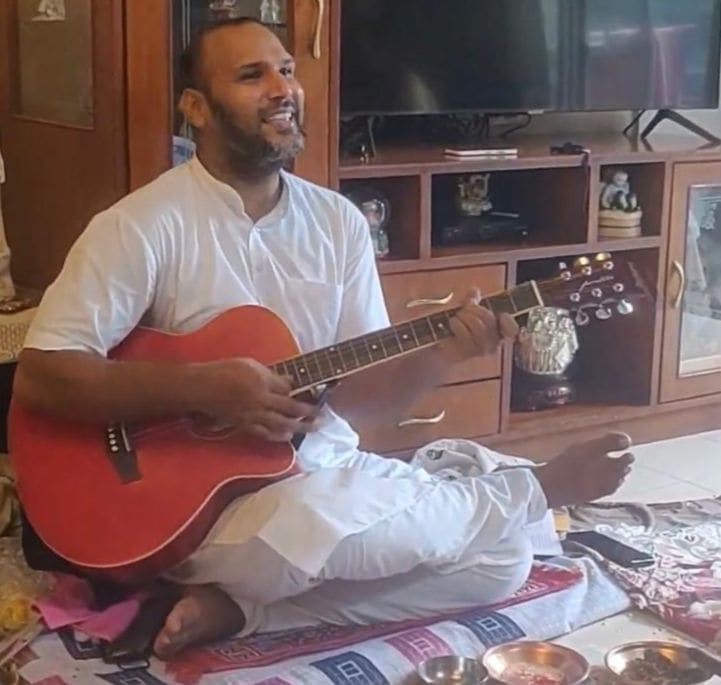
At weddings conducted by Hemant Acharya, aPune-based singer and priest, the sacred pheras are not just traditional chants.
Acharya sings them like devotional compositions, his voice filling the mandap as the bride and groom pause to listen.
Between verses, he explains the meaning of each vow — companionship, shared duty, and mutual respect — turning what is often a hurried ritual into a moment of reflection.
And then often he takes out his guitar and ends the ceremony, unpredictably enough, with a soulful Arijit Singh number sung in his deep, melodious voice, eliciting much surprise and huge applause.
The journey that brought him here has been equally unpredictable.
Acharya was born and raised in Joya, a small town in Uttar Pradesh, in a family where music and spiritual traditions were strong but domestic life was complicated.
His parents lived separately through much of his childhood, something he says shaped his early years deeply.
Music came to him through his father, a powerful singer who performed on Arya Samaj stages before large gatherings.
“In those days, microphones were rare,” Acharya, 42, recalls.
“My father would sing before audiences of a thousand or more people, and his voice would carry across the entire ground.” As a child, he often watched those performances.
His first moment on stage came in Class 3, when he sang Sare Jahan Se Achha.
The performance earned him a prize of Rs 75, which he handed proudly to his father.
“That was the moment I realised singing gave me joy,” he says.
“After that, I kept singing everywhere.” By Class 9, Acharya had decided he wanted formal training in music.
His father, however, believed music could not provide a stable livelihood and strongly opposed the idea.
Determined to pursue his passion, Acharya secretly enrolled at a music institute under Gandharva Mahavidyalaya in Ghaziabad, nearly 80 km from home.
Every day he travelled by train, telling his family he was attending computer classes.
Within a year, he had risen to the top of his batch.
When a local newspaper published his photograph celebrating the achievement, the truth reached home.
“The day I returned, my father had already seen the paper,” Acharya says.
“That evening was difficult.” Soon after, he ran away from home.
Acharya spent nearly two years moving between towns and survived on odd jobs.
“In Dehradun, I even applied for a watchman’s job before finding work in sales,” he says.
During this period, he came in touch with musicians and teachers who shaped his musical understanding, including classical vocalist Sucheet Narang, a visually impaired singer known for his deep knowledge of Hindustani classical music.
Eventually, his family located him and persuaded him to return home.
Alongside music, Acharya continued his education in Sanskrit within the gurukul tradition, completing degrees such as Shastri and Acharya.
In 2007, he began working as a schoolteacher in Hapur, earning Rs 1,800 a month.
Around that time, he briefly auditioned for the reality show Indian Idol and cleared the initial rounds, even appearing in a local newspaper report about a schoolteacher who had made it through the early stages of the competition.
But Acharya soon realised the pursuit of television fame was not for him.
“I felt that path was not meant for me,” he says.
For a while, he contemplated renouncing worldly life altogether.
Drawn to spiritual study, he returned to a gurukul near the Ganga at Garhmukteshwar and decided to embrace sanyas.
The decision lasted barely a month.
“My father came there and told my guru that I was his only son,” he recalls.
“My acharya told me my first responsibility was towards my family.” In 2011, he married.
The early years of married life were not easy.
“I had no understanding of relationships, and I was short-tempered too,” he says.
Over time, Acharya says he learned patience and responsibility.
His son was born in 2016.
In 2015, he moved to Pune, where his background in Sanskrit and gurukul training helped him begin conducting traditional rites and ceremonies.
Music slowly became part of these rituals.
“I would sing bhajans during the ceremonies,” he says.
“People started asking me to explain the meaning of the mantras too.” Gradually, families began inviting him to conduct weddings.
Acharya began singing the mantras during the pheras, explaining their meaning to the couple.
“Marriage is not just about completing rituals,” he says.
“It is about understanding the responsibilities two people are taking towards each other.”
Today, Acharya conducts ceremonies across Pune and beyond, blending music with rituals that mark life’s milestones.
Looking back, he says the lessons he once resisted shaped him the most.
“My father told me I would grow in life only if I controlled my anger,” Acharya says.
“I understood what he meant only after I lost him.”Now calmer and more reflective, Acharya believes the path he once struggled against eventually led him to his purpose.
“Life takes you through many detours,” he says.
“But when you finally understand your role, everything begins to make sense.”
Neha Rathod is an intern with TheIndian Express, Pune.
Related Stories



Source: This article was originally published by The Indian Express
Read Full Original Article →
Comments (0)
No comments yet. Be the first to comment!
Leave a Comment