
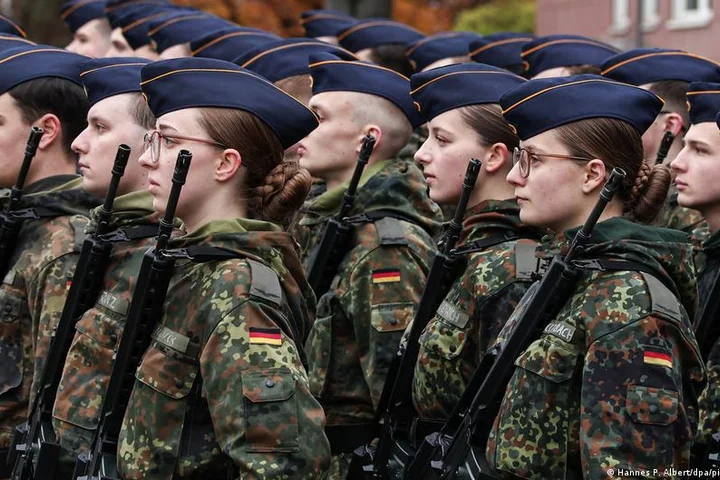
A new rule requiring men to get permission to travel abroad recently put Defense Minister Boris Pistorius under pressure.
He says he has fixed the situation, but the criticism continues.
For several days, German Defense Minister Boris Pistorius struggled to explain himself.
A provision in the new Military Service Act, which took effect on January 1, appeared to require men between the ages of 17 and 45 to notify the German military, or Bundeswehr , before taking trips abroad longer than three months.
Though it took months for this provision to come to light, the uproar was huge: Why does the Bundeswehr want men to request permission to leave the country if military service in Germany is voluntary?
Pistorius this week clarified the situation.
"Everyone is allowed to travel, whether they are 17, 45, or anywhere in between, and permission is not currently required," he told the German press agency dpa.
The Social Democrat added that an administrative regulation would be issued this week to remove any doubt.
Germany seeks to recruit 80,000 more active soldiers
To view this video please enable JavaScript, and consider upgrading to a web browser that supports HTML5 video
New rule on overseas travel went unnoticed
At first, the rule went largely unnoticed.
Even the Defense Ministry had not bothered to publicly communicate or even explain the new requirement.
It wasn't until the Frankfurter Rundschau newspaper picked up the story that uncertainty began to spread: How exactly does one go about obtaining approval before a prolonged stay abroad?
Are there penalties for non-compliance?
The parliamentary opposition leveled sharp criticism, arguing that the Military Service Act had been poorly drafted, and that the requirement to notify the authorities before traveling abroad constituted a massive infringement on the right to personal autonomy.
Britta Haßelmann, chair of the Green Party's parliamentary group, criticized the regulation as ill-conceived and said it jeopardized public support for the new military service law.
Deputy chair of the socialist Left Party's parliamentary group in the Bundestag, Desiree Becker, added: "What Boris Pistorius and his ministry have put forward here is a display of incompetence.
Anyone who wants to send young people into the trenches to defend the supposed 'fatherland' should at least be capable of presenting a legally sound bill."
For its part, the far-right Alternative for Germany (AfD) mocked the "chaos over men's foreign travel."
Legal expert: Major infringement on basic rights
Politicians specializing in defense policy called for prompt clarification from Pistorius, who had apparently underestimated the fierce reactions to the controversial regulation.
Now he insists that he wants to avoid unnecessary bureaucracy caused by reporting requirements.
"We are suspending the approval requirement as long as military service remains voluntary," he said, before adding that the regulation had only been created to prepare for emergency situations.
According to ARD legal expert Frank Bräutigam, the latest amendment was not a concession by the ministry, but rather a legal obligation.
Requiring mandatory authorization for travel abroad without reinstating conscription would constitute a major infringement on the fundamental rights of young people.
The controversial regulation is a result of Germany's recent return to a kind of partial military service, which involves the systematic collection of data on all men of military age.
Germany had military service — with a civilian national service option — in place until 2011, but that data was no longer collected.
The new Military Service Act provides a solution: Since the beginning of the year, all young men born in 2008 or later are now required to appear for a physical examination by the Bundeswehr, the data from which will be stored by the Defense Ministry.
Requiring potential recruits to report before extended stays abroad serves to further this objective.
Since, under the German Constitution, only men can be conscripted for military service, it is only their data that is collected, though women can voluntarily enlist.
Bundeswehr wants more volunteers
The goal of the reformed military service is to recruit new personnel for the Bundeswehr.
Through a combination of requirements and incentives, the army aims to attract more volunteers, and since the beginning of the year, new recruits now receive significantly better pay than before.
Those who commit to at least 12 months also receive assistance toward the cost of a driver's license, which can cost several thousand euros.
Pistorius is banking on such offers, combined with a certain degree of obligation: As well as the physical examination, all 18-year-old men are now required to fill out a questionnaire stating whether they are interested in serving in the Bundeswehr.
Currently, more than 13,000 people are serving in the military voluntarily or have signed up as "short-term conscripts" for a maximum of 23 months.
This represents an increase of 15% compared to the previous year, the Defense Ministry announced in mid-March.
But it remains to be seen whether the increase in volunteers will be sufficient to meet the country's ambitious recruitment targets.
A return to compulsory military service remains a possibility.
Chancellor Friedrich Merz (CDU) wants to have an assessment carried out "by 2027 at the latest" to determine whether enough volunteers are signing up for the new military service.
If the numbers are insufficient, "we will have no choice but to also discuss mandatory service in the Bundeswehr," Merz said in December in the Bundestag.
Many young men are not waiting to see if this happens: The number of those applying for conscientious objection is rising steadily .
In 2025, it reached its highest level since the suspension of military service in 2011.
This article was translated from German.
Related Stories



Source: This article was originally published by Deutsche Welle (DW)
Read Full Original Article →
Comments (0)
No comments yet. Be the first to comment!
Leave a Comment