
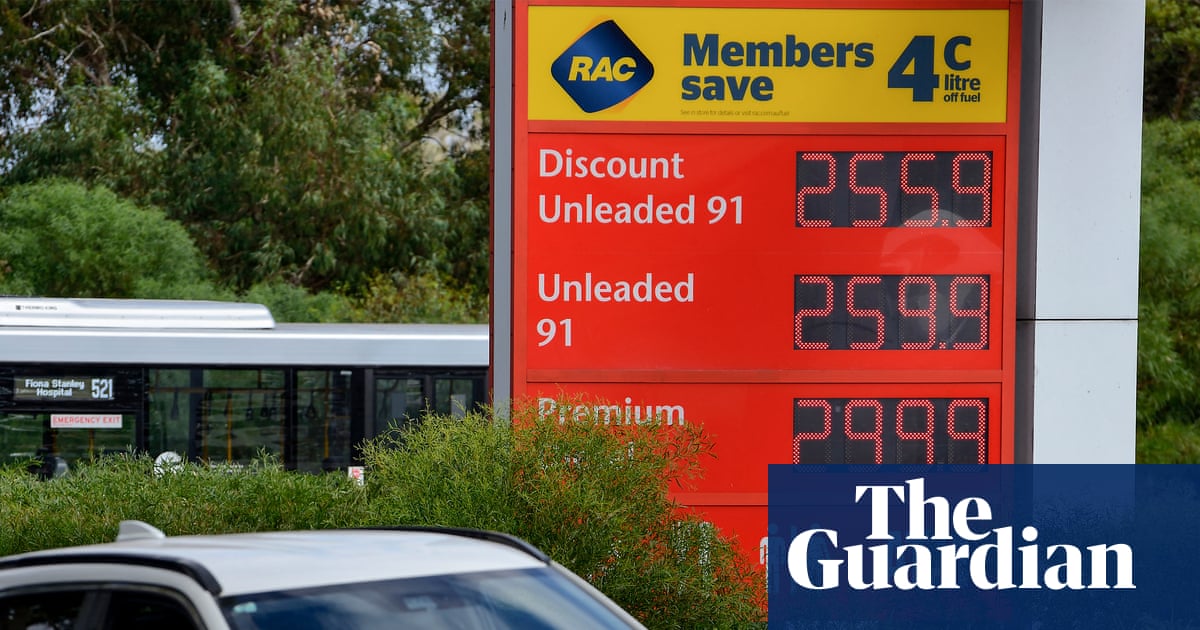
David Pocock says a flat 25% export levy on gas producers could redirect ‘wartime profits’ to struggling Australians
Get our breaking news email , free app or daily news podcast
Nearly 150,000 New Zealand families will soon receive a weekly cash payment to help them afford petrol , believed to be the world’s first fuel relief package that directly pays citizens since the Israel-US war on Iran began.
Expectations are increasing on the federal government to act similarly in a bid to ease the spiralling cost-of-living crisis worsened by the conflict in the lead-up to its May budget.
On Tuesday, the treasurer, Jim Chalmers, again ruled out any cut to the fuel excise, which adds more than 52 cents per litre to the price of petrol – but doesn’t increase or decrease when the fuel price changes.
Tax rate cuts coming into effect from next financial year are the main area of focus, he said.
“The most helpful thing people could do is just buy the fuel they need and no more.”
The Nationals, the Greens and the crossbench voted for a motion against the federal government on Tuesday afternoon urging Labor to deliver “accessible, free or affordable nationwide public transport” during the fuel crisis.
The Liberals ultimately abstained.
In NSW, the opposition called for an upper limit on fuel prices every 24 hours and free public transport across Easter, but the premier, Chris Minns, said transport was already subsidised heavily.
The independent ACT senator, David Pocock , proposed a flat 25% export levy on gas producers to redirect “wartime profits” to support struggling Australians.
On Tuesday, he said that revenue could also be used to lift welfare payments.
“People on fixed incomes, like pensioners or those reliant on safety net payments, are hurting the most from increased petrol, groceries and other essentials while benefiting the least from things like electric vehicles and rooftop solar,” he said.
In a letter written to Chalmers on Tuesday, the Greens senator Penny Allman-Payne urged the government to pause requirements on welfare recipients in order to keep their payments, known as mutual obligations
“People forced to survive on these poverty payments have been smashed by the cost of living crisis,” she said.
“With fuel prices going through the roof, many people will simply not be able to afford to go to appointments or travel to work for the dole sites to do unpaid labour.”
If almost 1 million Australians on the welfare compliance regime do not fulfil activities – such as completing job applications or attending meetings with job providers – their payments can be suspended.
Allman-Payne’s letter follows another request last week by poverty experts, the Antipoverty Centre, to the employment minister, Amanda Rishworth.
Jay Coonan, the centre’s spokesperson, said “privatised welfare compliance should not have the power or discretion to force people to travel”.
A government spokesperson encouraged participants to contact their employment services provider if they were struggling to attend appointments or look for work.
“A range of supports, including flexibility in attending face-to-face appointments and assistance with transport for employment-related activities, may be available.”
“The testimonies we have received as part of this research make it clear, in particular, that compulsory activities in remote parts of Australia can require travelling huge distances, without access to public transport, to reach employment service providers,” she said.
“The cost of petrol required to take such a trip would be astonishing at the best of times.”
Related Stories



Source: This article was originally published by The Guardian
Read Full Original Article →
Comments (0)
No comments yet. Be the first to comment!
Leave a Comment