
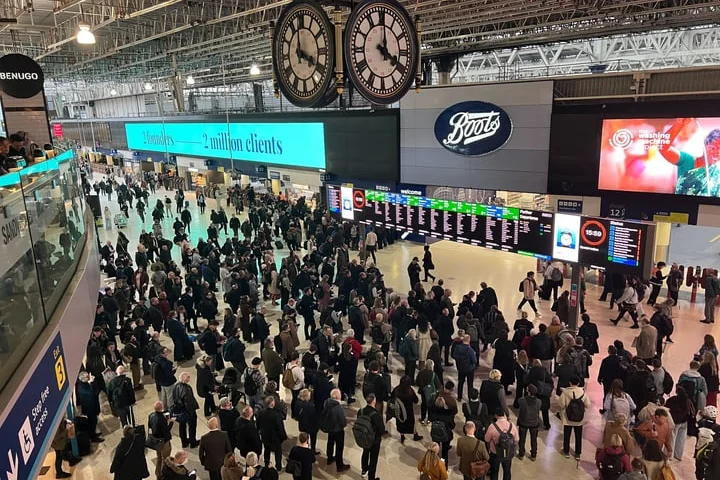
With the Easter bank holiday ahead of us, with thousands across the UK gearing up for a well-earned break— whether that’s jetting off abroad , camping with the family, or squeezing in a last-minute spa escape.
But with everyone seemingly having the same idea, travel is expected to reach a four-year high this weekend, with the RAC estimating around 21 million leisure journeys between Thursday and Monday, making it the busiest Easter weekend since coronavirus restrictions lifted in 2022.
Significant congestion is expected on Britain’s roads, particularly on routes to the south coast and the Lake District, while planned engineering works on the rail network and higher passenger numbers at airports are also likely to add to the holiday rush.
The Standard has put together a guide to the expected travel disruption across road , rail and air to help make journeys as smooth and stress-free as possible this weekend.
Despite rising fuel prices linked to the US-Iran conflict , most drivers are not changing their holiday plans, with Britain’s roads set to be extremely busy this weekend.
The AA predicts traffic will peak on Thursday, April 2, with an estimated 21.7 million trips expected, prompting an amber traffic warning for the period.
Congestion is likely to be heaviest on routes heading to the south coast and the Lake District, with transport analytics company Inrix highlighting several hotspots, including:
In a bid to keep things moving, around 1,500 miles of roadworks on motorways and major A-roads across the UK will be temporarily lifted over the weekend.
The cost of filling up a 55-litre family car with diesel is about £19 higher than on Good Friday last year, as Donald Trump’s war on Iran continues to have rippling effects across the globe.
RAC mobile servicing and repairs team leader Sean Kimberlin said: "Despite fuel prices rising dramatically due to the conflict in the Middle East , our research suggests Easter remains incredibly important to people as it’s often the first chance to get away since Christmas or to meet up with friends and family.
"While a significant number of drivers are concerned about rising fuel prices, a much smaller contingent are actually changing their plans this Easter as a result.
"We expect traffic levels to be consistently high from Thursday, when many schools break up.”
Disruption across Britain’s rail network is also expected over the bank holiday weekend, with planned engineering works set to cause widespread delays.
The biggest impact will come from a six-day shutdown of the southern section of the West Coast Main Line, which is expected to significantly disrupt services and journeys across the network.
The line runs between London and Glasgow, serving major cities including Milton Keynes, Birmingham, Manchester, Liverpool and Edinburgh.
The Easter sales you can't miss this Bank Holiday weekend
Princesses Beatrice and Eugenie to miss Royals’ Easter church service
Scale of London bus crashes revealed as TfL records 40 'damage' incidents a day
Rediscover your adventurous side on an exotic getaway
London Euston station will close from Good Friday, April 3 to Wednesday, April 8 for a “programme of essential upgrades”, with all Avanti West Coast and London Northwestern Railway services south of Milton Keynes replaced by buses.
As a result, journeys from London to the north west are expected to take longer than usual, with increased demand, rail replacement buses and possible changes.
Chiltern Railways has promised extra trains between London and Birmingham, connecting Marylebone station in the capital with Birmingham Moor Street.
For those travelling to the Lakes, the WCML will close on Easter Saturday between Preston and Oxenholme.
Here’s a list of the biggest projects undertaken over the Bank Holiday weekend which impact London services:
There will also be some disruption across Transport for London services over the bank holiday weekend, with several lines affected by closures and reduced timetables.
Some UK airports are braced for their busiest Easter on record, with easyJet alone expecting to carry a record number of passengers over the four-day getaway.
For many travellers, the biggest concern will be the rollout of the EU’s new entry-exit system.
Although full implementation isn’t due until April 10, a number of European airports are already operating “dual systems”, leading to reports of queues of up to two to four hours at passport control for non-EU passengers, including Brits.
Security rules are also proving a potential stumbling block.
While some airports, including Heathrow and Bristol, have introduced new scanners allowing passengers to carry up to two litres of liquids, many others still enforce the 100ml limit.
Heading for the wrong queue, or packing too many toiletries, could be an easy way to add extra time to your journey this weekend.
Given the EES biometric requirements, passengers are advised to allow for extra time at both ends of their journey, to monitor their flight status and check their passport is in date before travelling to the airport.
Meanwhile, the ongoing conflict in the Middle East has had an impact on jet fuel security and in some cases, caused flights to re-route.
Delays have been reported at major hubs including Gatwick and Heathrow.
Airlines including Tui, Wizz Air, British Airways and Emirates have provided travel advice on flights amid the conflict in the Middle East.
The FCDO has advised against “all but essential travel” to the United Arab Emirates, which remains in place as of March 30.
There are no available flights to the United Arab Emirates via British Airways, Wizz Air, Tui or easyJet.
Flights are operating via Emirates to certain destinations including Dubai.
Related Stories


Source: This article was originally published by Evening Standard
Read Full Original Article →
Comments (0)
No comments yet. Be the first to comment!
Leave a Comment