
Search author on: PubMed Google Scholar
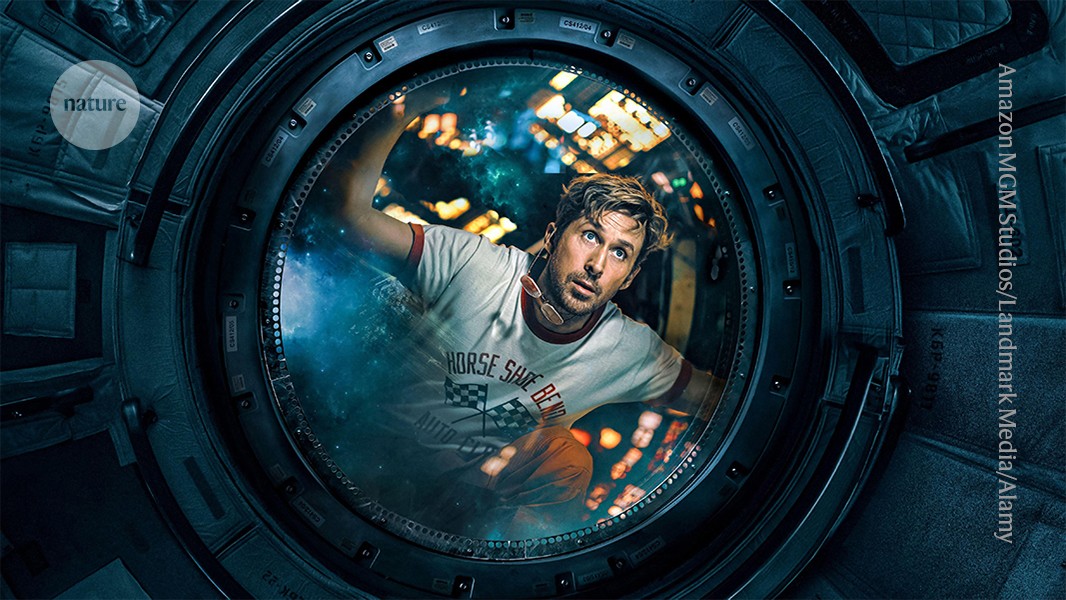
Ryan Gosling stars as a scientist who wakes up alone in deep space in Project Hail Mary .
Credit: Amazon MGM Studios/Landmark Media/Alamy
The science of Oppenheimer: meet the Oscar-winning movie’s specialist advisers
Weir famously steeps his books in science, going so far as to do calculations on orbital mechanics and stellar astrophysics to ensure that the stories are as realistic as they can be while still being fiction.
That all-out nerdery has earned him many fans, says Andy Howell, an astronomer at the University of California, Santa Barbara, who advised Weir on the science in Project Hail Mary .
“I’ve talked to so many scientists who are like, ‘this is great’”, Howell says, but also engineers, physics students and others.
So how does the new film, directed by Phil Lord and Christopher Miller, measure up?
Nature went to an advance screening and talked to some of the book’s science advisers to find out.
Without giving away too much of the plot, Project Hail Mary is about a man, Ryland Grace (played by Ryan Gosling), who embarks on interstellar travel to understand why the Sun is dying.
Like Watney in The Martian , he has to summon knowledge from a raft of different types of science — molecular biology, neutrino physics and more — to solve his crisis.
“It’s a great blend of some ideas that have been around, but a fresh take on them — and then some completely new ideas,” says Howell, who also runs a YouTube channel called Science vs.
Cinema .
The film version of Project Hail Mary dispenses with many of the detailed science explanations found in the book but still feels grounded in reality.
Take astrophage, a fictional space microorganism that underpins much of the plot.
Weir conceived of it as ‘black matter’ that can absorb huge amounts of stellar radiation and then re-emit the energy to enable interstellar travel.
Astrophage doesn’t exist in our world, but Weir made sure it had biology and chemistry that could exist in the Galaxy.
In the film, Grace grapples with the nature of astrophage, which is devouring the Sun, and how it does or doesn’t meet scientists’ notions of extraterrestrial life.
It’s reminiscent of debates over how to recognize the signatures of life beyond Earth — for instance, gases in planets’ atmospheres that might have been generated by living organisms .
How astronomers in the film (and book) discover that the Sun is dimming is also grounded in reality.
On Howell’s advice, Project Hail Mary gives a shout-out to the amateur astronomers who regularly monitor fluctuations in stars’ brightnesses.
In 2019, astronomy enthusiasts spotted the mysterious dimming of the red-giant star Betelgeuse; fortunately, it turned out to be caused by the star belching dust , rather than an astrophage attack.
Enjoying our latest content?
Log in or create an account to continue
doi: https://doi.org/10.1038/d41586-026-00870-9
Why Oppenheimer has important lessons for scientists today
Meet the real-life versions of Dune’s epic sandworms
Barbie and body image: a scholar’s take on the research — and the blockbuster film
What Twisters gets right — and wrong — about tornado science
How the Pokémon franchise has helped to shape neuroscience
How the classic computer game Doom became a tool for science
Jupiter gets downsized — and squashed
NASA’s latest telescope is a feat of early-career leadership
Core–envelope miscibility in sub-Neptunes and super-Earths
Join HZAU's global faculty team to advance research with competitive benefits.
Huazhong Agricultural University (HZAU)
The Stomatology Hospital, School of Stomatology, Zhejiang University School of Medicine(ZJUSS)
IRB Barcelona invites applications for Group Leader positions in Chemical Biology (one) and Structural Biology (one).
Barcelona (Provincia), Cataluña (ES)
Fundació Institut de Recerca Biomèdica (IRB Barcelona)
The Paris Brain Institute invites expressions of interest from internationally recognized senior and mid-career researchers.
Full Professorship (W3) for ‚Clinical Epidemiology of Early Cancer Detection’ (f/m/d) We are looking for a highly distinguished physician scientist...
Heidelberg, Baden-Württemberg (DE)
Medizinische Fakultät Mannheim der Universität Heidelberg
Related Stories


Source: This article was originally published by Nature News
Read Full Original Article →
Comments (0)
No comments yet. Be the first to comment!
Leave a Comment