
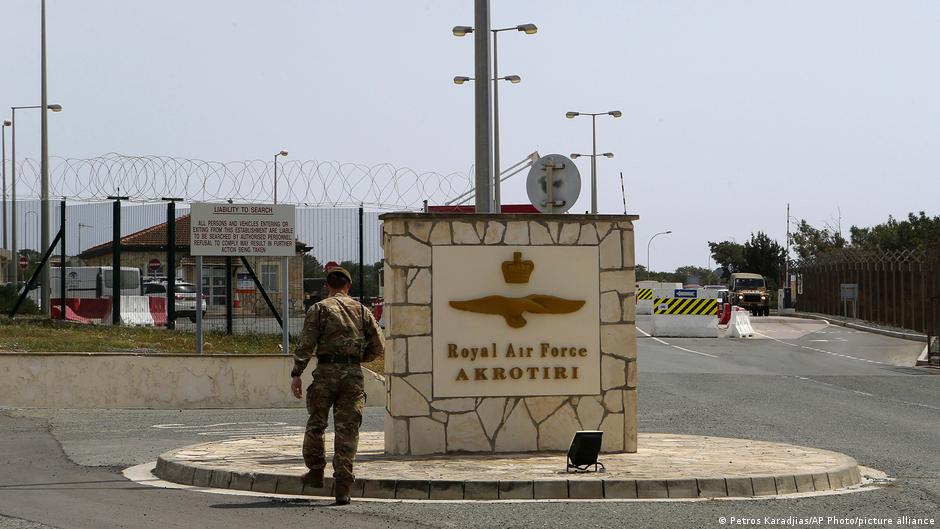
Cyprus wants a "frank discussion" about the future of UK bases.
A drone incident in early March has blown open old debates across this de facto divided island.
If you spend a day soaking up the Cypriot sun, you'll notice a few subtle signs that this Mediterranean island was once a British colony.
You have to drive on the left side of the road here.
Power outlets have three holes, unlike most other parts of the EU.
On the beach or high in the mountains, you'll find plenty of people who speak English.
But if you drive half an hour or so outside holiday hotspot Limassol, you'll find something much more concrete: Sovereign British territory, and a British Royal Air Force base.
It's one of two parts of Cypriot soil that remained officially British under the 1960 treaty that set out the terms for Cyprus' independence.
And when an Iranian-made drone crashed into the Akrotiri base in the early days of the US-Israel war with Iran , it blew open a debate that's been simmering in Cyprus for years.
On Cyprus, some fear British bases put them at risk
To view this video please enable JavaScript, and consider upgrading to a web browser that supports HTML5 video
Cypriot officials suspect the drone that hit at the beginning of March may have been launched from nearby Lebanon by Iran-backed group Hezbollah after US-Israeli strikes killed Iran's supreme leader.
The militia has threatened the Republic of Cyprus in the past over its close ties with Israel
The impact caused minimal damage and no casualties at the base, but it sparked anger among some locals who feel the UK's association with Washington is putting a target on their backs.
"We were targeted as a country because of the bases.
So maybe it's time to reconsider the status.
And maybe it's time for them to go," Panayiotis, a father of three, told DW on the beachfront in nearby Limassol.
"They're putting us in danger," added Limassol resident Michalis.
Calls for 'frank discussion' on UK bases
Even Cypriot president Nikos Christodoulides , not known for stirring up diplomatic spats, said he wants an "open and frank discussion" about the future of the bases "when this situation is over in the Middle East."
Christodoulides called the bases a "colonial consequence" in comments to journalists in Brussels at last week's EU summit.
At the gathering, his fellow EU leaders signed a statement supporting Cyprus's wish to open a conversation with Britain.
The UK has pushed back against criticism of its presence, which is also a source of employment for thousands of Cypriots.
"Our bases in Cyprus play a crucial role in supporting the safety of British citizens and our allies in the Mediterranean and in the Middle East," a spokesperson for the UK Ministry of Defence told DW.
"We have been deploying additional defensive capabilities to Cyprus since January, including radar systems, counter-drone systems, F-35 jets, ground-based air defence, and 400 extra air defence personnel," they added.
Military build-up: Crash test for EU defense?
Not all foreign military presence is treated with such suspicion in Cyprus.
In the aftermath of the drone incident, several EU countries, including France, Spain, Italy, the Netherlands and Greece, sent warships and other military assets to beef up defenses around the island.
"It's the first time the European Union looks like an actual alliance," political scientist Michalis Kontos told DW.
Kontos said EU support feels more important in the Republic of Cyprus, given that the country is not a member of NATO.
"There has been some kind of communication and contact before the deployment of these assets regarding what kind of defense systems should every country dispatch offshore Cyprus," he said.
Kontos said the deployments could be viewed as something of a "crash test" for Europe's collective defense, but cautioned against drawing too many EU-wide conclusions.
"In the case of Cyprus, I think we're talking about a low-risk, low-cost case of solidarity.
It is not expected that either Iran or Hezbollah will focus on Cyprus," he said.
A military presence is not restricted to the South, but for the next chapter of this story, we have to cross a checkpoint and dive into the history books.
Instead, years of intercommunal violence followed and by 1974, Greece had backed a coup and Turkish forces launched a military intervention and an occupation which endures to this day.
The result of this bitterly disputed history was a de facto division of the island, which cuts through the capital: In the South, the internationally recognized Republic of Cyprus.
In the Northern third of the island, the self-declared Turkish Republic of Northern Cyprus — recognized only by Turkey .
These double deployments to the North and South could mean more potential for cross-island tensions, according to Turkish Cypriot activist Beran Djemal.
"We know that geopolitics will never make it possible for us to live like an isolated little Mediterranean island," she told DW.
"There's always a risk for a spillover.
A little spark can turn into something horrible for all of us," she said, although adding, "I'm not so pessimistic about that."
Djemal campaigns for a reunified Cyprus and hopes Turkish forces and all foreign soldiers will leave here one day.
But for now, she says, that's a non-starter.
"If the general feeling is like: Okay, this is a day and age that every country should have a strong military presence, then why would they [Turkey] feel like they can just compromise and not be there?" she explained.
Cyprus problem remains unsolved
Most people we spoke to in the North and South have similar assessments: They'd like to see an end to the checkpoints and de facto borders and buffer zones, but for now they can't see a way forward.
"Turkish Cypriots and Greek Cypriots are brothers.
We need to find a solution to this," Umran, who runs a cafe in Northern Cyprus, told DW as she served up thick slices of chocolate cake and Turkish coffee to customers.
"People — the public — love each other, but unfortunately, both sides of Cyprus are suffering because of the politicians, and unfortunately, external forces are fueling this," she said.
Back in the South, Nicosia-based political scientist Michalis Kontos says the brush with the Iran war only magnifies the legacy and unsolved nature of Cyprus's own frozen conflict.
"This is another reminder, an alarm bell, that while dealing with the threats coming from the Middle East theater, we also need to focus on solving our own domestic problems," he said.
Loucianos Lyritsas contributed to reporting.
Related Stories

Source: This article was originally published by Deutsche Welle (DW)
Read Full Original Article →
Comments (0)
No comments yet. Be the first to comment!
Leave a Comment