
Spotless Days Current Stretch: 0 days 2026 total: 3 days (4%) 2025 total: 0 days (0%) 2024 total: 0 days (0%) 2023 total: 0 days (0%) 2022 total: 1 day (<1%) 2021 total: 64 days (18%) 2020 total: 208 days (57%) 2019 total: 281 days (77%) 2018 total: 221 days (61%) 2017 total: 104 days (28%) 2016 total: 32 days (9%) 2015 total: 0 days (0%) 2014 total: 1 day (<1%) 2013 total: 0 days (0%) 2012 total: 0 days (0%) 2011 total: 2 days (<1%) 2010 total: 51 days (14%) 2009 total: 260 days (71%) 2008 total: 268 days (73%) 2007 total: 152 days (42%) 2006 total : 70 days (19%) Updated 18 Mar 2026 Thermosphere Climate Index today: 20.53 x10 10 W Warm Max: 49.4 x10 10 W Hot (10/1957) Min: 2.05 x10 10 W Cold (02/2009) explanation | more data: gfx , txt Updated 17 Mar 2026
The Radio Sun 10.7 cm flux: 111 sfu explanation | more data Updated 18 Mar 2026
Cosmic Rays Solar Cycle 25 is near its peak, and this is reflected in the number of cosmic rays entering Earth's atmosphere.
Neutron counts from the University of Oulu's Sodankyla Geophysical Observatory show that cosmic rays reaching Earth are slowly declining--a result of the yin-yang relationship between the solar cycle and cosmic rays.
Oulu Neutron Counts Percentages of the Space Age average: today: -6.0% Low 48-hr change: +0.3% Max: +11.7% Very High (12/2009) Min: -32.1% Very Low (06/1991) explanation | more data Updated 18 Mar 2026 @ 0700 UT
This is an AI Free Zone: Text created by Large Language Models is spreading across the Internet.
It's well-written, but frequently inaccurate.
If you find a mistake on Spaceweather.com, rest assured it was made by a real human being.
AURORAS ARE POSSIBLE TOMORROW: NOAA's latest forecast model predicts a CME impact on March 19th just hours before the northern vernal equinox.
The timing is perfect for amplification by the " Russell-McPherron effect , which boosts storms around the onset of Spring.
The impact could produce a G2 -class geomagnetic storm with photographic auroras at mid-latitudes.
Would you like an instant text message when the CME arrives?
Sign up for CME Impact Alerts .
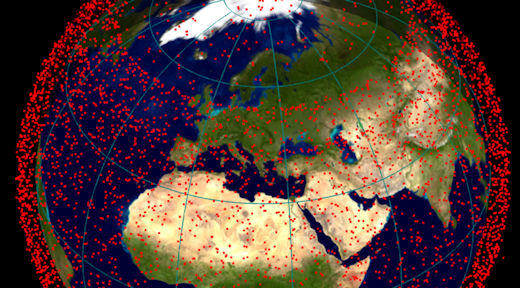
TEN THOUSAND STARLINKS: On March 16th, a Falcon 9 rocket lifted off from Vandenberg Space Force Base carrying 25 Starlink satellites.
It was a routine launch for SpaceX, the 33rd of 2026.
But those 25 Starlinks crossed a milestone.
For the first time in history, more than 10,000 Starlink satellites were simultaneously circling Earth.
Click to view of dynamic plot of Low-Earth Orbit from Heavens Above
Consider where we started: When SpaceX launched its first operational Starlinks in May 2019, there were roughly 2,000 active satellites of all kinds orbiting Earth.
Starlink alone now outnumbers the entire pre-2019 fleet five to one.
The constellation has utterly transformed the orbital environment.
The numbers are sobering.
Since 2019, more than 11,596 Starlinks have been launched.
Of those, more than 1,500 have already reentered the atmosphere as SpaceX retires older satellites to make room for newer models.
Each re-entry deposits about 30 kg of aluminum oxide into the upper atmosphere--an uncontrolled chemistry experiment on a planetary scale.
In case you're wondering how this might affect astronomy, consider this recent video of Comet WierzchoÅ (C/2024 E1) from Gerald Rhemann:
Starlinks outnumbered the comet 10:1.
"Satellite interference is a growing challenge--especially near dusk and dawn," he says.
With so many Starlinks circling Earth, the orbital environment is increasingly unstable.
It's "an orbital house of cards," according to a study led by Sarah Thiele of Princeton University, which finds that a severe solar storm could kickstart widespread catastrophic collisions in as little as 2-3 days.
SpaceX itself reported to the FCC that Starlink satellites performed roughly 300,000 collision-avoidance maneuvers in 2025 alone.
Meanwhile, Starlink internet is awesome.
Enjoy it while you can.
Extra: Because satellite megaconstellations are an increasingly important aspect of space weather and amateur astronomy, we've decided to track them.
Look here .
Every day we will update Starlink Statistics, eventually adding other megaconstellations when they become important.
THE METEOR CRATER PENDANT: Have you heard of Moissanite?
It's a very rare mineral discovered by 19th-century chemist Henri Moissan in Arizona's Meteor Crater.
At first, he thought it was diamond, but later realized it was even more rare.
It's a diamond lookalike that, until the 1950s, was found naturally only in meteorites.
On Aug.
2, 2025, the students of Earth to Sky Calculus launched this Moissanite pendant to the stratosphere onboard a cosmic ray research balloon:
You can have it for $169.95 .
Engraved with the words "I love you always and forever," the sterling silver frame bends around the Moissanite in a heart-shaped curve--all highlighted by glittering 5A cubic zirconia nuggets.
The students are selling space pendants to pay the helium bill for their cosmic ray ballooning program.
Each one comes with a greeting card showing the jewelry in flight and telling the story of its trip to the stratosphere and back again.
Far Out Gifts: Earth to Sky Store All sales support hands-on STEM education
On March 17, 2026, the network reported 17 fireballs.
(17 sporadics)
In this diagram of the inner solar system, all of the fireball orbits intersect at a single point--Earth.
The orbits are color-coded by velocity, from slow (red) to fast (blue).
[ Larger image ] [ movies ]
SPACE WEATHER BALLOON DATA: Almost once a week, Spaceweather.com and the students of Earth to Sky Calculus fly space weather balloons to the stratosphere over California.
These balloons are equipped with sensors that detect secondary cosmic rays, a form of radiation from space that can penetrate all the way down to Earth's surface.
Our monitoring program has been underway without interruption for 10 years, resulting in a unique dataset of in situ atmospheric measurements.
Latest results (Nov.
2024): Atmospheric radiation is sharply decreasing in 2024.
Our latest measurements in November registered a 10-year low:
What's going on?
Ironically, the radiation drop is caused by increasing solar activity.
Solar Cycle 25 has roared to life faster than forecasters expected.
The sun's strengthening and increasingly tangled magnetic field repels cosmic rays from deep space.
In addition, solar coronal mass ejections (CMEs) sweep aside cosmic rays, causing sharp reductions called " Forbush Decreases ." The two effects blend together to bring daily radiation levels down.
.
Who cares?
Cosmic rays are a surprisingly "down to Earth" form of space weather.
They can alter the chemistry of the atmosphere, trigger lightning , and penetrate commercial airplanes .
According to a study from the Harvard T.H.
Chan school of public health, crews of aircraft have higher rates of cancer than the general population.
The researchers listed cosmic rays , irregular sleep habits, and chemical contaminants as leading risk factors.
A number of controversial studies ( #1 , #2 , #3 , #4 ) go even further, linking cosmic rays with cardiac arrhythmias and sudden cardiac death.
Technical notes: The radiation sensors onboard our helium balloons detect X-rays and gamma-rays in the energy range 10 keV to 20 MeV.
These energies span the range of medical X-ray machines and airport security scanners.
Data points in the graph labeled "Stratospheric Radiation" correspond to the peak of the Regener-Pfotzer maximum , which lies about 67,000 feet above central California.
When cosmic rays crash into Earth's atmosphere, they produce a spray of secondary particles that is most intense at the entrance to the stratosphere.
Physicists Eric Regener and Georg Pfotzer discovered the maximum using balloons in the 1930s and it is what we are measuring today .
Spaceweather.com welcomes these supporters of science communication: AI SEO Agency  and SEO agency  and roofers and roofing contractors in South Jersey and commercial cleaning in Phoenix and Peoria AZ  | Pest Control in Phoenix | HVAC repair in South Jersey  | Dental implants New Jersey | dentist in Ahwatukee
To get the best views of the cosmos, check out the Phoenix Window Glass Replacement experts for all your window and glass needs
Onlinecasinoinformatie.com is an expert in comparing foreign online casinos for players in the Netherlands, offering reliable insights, clear reviews, and up-to-date information
Trusted casinos not connected to GamStop
Most Trusted seller for 1:1 super clone watches  in the market
Premium quality super clone watches for sale with true 1:1 detailing
Buy Instagram Followers Text: from Smikky !
For the new best Norwegian casinos, visit nyecasino.com Instant Famous , a reliable provider for followers, likes, and views on Instagram, Facebook, YouTube, TikTok, and more.
NonGamstopCasinos.net compares Non Gamstop Casinos and UK Casinos & Betting sites not on Gamstop.
Independent casino reviews & exclusive bonus offers for British Gamblers.
Zamsino is one of the most popular online casino guides in the world.
Kiwislots.nz is the best free spins no deposit guide in New Zealand!
Find your best no deposit bonus in Germany at BetterBonus
Adlerslots hat die besten neuen Boni ohne Einzahlung in Deutschland für dich zusammengestellt!
BonusZonderStorting.com is de nummer 1 site om online casino's zonder storting in Nederland te vergelijken.
Vind de nieuwste free spins-aanbiedingen ter wereld op Leeuwslots.com .
Visit prestigewatches for best super clone watches and rolex replica for sale
Related Stories



Source: This article was originally published by Hacker News
Read Full Original Article →
Comments (0)
No comments yet. Be the first to comment!
Leave a Comment