
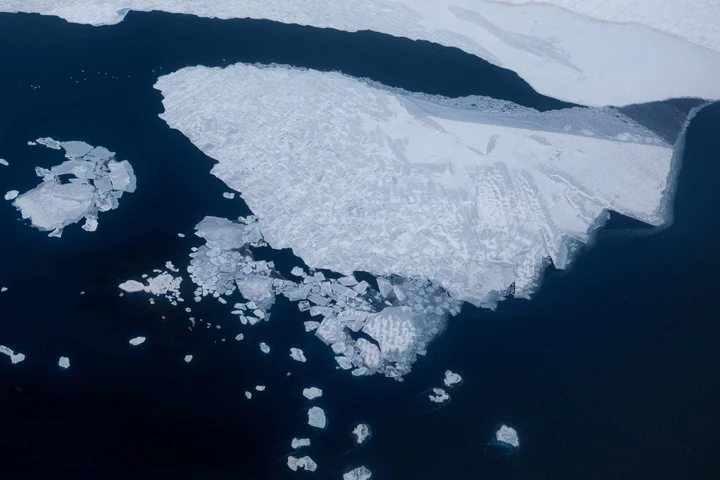
Arctic sea ice reached its lowest level ever recorded, a leading U.S
Threads
Email
Print
Bookmark story
Copy link
WASHINGTON –
Arctic sea ice reached its lowest level ever recorded, statistically tying last year's record, a leading U.S
climate observatory for this geopolitically significant region said on Thursday.The ice is formed by seawater that freezes through the winter
It partially melts through the summer
However, the amount of reformation each winter is in decline, as rising temperatures due to climate change disproportionately affect the Arctic.This year's maximum ice level was reached on March 15 — a week earlier than last year.The ice clocked in just below last year's level at 14.29 million square kilometers, a statistical tie with last year's all-time record low of 14.31 million square kilometers, according to the National Snow and Ice Data Center (NSIDC) in Boulder, Colorado.It is the lowest level observed in 48 years of satellite monitoring
Previous records were set in 2016, 2017 and 2018.This year's weak ice formation "gives a head start to the spring and summer melt season," said NSIDC Senior Researcher Walt Meier.Samantha Burgess of the European Centre for Medium-Range Weather Forecasts (ECMWF) had a similar analysis, saying it may trigger a "potentially faster and more extensive summer melt."The weak ice growth was visible on satellite for weeks, as it was reported earlier in March.Unlike land-based ice — such as glaciers or ice sheets — melting sea ice does not directly raise sea levels
But it does cause wide-ranging climate impacts that threaten ecosystems.Many species, including polar bears in the Arctic and emperor penguins in Antarctica, rely on sea ice to breed and feed.Some effects can cascade."There are areas, for example, in the Beaufort Sea, near Canada or the Siberian seas of the ocean, that had never been exposed to the atmosphere," says Gilles Garric, a polar oceanographer at Mercator Ocean Toulouse
That exposure, in turn, could make these waters warmer in the summer.The melt also has geopolitical consequences, as it opens new shipping routes and access to mineral resources
Since returning to the White House, U.S
KEYWORDS
climate change(https://www.japantimes.co.jp/tag/climate-change), oceans(https://www.japantimes.co.jp/tag/oceans), U.S.(https://www.japantimes.co.jp/tag/us)
In a time of both misinformation and too much information, quality journalism is more crucial than ever.By subscribing, you can help us get the story right.
SUBSCRIBE NOW
With your current subscription plan you can comment on stories
However, before writing your first comment, please create a display name
in the Profile section of your subscriber account page.
Your subscription plan doesn't allow commenting
What to know about Japan’s new traffic rules for cyclists
The West should learn from Japan how to stand up to China
Japan calls GSDF officer’s break-in at Chinese Embassy ‘deeply regrettable’
Cabinet Office and Tokyo government prepare for Mount Fuji eruption risk
Japan’s change of China’s description is not a 'significant shift'
Tokyo earns seven spots on Asia’s 50 Best Restaurants list
Spring reawakens concerns over bear encounters in Japan
What you need to know about Japan’s new joint custody system
Beijing row highlights need for Japan to reduce cleantech dependence on China
Kabukicho: Tokyo’s ‘stadium of desire’
The human-made roots of Japan's hay fever crisis
Inaka no Taiho: Chinese restaurant offers experience of ‘receiving life’
Sponsored contents planned and edited by JT Media Enterprise Division.
Japan's tally of specified skilled workers hits record 390,296
5 hours ago
Japan's Ispace delays NASA-sponsored moon landing to 2030
5 hours ago
Shadow raises pitched as option for cash-strapped Japanese companies
5 hours ago
MSDF destroyer becomes Japan’s first ship capable of firing Tomahawk missiles
6 hours ago
Welcome to 'New Russia': How the Kremlin is remaking occupied Ukraine
6 hours ago
Related Stories



Source: This article was originally published by The Japan Times
Read Full Original Article →
Comments (0)
No comments yet. Be the first to comment!
Leave a Comment