
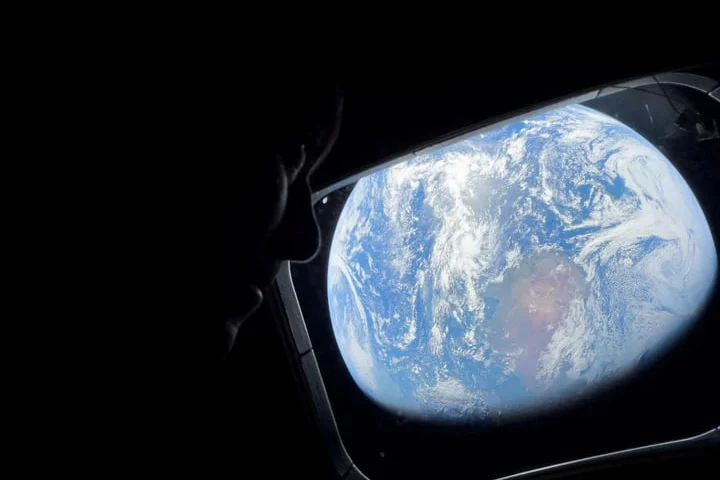
A new record will be set today for the furthest a human being has ever travelled from the earth .
NASA’s Artemis II crew, Commander Reid Wiseman , mission specialists Christina Koch and Jeremy Hansen, and pilot Victor Glover, embarked on a 10-day voyage to our closest neighbour this week.
As of 6am this morning, the crew entered the Moon’s ‘sphere of influence’.
In doing so, the team have edged past a record that has stood for nearly 56 years, previously set by the Apollo 13 team during their historic 1970 mission.
Just before 7pm tonight the crew is expected to reach the furthest point on their journey — 252,760 miles from the Earth.
Lunar observations are scheduled to begin at 7.45pm, as the crew turn their attention to the Moon’s surface.
At 11:44pm, mission control will briefly lose contact with Orion as the spacecraft passes completely behind the Moon, with the lunar body blocking all signals to and from Earth.
"It is blowing my mind what you can see with the naked eye from the moon right now...
It is just unbelievable," Canadian astronaut Jeremy Hansen radioed ahead of the flyby.
He challenged "this generation and the next to make sure this record is not long-lived".
As the crew make their loop around the moon, the astronauts will "analyse and photograph geologic features, such as impact craters and ancient lava flow".
Some of the regions they will be studying are on the Moon’s far side — territory that no astronaut has seen directly before, making it an incredible feat for the Artemis crew.
Their observations and images will help inform future missions to the South Pole region of the Moon.
Studies on the astronauts will also help NASA to better understand how deep space travel affects the human mind and body, which will protect astronauts in future missions as well as to travel to Mars.
Nasa spacecraft en route to Moon for flyby more than 100,000 miles from Earth
Manned mission to Moon fires engines to leave Earth’s orbit
This is the exact watch the crew are wearing aboard Artemis II
Choose the right education path for your child
If the Artemis II crew completes their mission safely, the next step is for Artemis IV and V to become lunar landing missions, which will both happen in 2028.
Related Stories



Source: This article was originally published by Evening Standard
Read Full Original Article →
Comments (0)
No comments yet. Be the first to comment!
Leave a Comment