
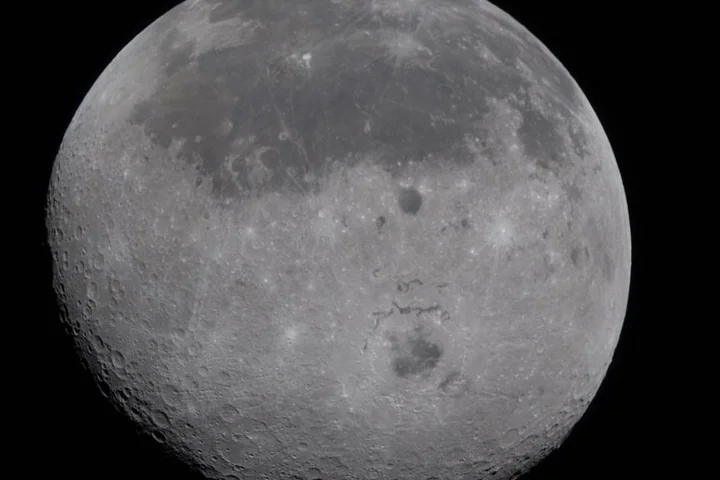
Four people saw something yesterday which no one has ever seen before – the far side of the moon.
On the sixth day of Nasa’s Artemis II, Reid Wiseman, Victor Glover, Christina Koch and Jeremy Hansen swung around our celestial neighbour.
While doing so, they did yet another record-breaking thing – going farther than any human has ever travelled in history, at 248,655 miles.
For 41 minutes, it was just four humans and the moon when their comms dropped off because the moon blocked radio signals from reaching any of the eight billion people down below.
Embraced by the lunar gravity, the spacecraft the crew dubbed Intergetry then reappeared behind the lonely grey orb.
Then they saw a blue and green crescent – the Earth – appear from their window as they witnessed a solar eclipse.
Glover said: ‘You can actually see a majority of the moon.
It is the strangest-looking thing that you can see so much on the surface.’
In 2016, Wiseman posted on X that he dreamt he did a lunar flyby.
‘Been in that post-vivid-dream-that-wasn’t-real funk all morning,’ he said.
Writing yesterday, he wrote: ‘All I feel is gratitude for this experience.’
Astronauts name moon ‘bright spot’ after mission commander’s late wife
As they drifted through the abyss of space, the crew decided to name two craters on the moon.
One would be named after Integrity.
The other, Caroll, is in honour of Wiseman’s wife, who died in 2020 of cancer.
The ‘Caroll’ crater is just northwest of the moon’s Glushko crater.
Nasa’s mission control responded to their transmission: ‘Integrity and Carroll Crater, loud and clear.’
While David Bowie once sang in Rocketman that space is a lonely place, it was anything but aboard the deep space capsule, Orion.
The crew hugged, cried and cheered as they marked the historic moment.
The far side of the moon, popularly called the ‘dark side’, is the hemisphere that never faces Earth.
Among the sights the crew observed – and there were many – was a new angle of the moon that captured the Orientale Basin, a 600-mile-wide crater that can be seen only partly from Earth.
The moon’s famous dark splotches, which are actually ancient lava flows, were clearly visible.
Wiseman commented on the live feed: ‘Orientale just looks so dynamic right now.
It’s very three-dimensional.’
They even saw five small meteors flick the already pockmarked lunar surface.
Behind them, they spotted Mars and Saturn.
The trip ended with a phone call from US President Donald Trump, who asked the obvious question: What was the moon like?
‘I must say,’ Glover replied, ‘it was actually quite nice.’
Today will be a rest day for the Artemis II crew.
Slowly, Earth’s gravity will tug the Orion back towards the planet.
Nasa administrator Jared Isaacman said on X: ‘Before they left, they said they hoped this mission would be forgotten, but it will be remembered as the moment people started to believe that America can once again do the near-impossible and change the world.
‘Congratulations to this incredible crew and the entire NASA team, our international and commercial partners, but this mission isn’t over until they’re under safe parachutes, splashing down into the Pacific.’
Get in touch with our news team by emailing us at webnews@metro.co.uk.
For more stories like this, check our news page.
Related Stories



Source: This article was originally published by Metro UK
Read Full Original Article →
Comments (0)
No comments yet. Be the first to comment!
Leave a Comment