
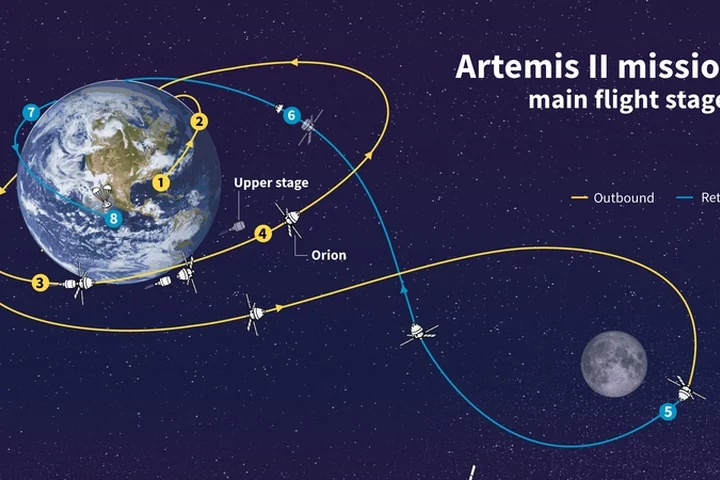
The Artemis II astronauts conducted a historic lunar flyby, gathered invaluable data and took in unprecedented Moon views, but one of the most crucial moments of their ten-day mission is still to come: the splashdown.
Earlier this week, Americans Reid Wiseman, Victor Glover and Christina Koch along with Canadian Jeremy Hansen voyaged further from Earth than any human before, in a mission considered a key stepping stone towards eventual crewed lunar landings, and more.
They are scheduled to splash down in the Pacific Ocean off the coast of San Diego at 5.07pm local time (1.07am Irish time), after which NASA and the military will help them get out of the capsule and fly them to a recovery ship.
Their journey has been rich in milestones and already resulted in stunning photographs that have captivated the imaginations of people on Earth.
"When we can start celebrating is when we have a crew safely in the medbay of the ship," the high-ranking official said.
"That's really when we can allow the emotions to take over, and, you know, start talking about success."
The stakes are particularly high given concerns that arose during Artemis I, a 2022 uncrewed test flight to the Moon and back that saw the Orion heat shield erode in unexpected ways.
The heat shield is vital: During their re-entry, the Orion spacecraft will face temperatures peaking around 5,000 degrees Fahrenheit (2,760 degrees Celsius), or half as hot as the surface of the Sun.
The astronauts will come hurtling back at a maximum velocity of 34,965 feet (10,657 metres) per second - more than 30 times the speed of sound.
The heat shield is meant to slowly erode - "ablate", as NASA puts it - to protect the capsule, a process that during Artemis I was disrupted.
To minimise any risk to the crew, NASA has changed the reentry path they had used in that test mission, after determining it had played a role in the complications.
"We have high confidence in the system and the heat shield and the parachutes and the recovery systems we put together," Mr Kshatriya said.
"The engineering supports it, the Artemis I flight data supports it.
All of our ground test supports it.
Our analysis supports it."
And "the crew is going to put their lives behind that confidence".
Asked later about stress levels on the ground, NASA's associate administrator said "it's impossible to say you don't have any irrational fears left".
"But I would tell you, I don't have any rational fears about what's going to happen."
NASA said loved ones of the astronauts will be watching the return from Houston's mission control.
Catherine Hansen, the wife of astronaut Jeremy, told AFP that "it has been a very emotional week".
The second phase of the Artemis program has been described by NASA as a "test mission", including to verify the reliability of the Orion capsule, which before now had not carried humans.
It was also a voyage marked by historic achievements: Glover was the first person of colour to fly around the Moon, Koch was the first woman, and Canadian Hansen the first non-American.
The crew have reported in vivid detail features of the lunar surface and later witnessed a solar eclipse as well as meteorite impacts.
NASA senior official Lakiesha Hawkins told a briefing this week that "when the mission goes well, it can look like flying to the Moon is easy".
"It certainly is not," she continued.
"We can't forget that this is a test flight, and we are taking everything that we're learning forward to support the next mission."
Late Wednesday, astronaut Koch said that "every single thing we do" is with the next crew in mind.
And mission commander Wiseman reflected that "what we really hoped in our soul is that we could, for just a moment, have the world pause - and remember that this is a beautiful planet in a very special place in our universe".
"We should all cherish what we have been gifted."
Related Stories



Source: This article was originally published by RTÉ News
Read Full Original Article →
Comments (0)
No comments yet. Be the first to comment!
Leave a Comment