
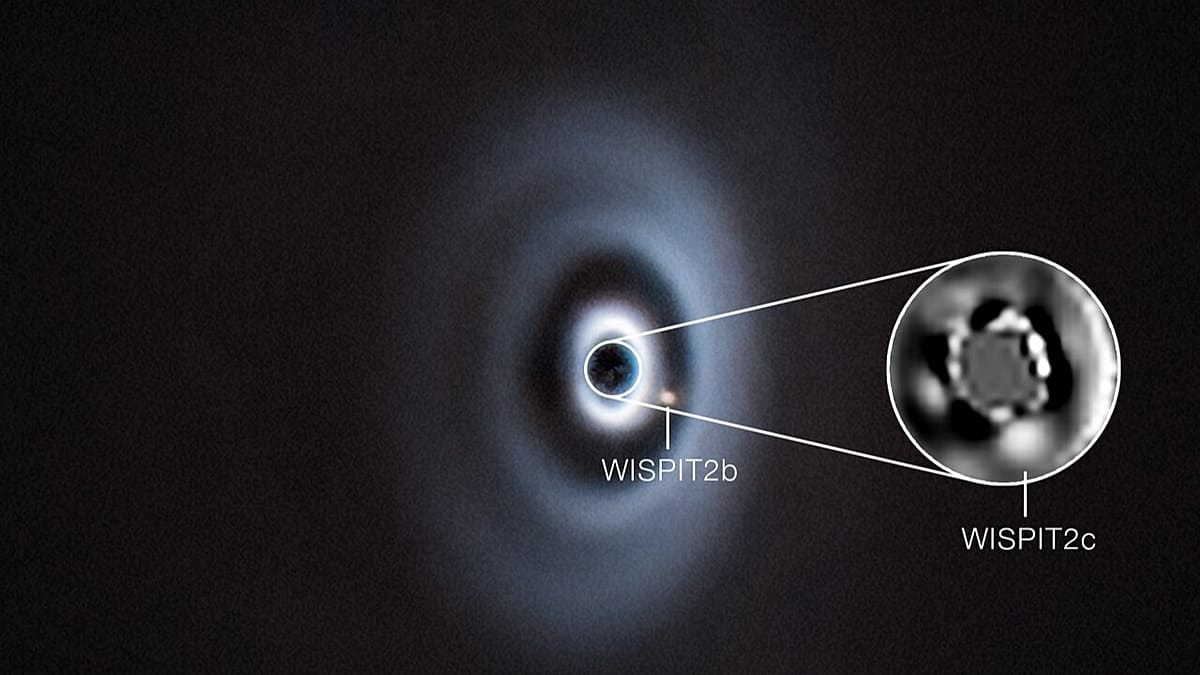
VLT images of two planets forming around the young star WISPIT 2
-
Copyright
Credit: ESO/C
Published on
25/03/2026 - 7:01 GMT+1
Using the European Southern Observatory’s Very Large Telescope, a team of scientists have observed two giant gas planets forming around a young star in what appears to be a new, emerging solar system.
Astronomers have caught something extraordinary happening in deep space - new planets being born, right now.
Around a young star called WISPIT 2, a team of reserchers have spotted not one, but two giant planets forming inside a swirling cloud of gas and dust
It’s one of the clearest, most real-time views we’ve ever had of how solar systems - including our own - come to life.
"WISPIT 2 is the best look into our own past that we have to date," says Chloe Lawlor, a PhD student at the University of Galway, Ireland, and lead author of the study published in The Astrophysical Journal Letters.
NASA prepares April launch for first crewed Moon mission in more than 50 years
A rare planetary double in the making
The discovery makes WISPIT 2 just the second known system - after PDS 70 - where two planets have been directly observed forming around a star.
"These structures suggest that more planets are currently forming, which we will eventually detect," Lawlor said.
But unlike its predecessor, WISPIT 2's disc is unusually large and structured, marked by striking gaps and rings carved out by the emerging planets.
"WISPIT 2 gives us a critical laboratory not just to observe the formation of a single planet but an entire planetary system," said Christian Ginski, a co-author of the study and researcher at the University of Galway.
A growing planetary system
The first planet, WISPIT 2b, was identified last year - a massive gas giant nearly five times the size of Jupiter, orbiting far from its host star.
A second planet has now been confirmed closer in
"This detection of a new world in formation really showed the amazing potential of our current instrumentation," said Richelle van Capelleveen, a PhD student at Leiden Observatory and leader of the previous study.
A newborn planet, WISPIT 2b, eating its way through its dusty cradle as it orbits its host star
Credit: ESO/R
The newly confirmed planet, WISPIT 2c, sits four times closer to the star and is twice as massive as its sibling
Like WISPIT 2b, it is a gas giant - similar to the outer planets in our own Solar System.
To document and observe the planet, researchers from the University of Galway and Leiden Observatory used instruments at the European Southern Observatory, including the disarmingly literally-named "Very Large Telescope" and its interferometer
How do planets actually form?
To understand exactly what's happening here, it's important to know how planet formation works - a fascinating phenomenon which unfolds over millions of years and what NASA describes as a snowball-like process
“They start out as globs of gas and dust that orbit a central star, which itself may also be forming
Gravity and other forces cause material within the disk to collide
If the collision is gentle enough, the material fuses, growing like rolling snowballs,” reads a statement on NASA's website.
“Over time, dust particles combine to form pebbles, which evolve into mile-sized rocks
As these forming planets orbit their star, they clear material from their path, leaving tracks of largely empty space
At the same time, the star gobbles up nearby gas and pushes more distant material farther away,” it added.
This image of the WISPIT 2 system was captured by the Magellan Telescope in Chile and the Large Binocular Telescope in Arizona
Credit: Laird Close, University of Arizona
This cosmic snowballing eventually produces full-fledged planets
Some grow into rocky worlds like Earth, while others, if they gather enough gas before the surrounding disc disperses, can become enormous gas giants such as Jupiter and Saturn, and in this new study's case, WISPIT 2b and WISPIT 2c
The possibility of a hidden third planet
Scientists think the story of this new emerging solar system may not end there
Farther out, another, smaller gap hints at the possible presence of a third, yet unseen planet.
"We suspect there may be a third planet carving out this gap," said Lawlor, "potentially of Saturn mass owing to the gap’s being much narrower and shallower".
Future research could confirm this suspicion, with astronomers already looking ahead to the next generation of telescopes
"With ESO's upcoming Extremely Large Telescope, we may be able to directly image such a planet," Ginski said.
Elon Musk plans to manufacture chips for SpaceX and Tesla
This is what an 8.5 million year old 'jellyfish gallery' looks like
Astronomers have caught a young solar system in the making
Related Stories



Source: This article was originally published by Euronews
Read Full Original Article →
Comments (0)
No comments yet. Be the first to comment!
Leave a Comment