
Bianca Nogrady is a freelance science journalist based in the Blue Mountains, west of Sydney, Australia.
Search author on: PubMed Google Scholar
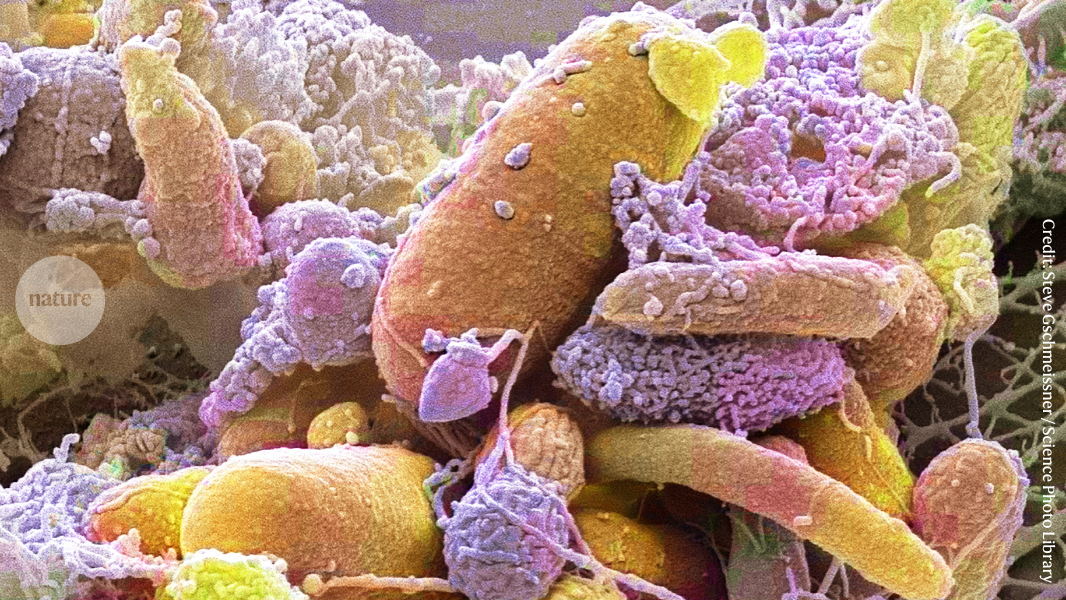
A mixed community of bacteria — some of which are found in the gut — imaged using a scanning electron microscope.
Steve Gschmeissner/SPL
As the saying goes, you are what you eat.
The choices that we make for every meal have a profound impact on our bodies, shaping our short- and long-term health.
It might be a decision as simple as having a coffee earlier in the day than usual, choosing mashed potatoes instead of fried ones or a more complex choice, such as giving up meat.
In an era when many of the leading causes of death are linked to diet-related metabolic disorders, such as obesity and diabetes, nutrition research seeks to understand such impacts, and to guide food and dietary choices for improved health outcomes.
This round-up examines some of the most interesting and important nutritional-health findings of the past few years.
Morning coffee best for heart health
For millions of people globally, the day starts with a steaming cup of coffee.
And for many of those coffee drinkers, it’s the first of several cups consumed throughout their waking hours.
The relationship between coffee consumption and health is unclear, particularly when it comes to having more than three cups a day.
To help understand the relationship between coffee intake and health, researchers have investigated whether the timing of coffee consumption throughout the day has any effect on mortality 1 .
Biostatistician Xuan Wang at Tulane University in New Orleans, Louisiana, and co-authors made use of detailed data from 40,725 adults involved in the US National Health and Nutrition Examination Survey, a long-term cohort study.
They also included data from 1,463 participants in two other US studies, the Women’s Lifestyle Validation Study and the Men’s Lifestyle Validation Study.
The authors found that around one-third of people enjoy their coffee mostly or exclusively before lunchtime, and that less than one-fifth drink coffee throughout the day.
The remainder didn’t drink coffee at all.
After adjusting for potential confounding factors — including age, sex, smoking, sleeping habits, conditions such as diabetes and high blood pressure and the overall intake of caffeine — researchers found that restricting coffee consumption to the morning was the healthiest option: healthier, even, than forgoing it entirely.
People who drank their coffees before midday had a 16% lower risk of all-cause mortality, and a 31% lower risk of cardiovascular-disease mortality than did those who don’t drink any coffee.
A barista pours a cup of coffee.
chayathonwong/Getty
However, all-day coffee drinkers had the same all-cause mortality and cardiovascular-mortality risks as non-coffee drinkers had.
Neither morning coffees nor all-day coffees had any significant impact on the risk of cancer mortality.
Wang and colleagues suggested that drinking coffee in the afternoon or evening could have negative effects on circadian rhythms by reducing the body’s production of the hormone melatonin, which, in turn, is associated with an increased risk of high blood pressure and heart disease.
“Our findings highlight the importance of considering drinking timing in the association between the amounts of coffee intake and health outcomes,” they wrote.
Go vegan for the gut microbiome
There is now a wealth of evidence that the gut microbiome — the population of harmless bacteria that live in the gastrointestinal tract — has a major influence on health, particularly in relation to metabolic conditions such as diabetes, obesity and heart disease 2 .
That, in turn, is driving an interest in how various dietary patterns influence the gut microbiome, and the health consequences of those food choices.
Plant-based foods are known to contribute to a healthy balance of gut bacteria because they contain substances, such as cellulose, that the bacteria can break down through fermentation, as well as compounds called polyphenols that boost beneficial microorganisms.
Gloria Fackelmann, a microbiome researcher at the University of Trento in Italy, and her colleagues were interested in how the proportion of plant-based foods in a diet affect the gut microbiome, and the subsequent effects on health.
In a study of 21,561 people from the United States, the United Kingdom and Italy, they used metagenomics to study the profile of each person’s gut microbiome 3 .
This technique enables researchers to identify and study the genomes of many organisms in a single sample, such as from a diverse population of gut bacteria.
The researchers found that vegans, vegetarians and omnivores had distinct microbiome configurations.
Omnivorous diets — the most varied — were associated with the most diverse microbiomes on average.
But specific food groups were linked to health effects; for example, red-meat eaters were more likely than those who don’t eat meat to host gut bacterial species that have been linked to inflammatory bowel disease, colorectal cancer and cardiometabolic diseases.
By contrast, vegans were most likely to have species that were known to produce short-chain fatty acids that can have an anti-inflammatory effect.
Diets higher in dairy products were associated with several lactic-acid bacteria that are generally linked to better health.
“Our work reinforces how humans can shape their own gut microbiomes, and by extension their health, directly through simple dietary choices,” the authors wrote.
Hunger might feel like a singular experience; when we are hungry, we crave food.
But there’s growing evidence that hunger can direct us towards nutrients that the body is lacking.
For example, studies have found evidence that when an animal is deprived of protein, it chooses food sources that are protein-rich, rather than those high in carbohydrates or fats 4 .
Shahjalal Hossain Khan, a postdoctoral researcher at Pennington Biomedical Research Center in Baton Rouge, Louisiana, and his colleagues set out to understand the underlying neurological mechanisms driving this appetite for protein 5 .
In particular, they were interested in the part played by the hormone FGF21, the levels of which are known to increase in the brains of animals on low-protein diets.
To begin with, the researchers confirmed that mice on a protein-restricted diet preferred food choices that were high in protein, even at the expense of foods that were higher in energy.
However, mice that were engineered with a knock-out of the Fgf21 gene, or its receptor, did not show that behaviour.
The study by Khan and his co-authors also looked at brain activity when mice were given a food high in protein or one high in the carbohydrate maltodextrin.
In normal mice, the maltodextrin triggered the activation of dopamine neurons in a part of the brain associated with reward.
In the protein-restricted mice, the protein-high food triggered the dopamine neurons, but this did not happen in the Fgf21 knock-out mice.
“These data provide convincing evidence that FGF21 is an endocrine signal of protein restriction that acts in the brain to specifically enhance the reward value of protein-containing foods and promote their consumption,” the authors wrote.
Although the study was in mice, it could inform research about overeating and obesity in humans and treatments for these conditions, they added.
Sugar rationing reduced diabetes and high blood pressure
From 1942 to 1953, the UK government imposed a daily ration on the amount of sugar that Britons could buy, owing to shortages of a range of essential products after the Second World War.
Enjoying our latest content?
Log in or create an account to continue
doi: https://doi.org/10.1038/d41586-026-00598-6
This article is part of Nature Spotlight: Nutrition , an editorially independent supplement.
Advertisers have no influence over the content.
Wang, X.
et al.
Eur.
Heart J.
46 , 749–759 (2025).
Fan, Y.
& Pedersen, O.
Nature Rev.
Microbiol.
19 , 55–71 (2021).
Fackelmann, G.
et al.
Nature Microbiol.
10 , 41–52 (2025).
Murphy, M.
et al.
Physiol.
Behav.
184 , 235–241 (2018).
Khan, S.
H.
et al.
Mol.
Metab.
91 , 102068 (2025).
Gracner, T., Boone, C.
& Gertler, P.
J.
Science 386 , 1043–1048 (2024).
Mousavi, S.
M.
et al.
BMJ 390 , e082121 (2025).
What is the science behind ‘science-backed’ supplements?
Researchers want a ‘nutrition label’ for academic-paper facts
Why nurturing the gut microbiota could resolve depression and anxiety
Want a younger brain?
Learn another language
Partner content: Exploring links between nutrition and longevity
Partner content: Exploring prebiotics for personal nutrition
Partner content: Rethinking the role of clinical nutrition in hospital care
Partner content: Speeding up the search for naturally occurring functional compounds
Partner content: Exploring rare sugars as low-calorie sweeteners with hidden benefits
Partner content: Exploring how to make foods pack a nutritional punch
Partner content: Early clues to a gut–tumour immune link
Partner content: Scoring foods to meet shifting nutritional needs
Partner content: Why nutrition is crucial in the fight against cancer
Partner content: Exploring compounds from nature to target ageing
Daily multivitamin slows signs of biological ageing
Coffee linked to slower brain ageing in study of 130,000 people
Insulin resistance prediction from wearables and routine blood biomarkers
Microbiota-mediated induction of beige adipocytes in response to dietary cues
Autism in older adults: the health system must recognize its effects
Dopamine takes a hit: how neuroscience is rethinking the ‘feel-good’ chemical
Data from smart watches reveal early signs of insulin resistance
CeMM is recruiting two scientists to join as Starting Principal Investigators within a new research program on pain and aging/healthy.
Research Center for Molecular Medicine (CeMM), ÖAW
Profile the cellular components of tissue microenvironments (TME) in healthy and inflamed sites.
Dortmund, Nordrhein-Westfalen (DE)
Leibniz-Institut für Analytische Wissenschaften – ISAS – e.V.
Postdoctoral positions exploring microbiota–stem cell interactions in development, disease & cancer using gnotobiotic models, organoids & multi-omics.
The Chinese Institutes for Medical Research (CIMR), Beijing
Join Huazhong Agricultural University
No.1 Shizishan Street, Hongshan District, Wuhan, Hubei Province, China
Huazhong Agricultural University (HZAU)
SUSTech School of Medicine offers equal opportunities and welcome applicants from the world with all ethnic backgrounds.
Southern University of Science and Technology, School of Medicine
Related Stories



Source: This article was originally published by Nature News
Read Full Original Article →
Comments (0)
No comments yet. Be the first to comment!
Leave a Comment