
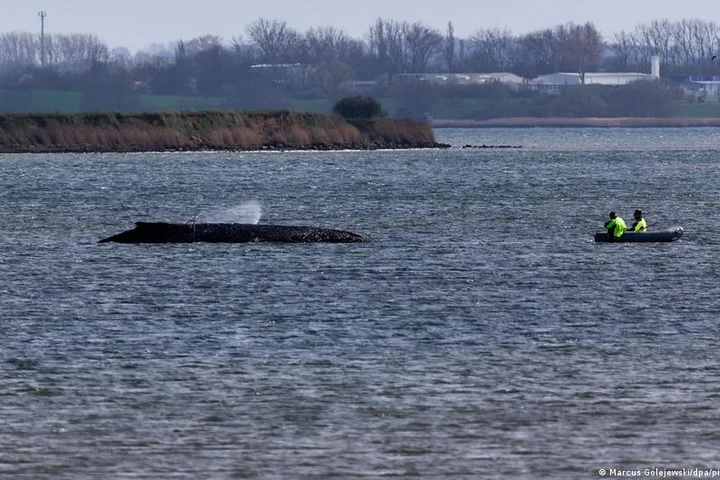
The plight of a whale marooned in shallow Baltic waters has had animal lovers gripped for the past week.
Meanwhile, Germany's Easter peace marches continue as the Iran war rages.
DW has the latest.
Welcome to our roundup of headlines from and about Germany on the Easter long weekend:
Wolf released after Hamburg attack — 'on probation'
A wolf that was captured after an attack on a woman in Hamburg has been released back into the wild with a tracking device.
Authorities said the young male had been fitted with a transmitter and released on Easter Sunday after being held at a wildlife rescue center in Lower Saxony.
Hamburg Environment Senator Katharina Fegebank said the move balanced public safety and animal welfare, describing it as "a release on probation." Officials added the animal's location can now be monitored at all times, allowing hunters to intervene if it approaches populated areas again.
The wolf had been spotted in the city's west in late March before entering a shopping passage in Altona, where a woman in her 60s was injured.
It later ran through the city center and jumped into the Binnenalster, where police captured it.
Authorities believe the wolf bit the woman as she approached the panicked animal, though details of the police report have not been made public.
Conservationists have disputed that account, citing a witness who said the wolf may have struck the woman with its paw rather than bitten her.
Germany faces wolf crisis: Hunting back on the table
To view this video please enable JavaScript, and consider upgrading to a web browser that supports HTML5 video
Germany confirms that men of military age need approval for long stays abroad
Germany has introduced a rule requiring men of military age to seek approval for extended stays abroad under a new reform.
The German Defense Ministry confirmed a report that men aged 18 to 45 must obtain permission for trips longer than three months .
Officials said the measure is intended to ensure a reliable system for tracking potential conscripts if needed.
The rule applies from age 17 under the legal wording, requiring prior approval from a Bundeswehr career center.
At the same time, authorities have said exemptions are being developed to avoid unnecessary bureaucracy.
Approval is expected to be granted if no military service is anticipated during the period in question.
Military service remains voluntary under current law, and officials have indicated future administrative rules will clarify that approvals are effectively automatic as long as that remains the case.
The reform, which took effect on January 1, reintroduces conscription registration and mandatory medical screening for entire age groups, aiming to boost troop numbers.
It follows updated NATO requirements amid heightened tensions with Russia.
German rearmament sparks controversy, again
Startups rise sharply in Germany amid economic strain
More people in Germany are turning to self-employment as economic pressures mount and prices rise.
A survey by the state-owned investment and development bank KfW showed the number of founders climbed to about 690,000 in 2025, up 18% from 585,000 a year earlier.
The main motivation for many has been to earn additional income alongside regular work.
KfW chief economist Dirk Schumacher said access to the labor market has become more difficult , and even small side jobs are harder to find, making self-employment an alternative source of income.
Schumacher said Germany needs more young, innovative companies but also a stable business base.
About 545,000 small and medium-sized firms are expected to seek successors by the end of 2029, highlighting the need for more entrepreneurs willing to take over existing businesses.
Young people between jobs crisis and a new beginning — MADE
Polonium-labeled vial found in German town
German authorities have launched an investigation after a vial labeled Polonium-210 was found during an Easter egg hunt in southern Germany.
Two men discovered the small bottle in a garden in the town of Vaihingen an der Enz, northwest of Stuttgart.
The case was taken over by Baden-Württemberg state police in coordination with the state Environment Ministry.
Officials said it remained unclear what substance the vial actually contained.
The container was secured and transported for analysis, while initial radiation measurements around it showed no detectable radioactivity.
Fire services assessed the vial as appearing genuine based on its look and weight, but confirmed no immediate danger.
The two men were unharmed, according to local authorities.
Polonium is a highly radiotoxic element and can be potentially lethal, particularly if inhaled or absorbed through wounds.
Authorities are now working to determine the origin of the vial and how it ended up in the town of about 11,000 residents.
The substance gained global attention after the 2006 poisoning of Alexander Litvinenko in London.
Wolf killed in collision in eastern Germany
A wolf has been killed after running onto the roadway and being struck by a car on a highway in northeastern Germany.
Police said the animal died in the collision overnight on the route between Berlin and the northern Baltic sea port of Rostock, while the 37-year-old driver was unharmed.
The vehicle sustained significant damage and was no longer drivable after the crash.
Last week, a wolf bit and injured a woman in the northern German city of Hamburg .
Wolves generally avoid humans, though younger individuals may approach out of curiosity.
Wolves had been considered extinct in Germany for the past century and a half, but they started to repopulate parts of the country in the past 15 years or so.
Stranded Baltic humpback whale is still breathing
The condition of a stranded humpback whale near the northern Baltic port city of Wismar has remained unchanged, with the animal continuing to breathe every two to four minutes.
Authorities said police monitored the whale overnight, while officials confirmed the situation had not improved.
The animal — dubbed Timmy by the German media and measuring about 12 meters (roughly 40 feet) in length — has been stranded near Wismar since last week.
Rescue efforts were halted on Wednesday after experts concluded the animal was unlikely to survive.
The state of Mecklenburg-Western Pomerania's Environment Minister Till Backhaus has said the low salinity of the Baltic Sea has been placed severe strain on the whale.
Welcome back to the DW newsroom in Bonn, where cherry blossom season is in full swing and where animals are making headlines in Germany once again.
Off the northeastern Baltic port city of Wismar, the nation is still tracking the fate of a whale stranded in shallow water for the past week.
Not so far away, a wolf was hit by a car on a major highway from Berlin.
Wolves have only recently made a comeback in Germany.
For these and all the latest stories about Germany, stick with us here.
We're pausing our updates of the top headlines out of Germany for the night.
But we'll be back again tomorrow with more news from Easter Monday in Germany.
Rally in Berlin to protest US-Israeli war on Iran
Several hundred people took to the streets of Berlin on Sunday to protest against the US-Israeli war against Iran.
Among the demonstrators were people seen carrying Iranian flags as well as pro-Palestinian protesters.
The demonstration began in the early afternoon at the main train station and was scheduled to proceed through the government district to the iconic Brandenburg Gate.
Police put the number of demonstrators at between 500 and 700.
A police spokesperson said in the evening that the rally had remained largely peaceful.
Iranian flags and pro-Palestinian protesters were also seen this weekend at Easter peace marches, an annual tradition in Germany since the height of the Cold War.
(see entry below)
Train union boss calls for rebates, state price cuts in face of high fuel prices
German railway and transport union (EVG) boss Martin Burkert told the German mass-market weekly Bild am Sonntag that the federal government should step in to support rail travel in light of the huge fuel price spikes Germans face as a result of global conflicts, especially the war in the Middle East.
Burkert called for Berlin to initiate a federal price cut for long-distance train and public transport fares.
The union boss told Bild that a "limited-time 30% rebate on Germany Tickets and up to 50% cuts to long-distance fares would provide fast and effective relief."
"Policymakers need to impose a windfall tax and make use of state-owned Deutsche Bahn rather than letting oil companies keep leading them around by the nose," Burkert added.
22-year-old shot dead fleeing police in car
Prosecutors in the southwestern German city of Saarbrücken say police there shot a 22-year-old man dead early Sunday when he attempted to outrun them in his car.
Two other men, aged 23 and 19, were in the car at the time of the incident.
Prosecutors say the 19-year-old backseat passenger was injured during a chase that unfolded when the driver sought to evade a police check northeast of the city around 1:00 a.m.
local time (2300 Saturday UTC/GMT).
Prosecutors say a female officer was injured during the driver's attempt to escape after he maneuvered himself into a dead-end street.
Officers reportedly shot the driver dead as he was trying to wheel around the cul-de-sac, bringing the vehicle to a stop.
Multiple police officers were deployed to the area and an investigation is underway.
Andreas Rinnert, chairman of GdP police union, said, "It is always tragic when someone is killed during a police operation.
In that context, we expressly call for calm and ask that people refrain from making premature assumptions or assigning blame, both in person and online."
"We all have the greatest possible interest in transparently investigating this incident," said Rinnert, "devoid of hate, vitriol and predetermined guilt."
The state of Saarland, where Saarbrücken is located, closely regulates police use of firearms , saying they may only be discharged against people "to render them incapable of attack or escape, provided that this objective cannot be achieved by using firearms against property."
A potentially lethal shot is only permissible if it is the last means of averting an immediate threat to life or serious injury.
Three killed by falling tree in northern Germany Easter egg hunt
Police say at least three people were killed on Sunday when a tree fell on them while they were hunting for Easter eggs.
Police said a 21-year-old mother and her 10-month-old child were among the dead as well as 16-year-old girl.
An 18-year-old woman was flown to a hospital in serious condition and other people were injured.
The accident reportedly occurred in a wooded area in Satrupholm, outside the northern German city of Flensburg, around 11 a.m.
local time (0900 GMT).
A group of about 50 people had gathered for the Easter egg hunt.
Police say the victims were killed when high winds sent a 30-meter (98-foot) tall tree crashing down upon them.
Others in the party were injured.
Germany's DWD weather service had previously issued high-wind warnings for the area, forecasting sustained winds of between 55 and 65 kph (34-40 mph) and gusts of up to 80 kph (50 mph) across the state of Schleswig-Holstein.
Police open probe after clashing fans invade pitch during Dynamo-Hertha match
The Bundesliga 2 soccer match between Dynamo Dresden and Hertha Berlin on Saturday night was marred by crowd trouble and rioting.
Police in the eastern German city are probing alleged breaches of the peace, dangerous bodily harm, criminal damage and ticket fraud.
It was unclear if both sets of fans were being investigated.
The German Football Federation (DFB) told news agency DPA that it would open its own probe into the clashes next week.
What happened during the match between Dynamo Dresden and Hertha Berlin?
Fans from both teams initially set off fireworks during Saturday evening's second division match at the Rudolf Harbig Stadion in Dresden.
Supporters climbed over fences, with masked Dresden fans running along the side of the pitch towards the Berlin fans.
The two sets of supporters then fired pyrotechnics at each other as they clashed.
The referee halted the game and sent the two teams to the changing rooms, while riot police tried to push Dynamo fans back away from the visiting Hertha supporters.
Hertha prevailed with a 1-0 win, despite having had a man sent off.
IN DEPTH — Easter peace marches in shadow of war
More than 100 peace marches and related events have been planned around Germany over the course of the Easter weekend.
The weekend has always had a strong geopolitical flavor, whether it was during the threat of nuclear war in the Cold War, or this year in the shadow of war in Ukraine, Iran, the Middle East, Sudan and beyond.
But very often there's a domestic tint to proceedings too.
DW's Ben Knight caught up with the Network of the German Peace Movement that coordinates the events.
More than 20 speakers have registered their intention to discuss the government's plans to partially reintroduce military service .
Berlin remembers victims of Berlin disco bombing on 40th anniversary of attack
In Berlin, residents and officials are commemorating the 40th anniversary of one of the worst international terror attacks ever to target Germany.
Wreaths and flowers were placed at the site of the "La Belle" nightclub in West Berlin — now an upscale supermarket and co-working space — where a bomb attack killed three people and injured over 200 more in the early morning hours of April 5, 1986.
A bomb planted under a table at the known hangout for US service members destroyed large parts of the building and killed one US soldier and a Turkish woman immediately.
Another US soldier soon died from his injuries.
The attack shocked the world, with US President Ronald Reagan blaming Libyan dictator Moammar Gadhafi for the crime and ordering US missile strikes on Tripoli and Benghazi just days later.
Libya never admitted direct involvement and extradited the man thought to have been behind the attack in 1996.
The case went to trial in November 1997.
In 2000, one of five defendants on trial said the bombing had been in response to previous US attacks on Libya.
He also testified that he had informed the East German Stasi before acting.
In November 2001, four of the five defendants were given prison sentences of between 12 and 14 years for their participation.
In 2004, the case was reviewed on appeal at Germany's highest criminal court, the Bundesgerichtshof (BGH), where judges upheld the convictions handed down by the lower court.
In its ruling, the BGH also made clear that Libya's intelligence agencies and operatives at the Libyan Embassy in East Berlin had planned the attack.
Related Stories
Source: This article was originally published by Deutsche Welle (DW)
Read Full Original Article →
Comments (0)
No comments yet. Be the first to comment!
Leave a Comment