
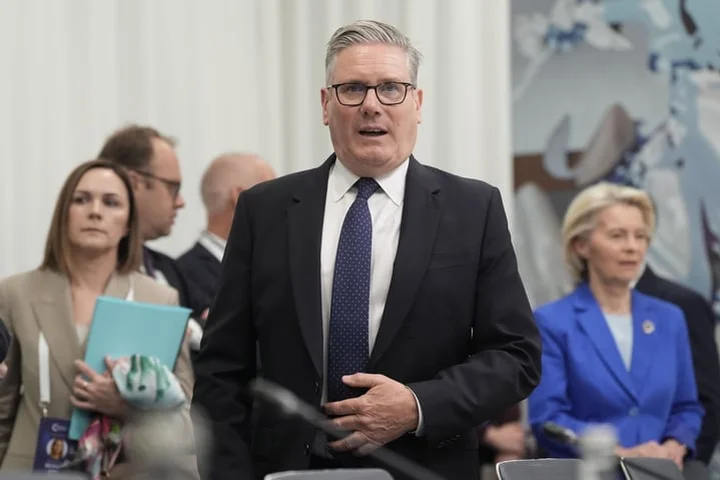
Sir Keir Starmer said the benefit of joining the EU’s 90 billion euro (£78 billion) loan for Ukraine “outweighs the cost” as he argued the continent must “move at pace” to bolster its own defence.
The bid to participate in the loan scheme, recently approved by the EU after Viktor Orban’s defeat in Hungarian elections ended a long-running impasse, is part of the Prime Minister’s reset with Brussels.
Asked about suggestions that Britain could be asked to pay the bloc up to £1 billion for greater access to the single market, Sir Keir focused on the “great benefit” that joining the Ukrainian initiative specifically would offer.
Speaking to broadcasters after the European Political Community gathering in the Armenian capital of Yerevan on Monday, he said: “It’s in our national interest to be closer to Europe.
“And whether that’s the EU loan scheme, which we are discussing with them, that’s of great benefit to Ukraine, but it’s also a great benefit to the United Kingdom as well, in terms of the jobs that it will create in the United Kingdom.
“So the benefit there outweighs the cost.
“But more generally, it is important that we see our future as a closer relationship with the EU that’s in our national interest, and that’s what I’ve been discussing here and on previous occasions.”
Sir Keir was using the trip to continue his push for closer ties with the bloc on defence, security and the economy, and to make the case for his reset with Brussels to UK voters ahead of local elections this week.
It comes after The Times reported that European negotiators had made clear the UK would need to make annual payments amounting to around £1 billion a year as a condition for greater access to the single market, with which Sir Keir has previously indicated an interest in aligning more closely.
EU relations minister Nick Thomas-Symonds insisted he did not recognise the figure when asked later on Monday about the prospect of handing over the cash as part of a wider reset.
“No, I’ve not come across, don’t recognise that figure,” he told BBC Radio 5 Live.
He added: “It is always about… those two principles – national interest, value for money – and that’s how I’ll continue to judge it.”
Sarwar says ‘focus’ is on beating John Swinney – not on Labour at Westminster
US denies Iranian claim of missile strike on warship amid Strait of Hormuz standoff
Sir Keir Starmer warns of ‘tension’ between Trump and Europe at Armenian summit
Rediscover your adventurous side on an exotic getaway
During the summit, Sir Keir spoke of heightened “tension” between Donald Trump and Europe at a gathering of leaders from across the continent.
Mr Trump has lashed out at some Nato nations for what he sees as their lack of support for Washington in Iran, most recently announcing plans to withdraw 5,000 troops from Germany.
The Prime Minister warned of the strained relations at the European Political Community summit in Armenia, which is being dominated by the conflicts in Ukraine and Iran, amid concerns over the US president’s waning interest in the first and attacks on traditional allies over their stance on the second.
Speaking in the plenary session, Sir Keir said: “We cannot deny that some of the alliances that we have come to rely on are not in the place we would want them to be.
“There is more tension in the alliances than there should be and it’s very important that we therefore face up to this as a group of countries together.”
He told reporters after the summit that Europe must step up commitments to defence and security.
Asked how challenging the geopolitical situation is, the Prime Minister said: “It’s very important that we’re clear that we work very closely with the US on all issues to do with defence and security and intelligence.
We have done for many years, and we do so every day.
“But clearly we also have to make sure that the European countries do more on defence and security.
“That’s actually an argument that President Trump makes, but I feel very strongly that the European countries now need to step up and do more on defence and security.
“Have a stronger European element of Nato, if you like.
“When you’re facing a war on two fronts, Ukraine and Iran, that’s having such a profound impact on our own country, on households across the whole of the United Kingdom, it’s really important we move at pace on that.”
The Prime Minister also said the damage done to economies around the world by the Middle East crisis would “play out with our electorates in all of our countries”.
His trip to Yerevan comes as Labour is expected to face a drubbing in this week’s local elections.
Meanwhile, former military chief and co-author of the Government’s strategic defence review General Sir Richard Barrons warned the Ministry of Defence had gone “backwards” since last June and lacked the money to buy new weapons until 2030.
As the Government’s long-delayed defence investment plan remains forthcoming, he told the Times that a lack of investment was “depleting” the industrial base and driving defence companies overseas.
“There is no money now and there may not be any money for four years and so a lot of technologically brilliant companies have followed the money to Germany and Poland or to the US and what that means is we are at risk of actually depleting the industrial base that we know we need to do the transformation when currently we elect to afford it, which seems to me four years away,” he said.
Asked about the intervention in Armenia, Sir Keir told reporters: “Since we came into power just under two years ago, we’ve increased defence spending to 2.6%, that’s the biggest sustained increase since the Cold War.
“I’ve made it clear we need to go further than that.
“We’ve made commitments to Nato and the defence investment plan is being finalised at the moment.”
Asked whether she would join the Brussels loan initiative if the Tories were in power, Conservative leader Kemi Badenoch said her party had been able to “lead” support for Ukraine while in government “without an EU scheme”.
Speaking to the Press Association, she added: “We heard from General Sir Richard Barrons today, we’ve gone backwards on defence since last year.
“That is a disgrace at a time when there’s not just a war in Europe, but also war in the Middle East.
“What the Government needs to do now is produce a defence investment plan, otherwise everything else is just more talking, more meetings, more summits and not enough action.”
Related Stories
Source: This article was originally published by Evening Standard
Read Full Original Article →
Comments (0)
No comments yet. Be the first to comment!
Leave a Comment