
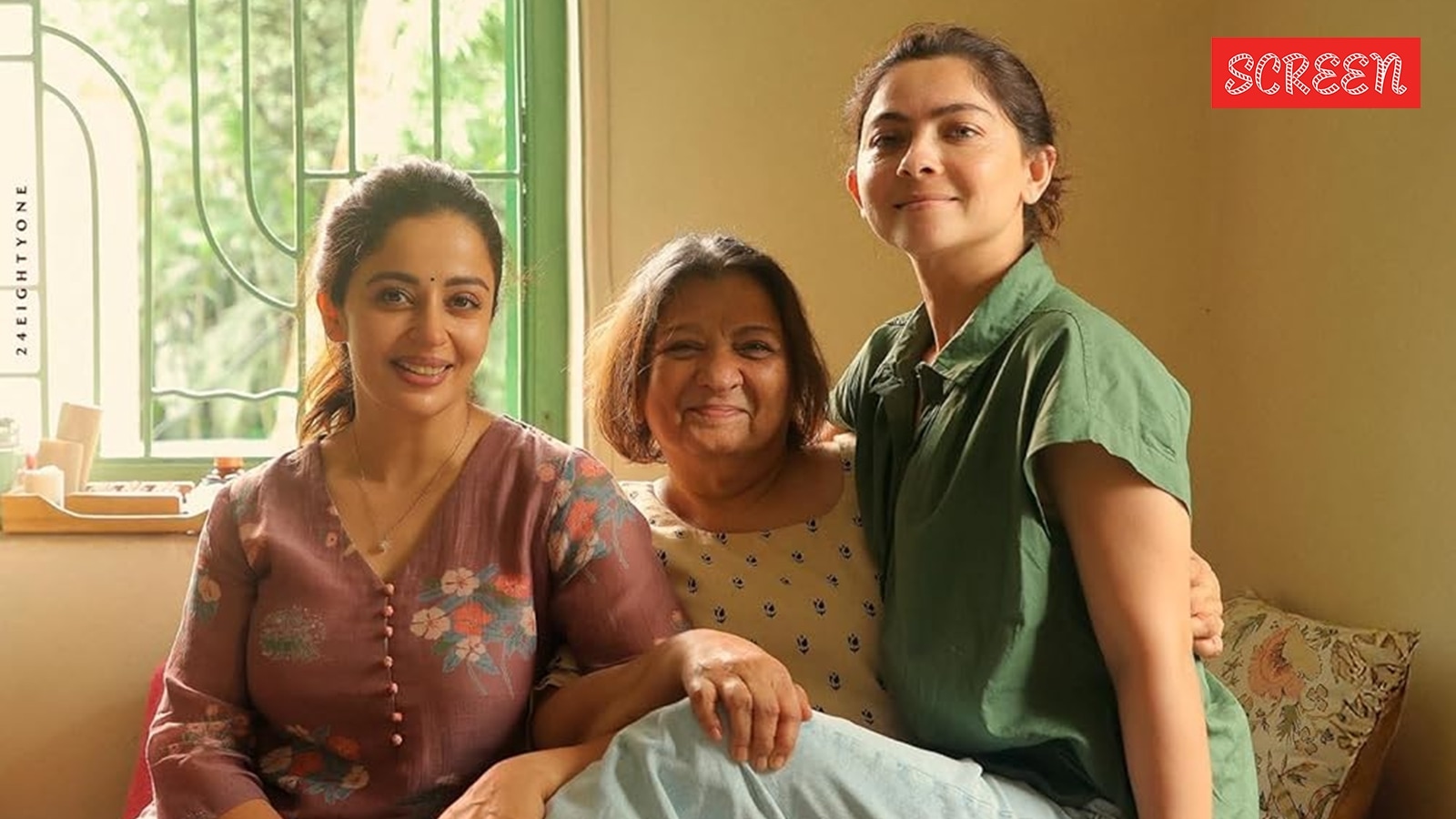
Tighee movie review: Marathi chamber drama Tighee (Three Of Us, or Us Three) features veteran Bharati Achrekar, familiar to Hindi film audiences through her impactful supporting roles, helming a story about simmering familial tensions, traumatic pasts, and the promise of a better future.
She plays the terminally ill Hemlata — mother to two fractious daughters, Swati (Neha Pendse) and Sarika (Sonalee Kulkarni) — back home one last time.
An impending tragedy is usually a strong hook to gather up estranged family members, throwing them into a difficult situation where memories, not always good one, reside.
Tighee’s troubled trio could well remind us of our own conflicted relationships and the much-needed promise of mending frayed ties, in the way Hemlata, nursing a dark secret, finally reveals all, and in the way the fatherless Swati and Sarika respond to that information, which has shaped their childhoods, and perhaps their adult relationships with the men in their lives.
Swati lives inMumbaiwith her husband (Pushkaraj Chirputkar), who seems more off than on in the marriage, showing up when he needs a cash-handout, but refusing to see it as merely transactional: that’s an interesting touch.
Also vividly executed is her discomfort around her predatory boss (Jaimini Pathak): here’s a felt example of how women are forced into dealing with their boundaries being violated every day they go to work.
Sarika (Sonalee Kulkarni) is the one who was left behind, inPune, having had to put her ambitions on hold, even as her friend and professional partner (Nipun Dharmadhikari, who’s stayed with me with his tiny scene in ‘Phalke’) remains supportive: of all the characters in the film, Kulkarni’s unvarnished performance is the most effective, as the sibling forced into a care-giving role.
Where I felt the film not as satisfying was in the thing between the women, while powerful as a premise, not always succeeding in touching me as deeply as I wanted.
There’s a group hug — the only time the three fuse physically together — which had both immediacy and intimacy, which felt right.
Also Read –Made in Korea movie review: A film with genuine heart that cannot quite find its footing
I also wanted to know more about the younger Hemlata, and the way in which she becomes convinced about taking a major step about her own marriage: yes, there is a shocking scene which is a tell, but the consequence seems much too abrupt.
Some more detailing on how that decision affects her, and the girls would have been welcome.
But overall, I’d say that this is the kind of film, revolving around complex, relatable human emotions, that we need more of: the end-note is perhaps most conflicting, leaving us to question our feelings; this is a scene I will be thinking long about.
Clickhere to follow Screen Digital on YouTubeand stay updated with the latest from the world of cinema.
Related Stories



Source: This article was originally published by The Indian Express
Read Full Original Article →
Comments (0)
No comments yet. Be the first to comment!
Leave a Comment