
Search author on: PubMed Google Scholar
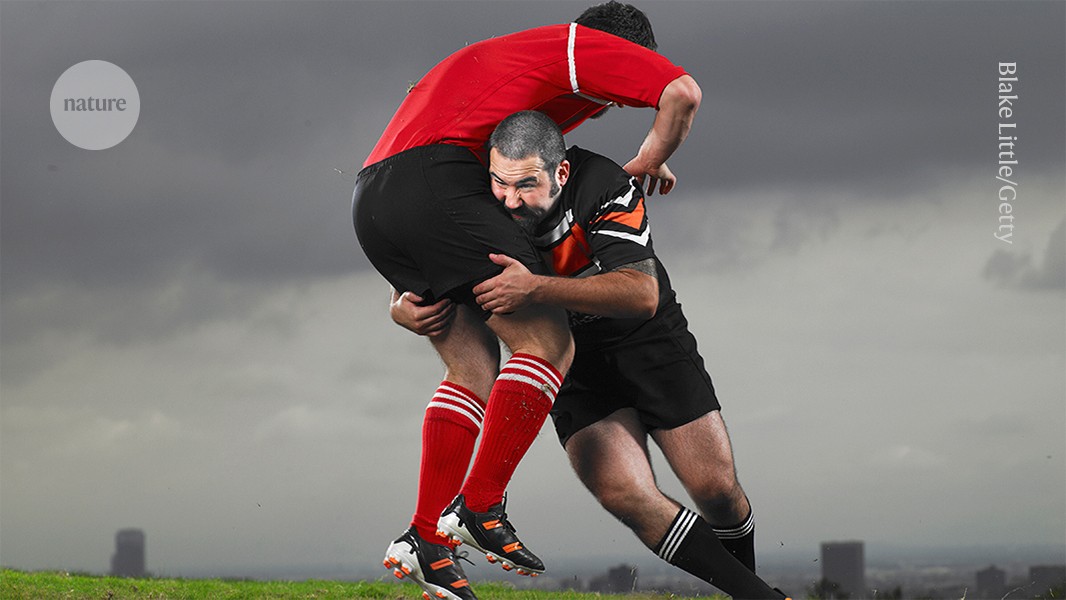
Repeated blows to the head over years of contact sports can lead to chronic brain damage.
Credit: Blake Little/Getty
For decades, scientists have struggled to understand exactly how years of taking hits to the head while playing sports can translate into severe memory loss and dementia later in life.
Now, a study 1 published today in Science Translational Medicine reveals that the protective shield known as the blood–brain barrier can be damaged and leaky decades after an athlete retires from sport.
This persistent leakiness seems to trigger a long-lasting immune response that is closely tied to cognitive decline, the study finds.
The work is a “very important study that finds the disruption of the blood–brain barrier many years after head trauma”, says Katerina Akassoglou, a neuroimmunologist at the Gladstone Institutes in San Francisco, California, who was not involved in the research.
Part of the difficulty in studying the long-term effects of head trauma is that some neurodegenerative conditions, such as chronic traumatic encephalopathy (CTE ), can be diagnosed only by examining neuronal tissue after death, says Matthew Campbell, a specialist in neurovascular genetics at Trinity College Dublin, who co-authored the paper.
Campbell and his colleagues wanted to see whether they could spot warning signs in living athletes by looking at the blood–brain barrier, a dense layer of cells lining the blood vessels that supply the brain .
This layer usually keeps harmful substances from leaking out of the blood and into brain tissue.
Concussion guidance for sport sidesteps link to brain disease — critics are baffled
To investigate, the researchers scanned the brains of 47 athletes who had retired from playing contact sports with a high risk of concussion and repetitive head impact, such as rugby and boxing.
They also examined a control group of non-athletes and athletes who had played non-contact sports.
The brain scans showed that the blood–brain barriers of the contact-sport athletes were significantly leakier than were those of people in the control group, even though the athletes had been retired for an average of 12 years at the time of the study.
People with the most extensive barrier damage performed worse than did those with less extensive leakiness on memory and cognitive tests, the researchers found.
“This was the first evidence in the living human brain that the blood–brain barrier is disrupted in individuals likely to have CTE,” Campbell says.
Enjoying our latest content?
Log in or create an account to continue
doi: https://doi.org/10.1038/d41586-026-00885-2
Greene, C.
et al.
Sci.
Transl.
Med.
18 , eadu6037 (2026).
Why sports concussions are worse for women
Head-injury risk higher for female soccer players, massive survey finds
Researchers seek definition of head-trauma
Years of hits to the head prime the brain for decline
Brain implants help people to recover after severe head injury
China approves brain chip to treat paralysis — a world first
Memory loss is fuelled by gut microbes in ageing mice
Scientists revive activity in frozen mouse brains for the first time
Stress can cause eczema to flare up – now we know why
Climbing fibres recruit disinhibition to enhance Purkinje cell calcium signals
Adaptive evolution of gene regulatory networks in mammalian neocortex
These brain cells clear proteins that contribute to Alzheimer’s
Immune cells from the gut drive development of Parkinson’s disease in the brain
‘Giant step forward’ for Huntington’s — the scientist behind the first gene therapy
Join HZAU's global faculty team to advance research with competitive benefits.
Huazhong Agricultural University (HZAU)
The Stomatology Hospital, School of Stomatology, Zhejiang University School of Medicine(ZJUSS)
IRB Barcelona invites applications for Group Leader positions in Chemical Biology (one) and Structural Biology (one).
Barcelona (Provincia), Cataluña (ES)
Fundació Institut de Recerca Biomèdica (IRB Barcelona)
The Paris Brain Institute invites expressions of interest from internationally recognized senior and mid-career researchers.
Full Professorship (W3) for ‚Clinical Epidemiology of Early Cancer Detection’ (f/m/d) We are looking for a highly distinguished physician scientist...
Heidelberg, Baden-Württemberg (DE)
Medizinische Fakultät Mannheim der Universität Heidelberg
Related Stories



Source: This article was originally published by Nature News
Read Full Original Article →
Comments (0)
No comments yet. Be the first to comment!
Leave a Comment