
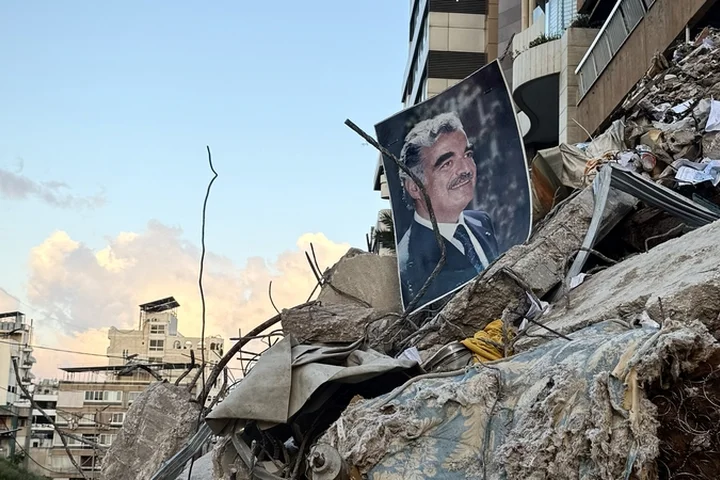
Amid the rubble, I encountered the remnants of ordinary life: a bottle of washing-up liquid; a packet of cucumber and vitamin E wax strips; baby talc; a tube of La Roche-Posay face wash - the same one I use myself.
The building was one of those struck in central Beirut, at lunchtime, on a Wednesday, without warning.
It was hit in one of 100 strikes launched by Israel in a 10-minute period, on what became the bloodiest day of the conflict so far in Lebanon.
And yet, for all the intimacy of those scattered traces, they were not what stayed with me most.
Perched on top of the debris, as if someone had placed it there deliberately, was a portrait of Rafik Hariri.
Hariri, who served five times as Lebanon's prime minister, rebuilt the city from the ruins of civil war.
He remains the defining figure of Lebanon's modern history.
And there he was, looking out from the wreckage, as Beirut fell apart around him again.
Some 20 years after his death, what happened to him feels anything but history.
On Valentine's Day in 2005, a bomb hidden in a van detonated as his convoy passed the St George Hotel in downtown Beirut.
Hariri and 21 others were killed instantly.
A UN tribunal later convicted Hezbollah operatives of the murder.
The man found guilty remains free to this day, under the group's protection.
No narrative is simple in Lebanon - least of all this one.
However, Hariri had become a threat to those who had long controlled the country.
He represented the prospect of a Lebanon that answered to itself - and not to foreign powers in Iran or Syria.
That made him dangerous and Lebanon has never forgotten what happens to politicians who challenge that order - a history written in blood.
That history feels very close right now.
Lebanon’s government has taken a series of decisions that Hezbollah regards as an existential challenge - banning its military activities, expelling Iran's ambassador, and agreeing to direct talks with Israel.
Hezbollah's response has been a series of warnings to the government that have made many deeply uneasy.
Mahmoud Qamati, the deputy head of Hezbollah's political council, warned last month that the group is "capable of turning the country and government upside down", calling the government "traitors", "complicit" and comparing them to the Vichy regime.
The prime minister himself felt compelled to warn publicly against the threat of civil war.
And yet Nawaf Salam's government has not backed down.
Because, for the first time in a long time, the forces behind that history are weaker than they have been in a generation.
Syria's Assad regime - for decades Iran's partner in controlling Lebanon - is gone.
Iran is fighting for its own survival.
And Hezbollah, for the first time in its history, is genuinely weakened - more than 1,000 of its fighters killed, its leadership decimated, its southern heartland occupied and destroyed.
Amid that shifting landscape, Lebanon last year elected a president, a prime minister, and formed a government that does not answer to Damascus or Tehran.
It was not installed by foreign powers.
It is not beholden to them.
"It represented a great opportunity for Lebanon," Paul Salem, senior fellow at the Middle East Institute, told me.
"The state was gradually rebuilding its control, and extending its authority gradually."
And then the war with Iran broke out.
On 2 March, Hezbollah fired rockets into northern Israel in solidarity with Iran.
Israel’s response since then has been overwhelming - a ground invasion, hundreds of airstrikes, more than 2,000 people killed, over a million displaced, and entire villages in the south reduced to rubble.
But the war, for all its devastation, also created an opening for the Lebanese government.
With the US and Iran negotiating a ceasefire that did not include Lebanon, the Lebanese government moved to negotiate its own, directly with Israel.
"At the end of the day, the state wants sovereignty," Mr Salem said.
"It wants all foreign forces out of the country, and it wants peaceful relations with all countries in its neighbourhood.
It has no enmity towards Israel as a state.
And, hence, direct negotiations are one way to try to move that goal forward."
I spoke to Mr Salem on Tuesday, as the Israeli and Lebanese ambassadors were preparing to sit down together in Washington for the first time in more than 40 years.
The talks between the two countries have an explicit goal - not just a ceasefire, but the normalisation of relations between Lebanon and Israel, as part of a long-term peace deal.
For Hezbollah, that is an existential threat - and not merely a rhetorical one.
The group was established in the early 1980s by Iran's Revolutionary Guards during Israel's occupation of Lebanon.
Its founding purpose was resistance to that occupation - and it is that purpose, more than anything else, that has given it legitimacy and popular support among Lebanon's Shia community, which makes up roughly a third of the population.
For four decades, it has defined itself by the conflict with Israel.
The occupation, the resistance, the liberation - these are not just political positions for Hezbollah.
They are the reason it exists.
If Lebanon and Israel were to normalise relations - if the conflict were declared over, the borders settled, the occupation ended by negotiation rather than by force - Hezbollah would be left without its central justification.
It would not just be politically weakened, but existentially hollowed out - an armed militia with no war to fight, and no enemy to name.
It is, in that sense, not difficult to understand why Hezbollah has reacted to this week's talks with such ferocity.
Or why its warnings to the Lebanese government have carried such an ominous tone.
"Iran and Hezbollah have killed former prime ministers, former officials in Lebanon, or serving officials, and they are raising these threats again," Mr Salem said.
He knows the country's history with particular intimacy.
His father, Elie Salem, served as Lebanon's foreign minister in the 1980s - the very years in which Hezbollah was being established by Iran’s Revolutionary Guards in the chaos of Israel's occupation.
"I take those threats seriously," Mr Salem told me.
"But I don't think Iran and Hezbollah can turn the tide in Lebanon like they could before.
"Iran and Hezbollah are still dangerous - and they can kill people.
But they cannot prevail."
Rafik Hariri too believed that Lebanon could be free - that the forces controlling it were weakening, that its moment would come.
Two decades after his death, his portrait is still turning up in the rubble for a reason.
Related Stories

Source: This article was originally published by RTÉ News
Read Full Original Article →
Comments (0)
No comments yet. Be the first to comment!
Leave a Comment