
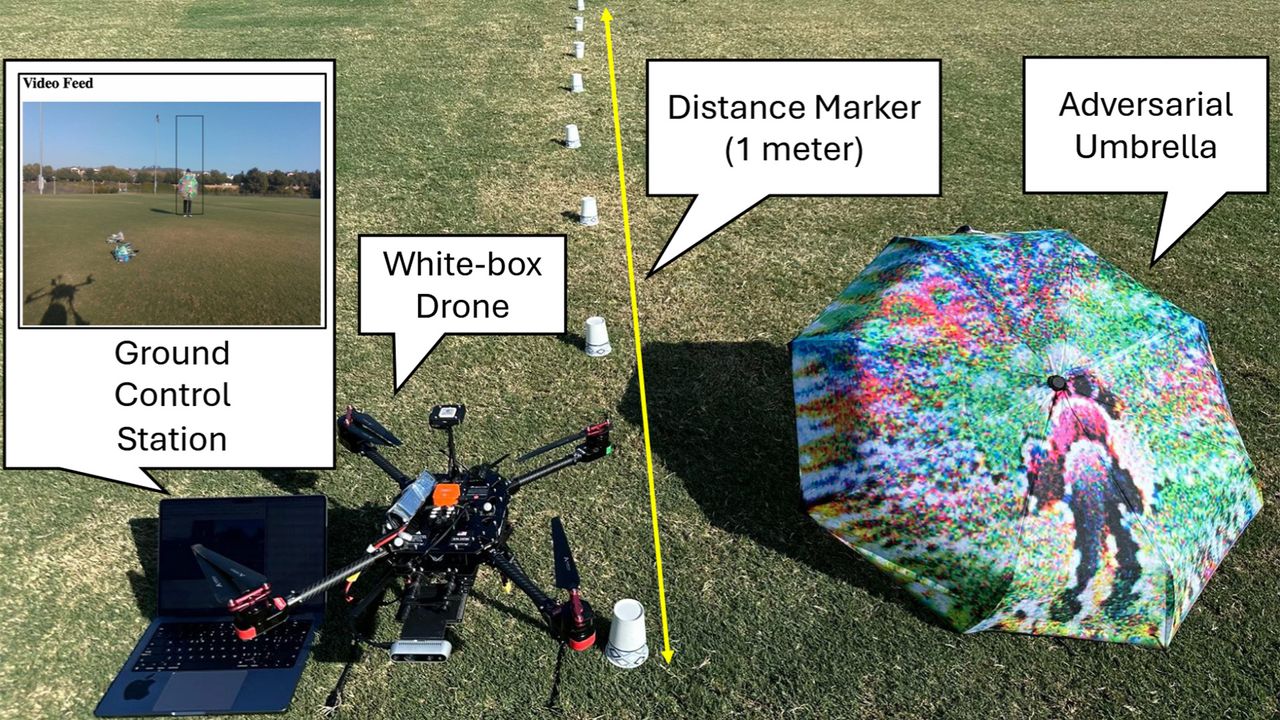
Adversarial umbrella design “exploits deficiencies in camera-based, autonomous target-tracking technology.” Umbrella also useful if it rains.
Get Tom's Hardware's best news and in-depth reviews, straight to your inbox.
Researchers at the University of California, Irvine (UC Irvine) have developed a drone capture and crash-inducing device.
The FlyTrap attack uses special patterns to exploit deficiencies in Autonomous Target Tracking (ATT), often referred to as Active Track, Motion Track, or Dynamic Track.
FlyTrap patterns can be easily carried around and deployed by anyone, as the researchers printed them on “adversarial umbrellas.” In essence, this seems like a deliciously lo-fi counter to a hi-tech hazard.
Umbrellas are also useful if it rains, or for portable shade.
The FlyTrap attack was demonstrated in the field, literally, by one of the researchers in the video above.
A specially formulated AI-generated pattern is displayed by opening an umbrella after a drone locks on to track the person in the field.
Specifically, the visual pattern performs a next-gen physical distance pulling (PDP) attack that works across multiple angles, even in motion, and in the real-world.
This demo works on three commercial drones that were tested, the DJI Mini 4 Pro, the DJI Neo and the HoverAir X1.
The umbrella-printed visual physically draws victim drones closer as its neural network tracking systems interpret the pattern to be the subject moving further away.
As the drone approaches the umbrella, the pattern causes the targeting bounding box to continue shrinking - so the drone moves to get closer.
Autonomous drones lured by the pattern can then easily be ensnared using a net gun, or further induced to crash to Earth.
The research shows that FlyTrap is significantly more effective than prior adversarial‑ML techniques like older PDP tech and Targeted Gradient Transfer (TGT).
“Autonomous target tracking represents both tremendous potential and significant risk,” said paper co-author Alfred Chen, UC Irvine assistant professor of computer science.
Chen reminds us that autonomous drones are used in areas like border patrol and public safety, but also by malicious actors.
Lead author, Shaoyuan Xie, a UC Irvine graduate student researcher in computer science added that “Our findings highlight urgent needs for security improvements in [autonomous target-tracking] systems before wider deployment in critical infrastructure."
It would be fascinating to see or hear about FlyTrap being used in the real-world.
However, both DJI and HoverAir have been responsibly notified about the neural processing vulnerabilities in their autonomous tracking systems.
Follow Tom's Hardware on Google News , or add us as a preferred source , to get our latest news, analysis, & reviews in your feeds.
Mark Tyson is a news editor at Tom's Hardware.
He enjoys covering the full breadth of PC tech; from business and semiconductor design to products approaching the edge of reason.
Notton said: That's hilarious, but also scary.
Did you see how that drone took a dive towards the umbrella?
Yeah, IDK how much I want a 1~5lbs drone taking a dive towards me, lol.
It'd be useful around prisons, my guess.
passivecool said: I would love to be able to see into the future if Humanity manages to figure out - on the scale of nations - that collaboration and compromise and rules of law and order are better for everyone than bashing each others brains in like Neanderthals, with painful GNP% priced, high-tech rocks.
bit_user said: We would ideally like all conflict to occur in peaceful and managed ways, which is essentially what capitalism tries to do.
chaos215bar2 said: just as easily as capitalism can foster cooperation, it can also enable precisely the kind of consolidation of resources that leads to war.
Related Stories

Source: This article was originally published by Toms Hardware
Read Full Original Article →
Comments (0)
No comments yet. Be the first to comment!
Leave a Comment