
David Adam is a science journalist based near London.
Search author on: PubMed Google Scholar
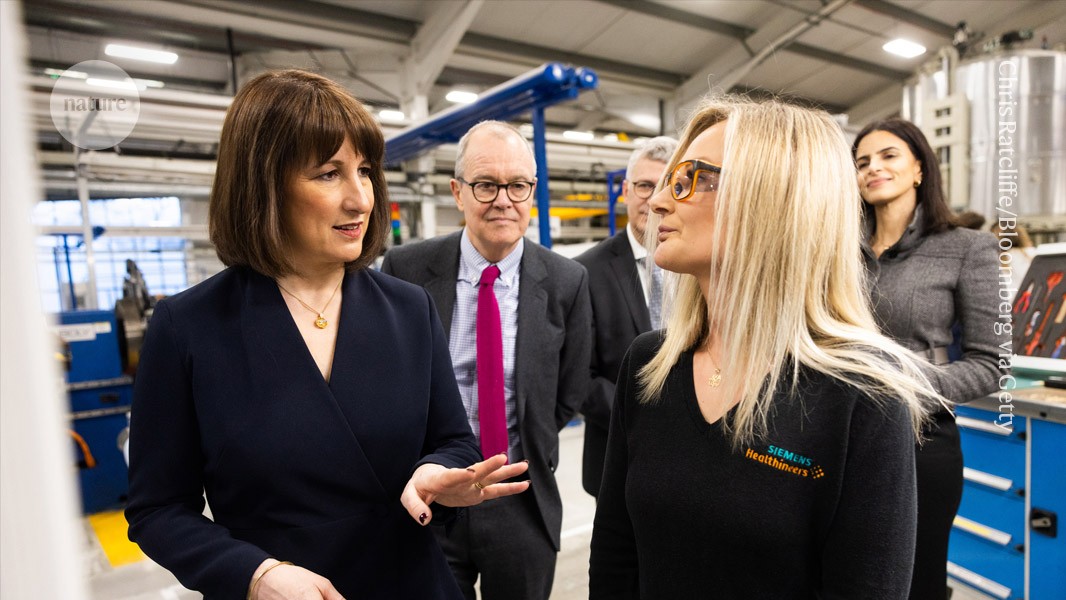
Rachel Reeves, UK chancellor of the exchequer (left), and Patrick Vallance, UK science minister (centre), speak to an employee during a visit to the Siemens Healthineers factory.
Credit: Chris Ratcliffe/Bloomberg via Getty
The changes — announced on 16 March as part of an ongoing national science and technology strategy — have been broadly welcomed by the research community.
And officials say that the money and increased strategic focus will help to push the United Kingdom to the forefront of both fields globally.
However, some point out that long-term commitments and more money will be needed if Britain is to push past its competitors.
Others lament that the funding is not so much a mark of heightened ambition as necessary merely to maintain aspects of the nation’s current scientific capabilities given the disruptive effects Brexit had on its science funding and access to joint European projects.
For example, the United Kingdom withdrew from ITER, a long-running international effort to build an experimental fusion reactor in France.
“You have to go back to Brexit to understand what’s going on now,” says Tony Roulstone, a nuclear-power researcher at the University of Cambridge, UK.
Officials say that the quantum investment will lay the foundations for the United Kingdom to become the first country to roll out the large-scale use of quantum computers and be the fastest to adopt artificial intelligence in the G7 group of nations.
Quantum computers: what are they good for?
The £2-billion quantum package aims to support research, infrastructure, skills and commercialization, including funding for hardware and software development, expanded facilities and support for start-ups and industry partnerships.
The government has also pledged to buy and use successful systems as they emerge — echoing the procurement mechanisms used by the United States to promote the development of satellite navigation systems and stealth aircraft.
But Britain faces stiff competition globally.
Large-scale quantum computing — systems that offer consistent, practical advantages across multiple sectors — is not yet possible .
The £2.5-billion fusion investment is similarly ambitious — although how it will compete on a global stage is also unclear.
The funds include plans to build a prototype fusion-energy plant called Spherical Tokamak for Energy Production (STEP) on the site of a former coal-fired power station in the centre of the United Kingdom.
They also include £45 million for building the nation’s first AI supercomputer dedicated to accelerating fusion-energy research.
Researchers say that STEP is a ‘moonshot’ project, a high-risk initiative that might not prove successful but could still spark scientific breakthroughs.
Its aim of producing significantly more power output than the total input — a key requirement for fusion energy — is extremely ambitious.
“It will build a lot of capacity in material science, in magnet engineering, all sorts of things,” says Richard Jones, an experimental physicist who retired last year from the University of Manchester, UK.
Enjoying our latest content?
Log in or create an account to continue
doi: https://doi.org/10.1038/d41586-026-00877-2
Is UK science in jeopardy?
Huge funding reforms spark chaos and anxiety
The UK’s $1-billion bet to create technologies that change the world
Nuclear-fusion breakthrough: this physicist helped to achieve the first-ever energy gain
Can UK science really spawn a $1-trillion company?
Can start-ups fast-track fusion energy?
Give UK science the overhaul it urgently needs
The UK’s post-Brexit EU science deal: a graphical guide
Pharmaceutical giants pull out of UK: why it matters for global science
Major Turing computing award goes to quantum science for first time
AI is programmed to hijack human empathy — we must resist that
‘RAMmageddon’ hits labs: AI-driven memory shortage is impacting science
Magnetic resonance control of spin-correlated radical pair dynamics in vivo
Nanophotonic waveguide chip-to-world beam scanning
EU leaders should not rush to revamp green-hydrogen rules
Why China and Europe should collaborate to ‘defossilize’ the world’s carbon
Join HZAU's global faculty team to advance research with competitive benefits.
Huazhong Agricultural University (HZAU)
The Stomatology Hospital, School of Stomatology, Zhejiang University School of Medicine(ZJUSS)
IRB Barcelona invites applications for Group Leader positions in Chemical Biology (one) and Structural Biology (one).
Barcelona (Provincia), Cataluña (ES)
Fundació Institut de Recerca Biomèdica (IRB Barcelona)
The Paris Brain Institute invites expressions of interest from internationally recognized senior and mid-career researchers.
Full Professorship (W3) for ‚Clinical Epidemiology of Early Cancer Detection’ (f/m/d) We are looking for a highly distinguished physician scientist...
Heidelberg, Baden-Württemberg (DE)
Medizinische Fakultät Mannheim der Universität Heidelberg
Related Stories



Source: This article was originally published by Nature News
Read Full Original Article →
Comments (0)
No comments yet. Be the first to comment!
Leave a Comment