
If you only own one pair of headphones, noise-canceling earbuds are the baseline.
Thanks to their pocketable designs and ability to suppress environmental sounds or invite them in with tiny exterior microphones, these buds can be your everything headphones , and I've worn them everywhere, from transatlantic flights and bustling cafés to lush forest hikes in the Pacific Northwest.
Nearly any pair of modern earbuds with active noise canceling (ANC) can give you a decent experience.
But if you want something that will last—and that you'll actually want to use—it's worth investing in a quality pair.
There's a staggering number of options, and my colleagues and I have tested nearly all of them.
These are the best of their trade, each one hand-picked for its specialized skill set.
Whether you're a die-hard Apple user, a budget buyer, or anything in between, there's a pick for you below.
For more choices, check out our Best Noise-Canceling Headphones (which includes non-earbuds), Best Cheap Headphones , and Best Workout Headphones guides.
What Is Noise Canceling and How Does It Work?
Active noise canceling (ANC) uses a mix of passive sound isolation (blocking your ears), exterior microphones, and software to suppress environmental sounds before they reach your eardrums.
The process, which has been refined since the late 1970s, involves sampling the sounds around you in real time (up to tens of thousands of times per second) and then neutralizing them.
To understand the process, we have to dig a little into physics.
Sound moves through the air as pressure waves that eventually hit your eardrums.
The frequency of a wave is the number of times it oscillates per second, and frequency determines pitch.
So we perceive a low-frequency wave, like from an airplane rumble, as a dull bass sound.
And a high-frequency wave, like from a siren or a yapping dog, we hear as a sharp treble sound.
What noise-canceling systems do is they perceive the frequency of a sound wave and instantly generate a polar opposite waveform: When one wave is at its peak, the other will be at its trough, and vice versa.
Adding those waves together, they zero each other out, as if there is no wave at all.
The difficulty is that there are often many sounds at once, and each contains a mix of different frequencies, so it’s hard to quell all the sounds in your environment.
But through a combination of faster processing, better microphones, and effective blocking of our ear canals, the latest earbuds and headphones are getting impressively close.
What Is Transparency Mode or Ambient Sound Mode?
Transparency mode (sometimes called ambient sound mode) aims for the opposite effect of noise canceling.
Instead of neutralizing or canceling sound around you, this feature filters environmental sounds into the speakers of your earbuds or headphones, blending it with your music or other audio source.
Cheaper versions often sound muffled or sharp, but buds like Apple's AirPods Pro have gotten so good at recreating sounds captured by their exterior microphones, it can almost feel like you're not wearing earbuds at all.
One major limitation of transparency mode is the small microphones used to capture the sound, which can easily be blocked or distorted by wind or other interference.
You may have tried to use transparency mode while riding your bike or ebike , only to find the wind pressure creates an unlistenable blast of sound.
This is where open earbuds can be a great alternative .
Instead of microphones, the best open earbuds simply keep your ear canals naturally open, while delivering satisfying sound from outside your ear canal.
I love open earbuds for all kinds of use cases, but for most situations, transparency mode from traditional noise-canceling earbuds will suffice.
Nearly all wireless earbuds, noise-canceling or otherwise, come with a charging case.
The simple reason?
The buds are very small, so they don't have space for the large batteries found in over-ear wireless headphones, which often offer 30 to 40 hours of playback time or more per charge so you can take them off the grid.
A charging case not only provides a safe place to keep your buds so they don't get lost or covered in lint, but it also allows for multiple recharges to extend the time you can step away from power sources and still keep your tunes rolling.
How We Test Noise-Canceling Earbuds
Here at WIRED, my colleagues and I test all headphones, including noise-canceling headphones , the way you use them.
We wear them over multiple weeks to test their comfort, battery life, and the convenience and accessibility of their onboard controls.
We listen to random tunes, podcasts, and videos, but also curated playlists full of music we've heard dozens of times.
For me, that means samples from the Beatles, Radiohead, Fleetwood Mac, Beck, Nickel Creek, Snarky Puppy, Frank Sinatra, Depeche Mode, Anderson .Paak, and many more.
Each of us has our own list, but the common factor is an array of genres to confirm how they work for all types of listeners.
Whenever possible we take time to test lossless or high-resolution sound codecs with supported devices, and I use Spotify Lossless as my main streaming source.
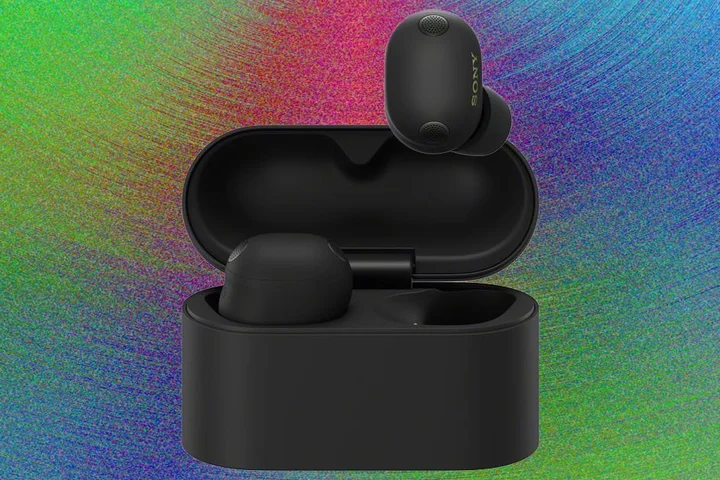
Sony's WF-1000XM6 simply sound amazing.
With excellent tuning from some of the world's top mastering engineers and an extremely customizable app, they really allow you to take great-sounding stereo with you anywhere.
Memory foam ear tips provide excellent passive isolation from the world around you, but its the active modes—ANC and transparency—that distinguish this pair.
The large mics on the outside of the rounded buds work marvelously to pipe sound in or keep it out, providing one of the most realistic “hear-through” experiences I've had with earbuds.
On noise canceling, these directly rival (and sometimes beat) the Bose earbuds below, but they're just a bit less easy to use, due to the foam ear tips.
My general rule: If you care about sound quality first, go with Sony; if you care about noise canceling first, go with Bose.
—Parker Hall
In all my travels, I've yet to find a pair of noise-canceling earbuds that take down Bose's best.
The latest pair, the QuietComfort Ultra 2 , are again the most powerful noise cancelers you can buy.
They offer some minor upgrades over the previous model, including improved immersive audio, more customization options, and a slight noise-cancelling boost to envelop you in near silence, even in raucous environments.
The case (finally) adds wireless charging, but the design remains virtually identical.
That keeps the Ultra 2 on the large side for modern buds, including their 7-gram weight, but their ergonomic shape provides comfy listening for longer sessions.
One notable drawback is their battery life of just six hours per charge, which sits below rival Sony's eight.
Otherwise, this pair is properly loaded with modern features, from personalized sound tuning with each insertion to Aware Mode that brings in environmental sounds naturally, while softening spikes like a slamming door.
If you want the ultimate noise cancellation, Bose's latest Ultra are the buds to beat.
If you're looking for affordable noise-canceling buds with exceptional sound, look no further than the Soundpeats Capsule3 Pro+ .
These buds may have a mouthful of a name, but they pair solid noise-canceling performance with a dual-speaker sound system in each bud that includes a regular speaker driver and a next-gen solid-state speaker called an “xMEMS” driver for fantastic clarity and an almost live quality to instruments.
Like many budget buds, the Capsule3 Pro+ have an Apple-esque design, but with a glitzier aesthetic than Apple's Stormtrooper white colorway.
They're light and comfortable, and offer advanced features like high-quality wireless transmission over Bluetooth LDAC with supported devices (iPhones don't support LDAC) and customizable sound via the Soundpeats app.
Battery life is average, and the touch controls aren't always as responsive as I'd like.
At this price, such concessions are a given, and their exceptional sound quality makes up for it, especially at $100 or less per pair.
Apple's AirPods Pro are the Robin to your iPhone's Batman.
Or maybe more like the Batmobile?
Superhero metaphors aside, you won't find a more seamless connection between phone and buds, making them my go-to choice for Apple users.
While the changes in each iteration often seem minor, these buds keep getting better.
The AirPods Pro 2 offered the most natural transparency mode I've ever heard for staying aware of environmental sounds, and their noise canceling and call quality are still among the best I've tested.
WIRED editor Parker Hall praised the current-gen AirPods Pro 3 in his review for thoughtful upgrades like improved noise canceling, new fitness features like a built-in heart rate monitor, and even better noise canceling and transparency features.
The one issue he raised is the bassier sound signature, which isn't adjustable due to Apple's EQ phobia.
Lack of customization notwithstanding, the AirPods Pro have few flaws.
With effortless comfort, intuitive controls, and numerous convenience features for Apple gear, from seamless device swapping to pinpoint location tracking with Find My, this is a premium package fit for anyone in the Apple fold.
Why should the near-magical convenience of the AirPods Pro be reserved for Apple phones only?
That's the philosophy behind Samsung's Galaxy Buds, and the Galaxy Buds4 Pro embody it better than any pair I've tried.
Squint and you'll see Apple's best buds, from the size and shape to the pinch/slide controls, with only minor visual differences like a metallic strip on the stem.
The Buds4 Pro's skills are also strikingly familiar, including efficient GPS tracking, seamlessly swapping between Samsung devices, and control over it all via your Galaxy phone's settings.
Samsung's pair stands out in some key ways, like their stylishly compact case, availability in other colors, and a dual-speaker audio system that provides rich bass and assertive treble for a bold but ultimately satisfying experience.
I wouldn't buy the Galaxy Buds without a corresponding phone , but Samsung fans after an AirPods Pro vibe will find a near-perfect match.
The Powerbeats Pro were in major need of an update after years on the market, and last year's Powerbeats Pro 2 delivered it with a full-scale rewrite.
The new pair is slimmer, lighter, and adds modern features like a heart rate sensor, clear transparency mode, and powerful noise canceling, while keeping favorites like massive battery life.
The nimbler ear hooks once again ensure the buds stay on tight in nearly any scenario, and I love the push-button controls, even if they're a little too sensitive while putting the buds in.
Like other Beats buds following Apple's buyout of the brand, the Pro 2 straddle the mobile aisle.
You'll find Apple-friendly things like Find My tracking and seamless swapping between iOS devices, while a dedicated Android app allows for basic customization, Locate My Beats, and one-touch pairing, though they lack multipoint to pair with multiple devices at once.
Sound quality is brash but refined, with accentuated bass and treble that I came to really enjoy.
The buds offer only basic water resistance, but it's enough for a good sweat, adding up to a fine match for your rigorous workouts.
Samsung GS25+ Free With T-Mobile for Business SuperMobile
Squarespace Promo Code: 20% Off Annual Acuity Subscriptions
LG Discount Code: 10% Off Any Purchase
10% Off Dell Coupon Code for New Customers
30% Samsung Coupon - Offer Program 2026
10% Off Canon Promo Code + Up to 30% Off
Related Stories



Source: This article was originally published by Wired
Read Full Original Article →
Comments (0)
No comments yet. Be the first to comment!
Leave a Comment