
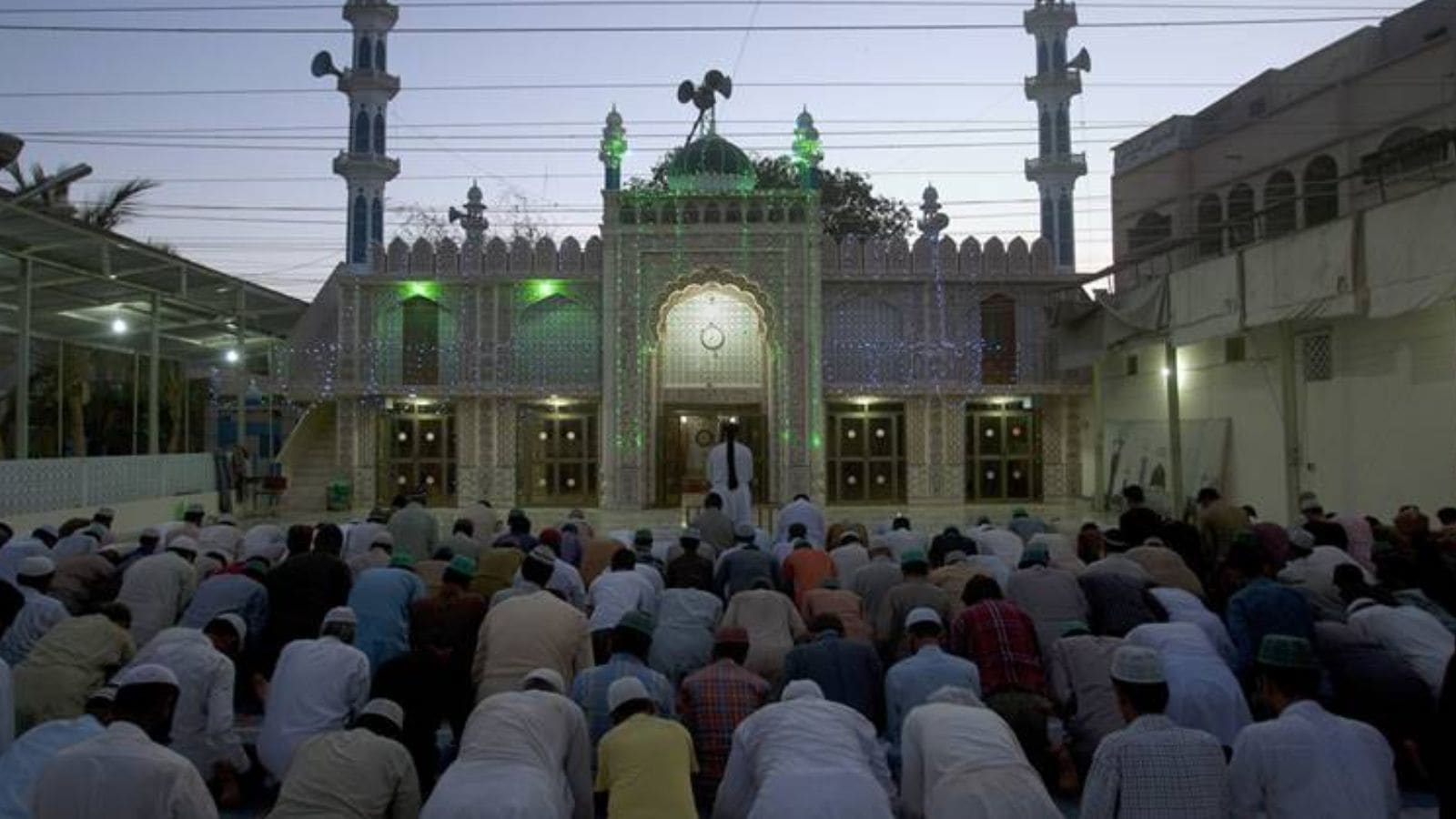
Taking strong note of Sambhal district authorities placing restrictions on the number of worshippers at a mosque, the Allahabad High Court asked the Sambhal SP and the District Magistrate to resign from their posts or opt for a transfer out of the district ifthey do not find themselves competent enoughto enforce the rule of law.
A division bench of Justices Atul Sreedharan and Siddharth Nandan observed in its order, passed on February 27, “It is the duty of the State to ensure that every community is able to offer worship peacefully in the designated place of worship… and if it is a private property, as already held by the Court earlier,to perform worship without any permissionfrom the State.
This Court has already settled that it is only where prayers or religious functions have to be held on public land or spill over to public property that the involvement of the State is essential and permission must be sought.”
In his submission, the counsel for the State told the court that on account of the perceived law and order situation, such an order restricting the number of worshipers has been passed.
Taking a tough stance to the justification, the bench stated, “We outrightly reject the contention put forth by the learned counsel for the State.
It is the duty of the State to ensure that the rule of law prevails under every circumstance.”
The bench further observed, “… If local authorities i.e.
the Superintendent of Police and Collector feel that a law and order situation could arise because of which they want to limit the number of worshipers within the premises, they should either resign from their post or seek transfer outside Sambhal if they feel they are not competent enough to enforce the rule of law.”
The petition was filed by Munazir Khan, praying for the court’s intervention, and stating that he is prevented from conducting prayers during Ramzan at a land where a mosque exists.
The petitioner, however, did not produce any photographs of the said mosque or a place of worship within which namaz is supposed to be offered.
He sought time to submit the photographs.
Objecting to the petitioner’s claim, the counsel for the State disputed the ownership of the land where the mosque reportedly exists.
The counsel stated that the land is reflected in the names of Mohan Singh and Bhooraj Singh, sons of Sukhi Singh in the revenue records.
The police and the district administration granted permission only to the extent of 20 worshipers, who may offer namaz, whereas the petitioner requested that a larger number of persons may come to offer namaz within the premises as it is the month of Ramzan.
Hearing submissions from both sides, the bench listed the matter for March 16, stating, “Under the circumstances, State has sought time to seek instructions in this case and the petitioner wants to file a supplementary affidavit bringing on record photographs and revenue records to show where namaz is to be offered.”
Bhupendra Pandey is the Resident Editor of the Lucknow edition of The Indian Express.
With decades of experience in the heart of Uttar Pradesh’s journalistic landscape, he oversees the bureau’s coverage of India’s most politically significant state.
His expertise lies in navigating the complex intersections of state governance, legislative policy, and grassroots social movements.
From tracking high-stakes assembly elections to analyzing administrative shifts in the Hindi heartland, Bhupendra’s reportage provides a definitive lens on the region's evolution.
Authoritativeness He leads a team of seasoned reporters and investigators, ensuring that The Indian Express’ signature "Journalism of Courage" is reflected in every regional story.
His leadership is central to the Lucknow bureau’s reputation for breaking stories that hold the powerful to account, making him a trusted figure for policy analysts, political scholars, and the general public seeking to understand the nuances of UP’s complex landscape.
Trustworthiness & Accountability Under his stewardship, the Lucknow edition adheres to the strictest standards of factual verification and non-partisan reporting.
He serves as a bridge between the local populace and the national discourse, ensuring that regional issues are elevated with accuracy and context.
By prioritizing primary-source reporting and on-the-ground verification, he upholds the trust that readers have placed in the Express brand for nearly a century....
Read More
Related Stories



Source: This article was originally published by The Indian Express
Read Full Original Article →
Comments (0)
No comments yet. Be the first to comment!
Leave a Comment