
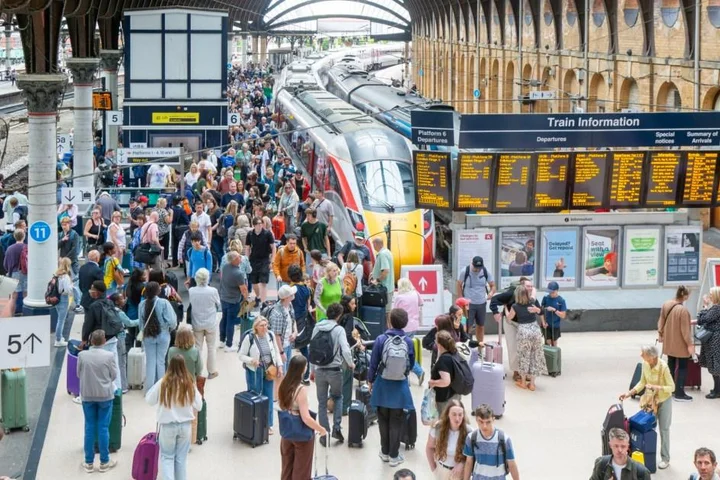
Sexually harassing people in public becomes a specific offence in the UK from today, as a change in the law officially takes effect.
It means behaviour such as following, catcalling and intimidating women or girls could result in up to two years in prison.
The change comes after a long wait for campaigners since the Protection from Sex-based Harassment in Public Act first passed under the Conservatives in September 2023.
Keir Starmer’s government finally set April 1 as the date for its enforcement in last year’s Violence Against Women and Girls strategy, following conversations between police, activists and politicians about how the legislation should be enforced.
Minister for Violence Against Women and Girls Jess Phillips told Metro the change would mean victims can call the police if they’re made to feel uncomfortable, and be assured that something can be done.
‘I want this shame to change sides.
I want them to change their behaviour.
‘I’m not the judge and jury in these circumstances.
I just write the law, and it would have to meet the evidential threshold.
But if anyone thinks that it’s OK to do that, then there’s something wrong with them.’
Commander Clair Kelland, the Public Protection Lead at the Metropolitan Police, said such incidents were previously dealt with through ‘more generic law’ like the Public Order Act.
She said: ‘We’re really pleased and excited about this legislation because it gives us an opportunity to criminalise behaviour that we know women and girls have put up with and tolerated for far too long.
‘It puts the focus on the perpetrator and not on the victims or the person that is exposed to that behaviour – things like following, catcalling, misogynistic remarks that make women and girls feel uncomfortable and feel unsafe.
This Is Not Right
On November 25, 2024 Metro launched This Is Not Right, a campaign to address the relentless epidemic of violence against women.
With the help of our partners at Women's Aid, This Is Not Right aims to shine a light on the sheer scale of this national emergency.
Read more:
- Introducing This Is Not Right: Metro's year-long violence against women campaign
- Remembering the women killed by men in 2024
‘We now have a really strong legislative framework to criminalise that behaviour, arrest perpetrators, and stop behaviour from escalating.’
Commander Kelland emphasised that reports would be tackled on a ‘case-by-case basis’, adding the legislation would help police ‘build intelligence around individual perpetrators and hotspots’ to help future investigations.
What will change as a result of the Public Sexual Harassment Act?
The UK already has a number of laws that can be applied to sexual harassment in a public place.
For example, there are specific offences for exposure, upskirting and ‘cyberflashing’.
Section 4A of the Public Order Act 1986 involves the intention to cause harassment, alarm or distress by words or behaviour.
In January this year, a car passenger was given a £100 fine for shouting ‘Go on ladies, get running’ at a group of female joggers.
Police handed him the fixed penalty notice for breaching a Public Space Protection Order, with a warning the behaviour constituted sexual harassment.
The new legislation forms section 4B of the Public Order Act, which introduces an aggravated offence if the harassment, alarm or distress was done because of someone’s sex or presumed sex.
That means someone who commits the offence can be given an increased sentence of up to two years in prison.
The law change comes after a number of other European countries made similar moves.
Belgium was the first, with the introduction of the Sexism Law in 2014, before France brought in legislation nicknamed the Loi Schiappa (Shiappa Law) in 2018.
The French law, named for then-minister of gender equality Marlène Schiappa, has resulted in thousands of offences being recorded by police in the years since.
In contrast, the less well-known Belgian law has had a less significant impact with police hesitant to make official reports, according to the country’s Institute for Equality of Women and Men.
The Netherlands also brought in a new law targeting public sexual harassment in 2024.
Campaign group Our Streets Now were behind the push to create the specific offence in the UK.
Director of Advocacy Georgia Theodoulou said the organisation was ‘extremely proud to have affected legal change’.
However, she added: ‘We know that while this sends a message that public sexual harassment will no longer be normalised for so many women and girls, the law alone will not change the problematic culture we still live in.
‘We will carry this success forward in our preventative education work with professionals and young people in the UK.’
Speaking at Victoria railway station in London, Jess Phillips said women should be aware there are ‘routes to report’ things that have happened to them – especially on public transport.
She said: ‘Local systems are in place to make sure that you can.
There are reporting mechanisms.
‘But also, this is potentially a crime, what has happened to you, and somebody could be held accountable, and I want people to know that.’
Get in touch with our news team by emailing us at webnews@metro.co.uk.
For more stories like this, check our news page.
Related Stories


Source: This article was originally published by Metro UK
Read Full Original Article →
Comments (0)
No comments yet. Be the first to comment!
Leave a Comment