
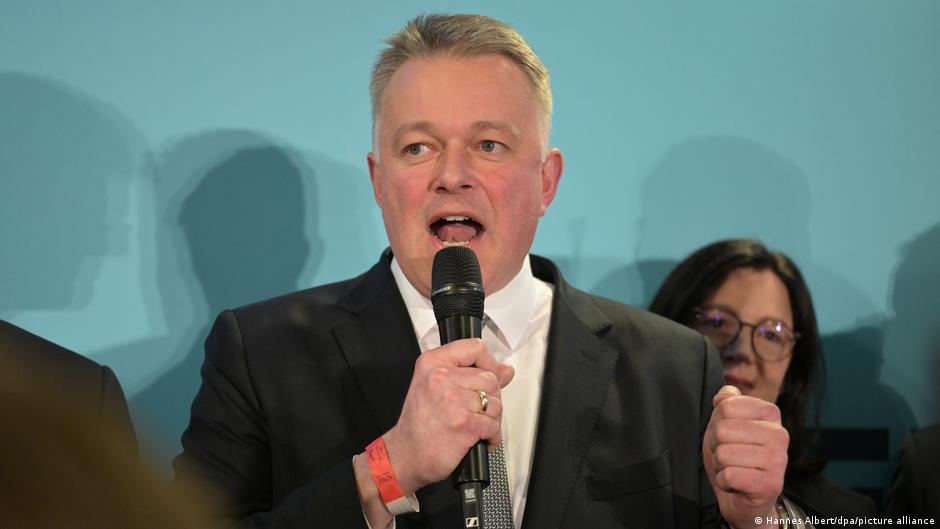
Projections show that Friedrich Merz's conservative Christian Democratic Union (CDU) has won the elections in Rhineland-Palatinate in western Germany.
DW has more.
Keep checking back for the latest updates from across Germany on Saturday, March 21, and Sunday, March 22:
Projected Rhineland-Palatinate state election result
Greens poised to win mayoral election in Munich, SPD concedes defeat
Green candidate Dominik Krause is leading in Sunday's runoff election for Munich mayor.
With 495 of the 926 precincts reporting, Krause had won 59.1% of the vote, compared to SPD Mayor Dieter Reiter's 40.9%.
This outcome is yet another setback for the center-left Social Democrats (SPD) on a disheartening night, as the party also lost the state election in Rhineland-Palatinate.
Reiter was considered the overwhelming favorite to retain his position in Munich until it was revealed that he had been receiving money from Bayern Munich for a position on its administrative advisory board without the necessary approval from the city council.
After intense public pressure, Reiter admitted to making mistakes, stepped down from the post, and resigned from the supervisory board — a position he had only recently taken up.
Reiter conceded defeat and congratulated Krause.
"This is the last day of my political career," he said.
Takeaways from Rhineland-Palatinate state election
Lesson one : The momentum is with Merz.
The conservative CDU's win in the state election in western Rhineland-Palatinate is a huge relief for German Chancellor Friedrich Merz.
He had raised expectations that his CDU party could win two state elections this month.
This failed to materialize — the conservatives came short in Baden-Württemberg two weeks ago.
But tonight they’ve pulled off a win.
It’s not a landslide win but it will give Merz a boost: He’ll need it as he heads into an intense few months of wrangling over reforms to the labor market and social security.
Lesson two : the Social Democrats need a time out.
After 35 years in power in Rhineland-Palatinate, it is not a huge surprise that voters have opted for change.
Given the dire results the party has suffered elsewhere in Germany, the result, in the high 20s, is still something to hold on to.
The problem for the SPD is that they will likely be junior members of the next government.
That will make it hard for them to truly sharpen their profile .
Lesson three : the AfD is a national force.
The far-right AfD landed their best result ever in a west German state election.
There have long been questions marks about whether the far-right party can replicate their success in eastern Germany in the west.
Today’s result is the second election this month where they have doubled their results.
It confirms their promise of radical change is resonating with Germans across the board.
So we can put that question to bed.
Lesson four : the liberals are on life support.
After the business-friendly liberal FDP party was kicked out of the federal Bundestag in elections one year ago, party bosses hoped a strong showing in these elections could spark a comeback .
Instead, they have lost support.
And worse, they’ve fallen well under the crucial 5% hurdle needed to enter parliament.
AFD vows to do 'a good job in the opposition'
Alice Weidel , the federal leader of the far-right Alternative for Germany (AfD) party , has announced that her party will do "great work in the opposition" following its expected record-breaking result in the Rhineland-Palatinate state election.
Weidel told ARD that the AfD is now the largest opposition party not only in the federal Bundestag but also in Baden-Württemberg and Rhineland-Palatinate.
She pointed out that, based on current figures, a coalition between the CDU and the AfD would be mathematically possible in Rhineland-Palatinate.
However, the parties had decided against it.
"Accordingly, we will continue to do a good job in the opposition," Weidel said.
Meanwhile, Tino Chrupalla, the party's co-leader, said that with this result, the AfD can form a strong opposition and "call out" the CDU-SPD coalition — or whoever ends up governing — on their mistakes.
Greens' leaders speak of 'good result' in Rhineland-Palatinate election
Green Party leaders expressed satisfaction with the result of the state election in Rhineland-Palatinate.
"It’s a good result for us in Rhineland-Palatinate given the challenging situation; the race was between the CDU and the SPD at the top," Franziska Brantner said.
While the Greens would have liked to continue to have a hand in governing the state, "we are now entering the opposition in a position of strength," Brantner said.
The Greens had been a junior coalition partner in the center-left SPD's state government alongside the pro-business Free Democrats (FDP), in what is dubbed a "traffic light coalition."
The party's co-leader Felix Banaszak also described the outcome of the election as "a really good result" for the environmentalist party.
CDU satisfied with election results in Rhineland-Palatinate
CDU Secretary-General Carsten Linnemann described the outcome of the state election in Rhineland-Palatinate as a "strong result with a strong candidate."
"As the lead candidate, Gordon Schnieder managed to focus on the important issues, including education and the economy." he said.
Linnemann also interpreted the state election results in Rhineland-Palatinate as a sign of support for the political center.
"If the result stays this way, we’ll have more than 50% support for the CDU and SPD — that’s also a strong result for the centrist parties," Linnemann said.
Forecast: CDU wins state elections in Rhineland-Palatinate
A forecast on Germany's ARD public broadcaster showed that conservative Christian Democrats (CDU) held a lead over their center-left Social Democrat (SPD) coalition partners in an election in the western state of Rhineland-Palatinate .
The first forecast after the polls closed showed the CDU with 30.5% of the vote, ahead of the SPD with 27%.
According to the forecast, the far-right Alternative for Germany (AfD) party came in third with 20% of the vote, ahead of the environmentalist Greens with 7.5-8.5%.
Meanwhile, the Free Democratic Party (FDP) , with 2.0-2.1%, and the Free Voters, with 3.5-4.0%, will lose their seats in the Mainz state parliament.
The socialist Left Party was forecast to receive 4.5%, which is below the 5% needed to enter the regional parliament.
Depending on the final outcome, the CDU and SPD could form a state-level coalition similar to the one in Berlin.
CDU candidate Gordon Schnieder is poised to replace the current SPD premier, Alexander Schweitzer.
Thousands protest digital sexual violence in Berlin
Under the motto "Against Sexualized Digital Violence — Solidarity with All Victims," several thousand people participated in a demonstration in Berlin .
In the afternoon, they gathered at the Brandenburg Gate on Pariser Platz, which was completely packed.
The participants held signs that read: "Human rights on the internet too" and "Shame must switch sides."
The police reported 6,700 participants, while the organizers estimated 13,000.
According to the organizers, the rally was held in solidarity with TV host and actress Collien Fernandes, who made serious allegations against her ex-partner, actor Christian Ulmen.
The allegations, first reported by the German newsmagazine Der Spiegel , concerned the distribution of fake pornographic recordings.
Ulmen’s lawyer, Christian Schertz, spoke of the dissemination of "untrue facts" and "unacceptable reporting based on suspicion" and announced legal action against Der Spiegel .
Leipzig Book Fair sets record for attendance
For the first time in its history, Leipzig Book Fair attracted more than 300,000 visitors.
On Sunday, the last day of the event, the organizers announced that around 313,000 guests came to the book fair, reading festival, and Manga Comic Con.
This surpassed last year's record by 17,000 visitors.
Over the course of four days, 2,044 exhibitors from 54 countries presented their products and services in the eastern German city .
The record comes amid uncertain times for the German book trade.
Last year, the industry suffered a 2.9% sales decline after a long period of stability.
Merz says Germany and US to keep 'close contact' after Trump call
German Chancellor Friedrich Merz on Sunday announced on X that he had, "spoken with US President Donald Trump about the situation in Iran, Israel and Ukraine."
The statement went on to say that both sides had agreed to "remain in close contact."
It comes after reports that the US had not consulted Germany when it decided to launch its war against Iran,
Berlin and some of the US' other NATO allies in Europe fear the US war with Iran will take focus off of Ukraine, which has been fending off a Russian invasion since February 2022 .
Trump has said NATO partners in Europe should defend Ukraine, not the US.
But now he is also haranguing those same partners into joining his war in Iran.
The US' war against Iran may have strengthened Vladimir Putin's hand by driving up oil prices, which also led Washington to drop some sanctions against Moscow.
How the Iran war is hurting Ukraine's chances at peace
To view this video please enable JavaScript, and consider upgrading to a web browser that supports HTML5 video
Click here for more developments related to the US and Israel's war with Iran.
More than 150 fans arrested after post-match brawl in Dortmund
The violence led to a large police deployments, with 152 arrests made, most of them fans of the Hamburg team, police said.
According to media reports, BVB fans attacked buses carrying those of Hamburg, while followers of both sides, some masked, clashed on the open road.
Police said personal details of those detained had been recorded and legal proceedings begun.
They were subsequently released.
There have been no reports of injuries so far.
Preliminary turnout of 40% in Rhineland-Palatinate elections
Some 40% of eligible voters had cast their ballot in Sunday's state election in Rhineland-Palatinate by 10 a.m.
local time (0900 GMT), most of them by post, election authorities said.
"Some 34% had applied for a postal vote [and] another 6% cast their ballots in the first two hours after polling stations opened today," the election head said.
He said it was not possible to directly compare the turnout with the last elections in 2021.
"Back then, 44% of eligible voters had already handed in a postal vote because of the coronavirus pandemic, plus a small, single-digit proportion of in-person voters in the first two hours," he said.
In 2021, overall turnout was 64.3%.
Some 2.95 million people are eligible to vote in the election.
Polling stations, which opened at 8 a.m., are set to close at 6 p.m.
IN PICTURES: Rhineland-Palatinate elections
The western state of Rhineland-Palatinate is currently governed by a coalition of center-left Social Democrats (SPD) with the neoliberal Free Democrats (FDP) and the environmentalist Greens.
But the Christian Democrats (CDU) with their candidate Gordon Schnieder have put up a strong campaign.
A so-called grand coalition of CDU and SPD seems likely, with the FDP below the 5% hurdle in pre-election surveys.
The Greens have also lost voter support, polls show.
Some 2.9 million people are eligible to vote from an overall population of around 4.2 million.
Alexander Schweitzer of the SPD is the current premier of the state and cast his ballot in Bad Bergzabern.
Polling stations close at 6 p.m.
local time (1700 GMT).
In the last elections in 2021, turnout was 64.3%
Germany and Japan look to boost military cooperation
German Defense Minister Boris Pistorius is in Japan on the second day of a visit designed to bolster German-Japanese military cooperation in the face of growing geopolitical security challenges.
Pistorius and his Japanese counterpart Shinjiro Koizumi met on Sunday at the Yokosuka naval base near the capital, Tokyo, where they said the two nation's collaboration should include an expansion of armaments cooperation and consultations on adequate countermeasures in the event of a crisis.
Pistorius said that Germany and Japan must "move even closer together and make it clear what we stand for and how we can guarantee this."
Koizumi said cooperation was becoming ever more necessary in a rapidly changing world.
"In view of this changed security situation, it is hardly possible to react alone as a single country," he said.
"The importance of close cooperation between like-minded countries such as Japan and Germany is greater today than ever before." PIstorius' delegation also includes the heads of major German defense companies.
Germany placed Japan on an equal footing with NATO partners for defense exports in 2010.
This simplified procedures but has so far not led to any great changes.
Since 2021, the two countries have also had a framework in place to exchange classified data on weapons systems.
Pistorius' trip to Asia, whose stated aim is to boost military and defense cooperation with strategic partners, will also take him to Singapore and then on to Australia.
Dobrindt wants 'civil protection' to be taught at schools
Interior Minister Alexander Dobrindt wants school pupils in Germany to learn about how to cope with various crisis situations, such as blackouts, floods, terror attacks or war.
The conservative politician told the Bild am Sonntag newspaper that Germany had to be better prepared for such events and that if pupils were to learn about them, the information would benefit those around them as well.
"Our pupils will thus become clever experts on crisis management and convey their knowledge directly to their families," he said.
Dobrindt, who belongs to the Christian Social Union (CSU) , the Bavaria-only sister party to Chancellor Friedrich Merz 's Christian Democrats (CDU) , said he intended to present the plan at the next conference of interior ministers in June.
Under the plan, pupils would receive a double lesson on the subject twice a year.
Germany's unusable bunkers reveals issues in emergency prep
Related Stories



Source: This article was originally published by Deutsche Welle (DW)
Read Full Original Article →
Comments (0)
No comments yet. Be the first to comment!
Leave a Comment