
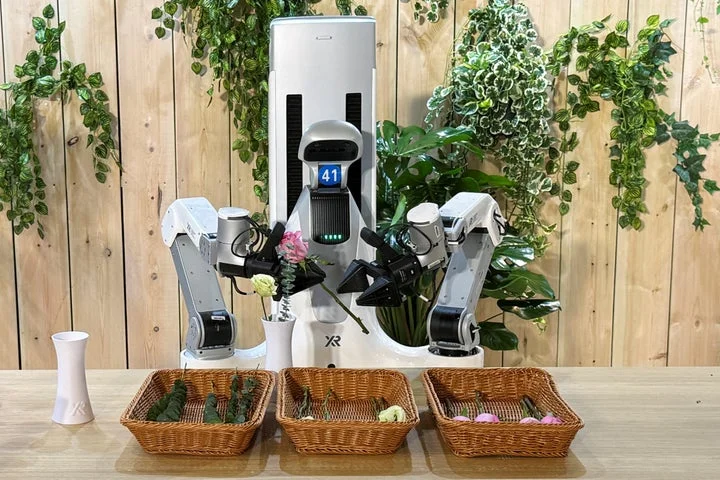
Chinese companies such as X Square Robot are trying to prove not what humanoids can do on stage but what value they can bring in the messy, unpredictable environments of everyday life
Humanoid robots offered a glimpse into their potential for tackling intricate household chores on Tuesday, as a Beijing startup demonstrated machines meticulously picking up litter and sorting flower bouquets.
The event, hosted by X Square Robot, presented a modest spectacle compared to the industry's usual showcases of robots that can sprint, flip, and dance.
Yet, it underscored a significant shift: Chinese companies like X Square Robot are now focused on proving the practical value humanoids can bring to the messy, unpredictable environments of everyday life, rather than just their stage capabilities.
"The hardware is largely there," said Wang Qian, chief executive of startup X Square Robot, at the event.
"But the brain hasn't caught up."
That gap is becoming increasingly apparent as companies shift from pre-programmed demonstrations to real-world deployment.
Chinese humanoid robots can complete half-marathons faster than elite athletes, but tasks that seem simple to the average human — tidying a cluttered room, loading a dishwasher, or folding clothes — remain stubbornly hard for these machines.
"Why don't marathon robots face this challenge?
Because what they mainly contend with is a constant gravitational field," said CEO Wang.
"But when we manipulate things with our hands, if we are off by 0.1 millimetres, the whole task may fail."
Repetitive actions such as running only require a robot to be trained on a relatively simple dataset.
Navigating a household, where no task is ever exactly the same, requires a much more sophisticated artificial intelligence "brain" that can allow a machine to perceive gravity and light like human beings.
X Square Robot, based in the southern Chinese tech hub of Shenzhen, says it has developed such an AI model, Wall-B, that was trained on data collected from more than 100 households, arguing that exposure to "noisy" conditions, from pets to clutter, is critical to improving performance.
While consumer feedback has been mainly that the machine is slow and clumsy, CEO Wang argues that only by entering real households can the robots improve their ability to perform simple tasks.
"Sometimes it may put slippers in the kitchen, or stop halfway through wiping a table to 'think'," Wang said, adding that whenever the robot malfunctions or is unable to complete a task, a company employee will intervene remotely.
Wang pointed out that once the technology matures and robots become reliable household helpers, the potential market size would be enormous.
"Household labour accounts for roughly 20% of GDP, so in theory this is a 20%-of-GDP market," he said.
Founded less than three years ago, X Square Robot has raised billions of yuan over several fundraising rounds, including from Chinese tech giants investing heavily in AI, such as Xiaomi and Alibaba.
(
Join thought-provoking conversations, follow other Independent readers and see their replies
Related Stories



Source: This article was originally published by The Independent
Read Full Original Article →
Comments (0)
No comments yet. Be the first to comment!
Leave a Comment