
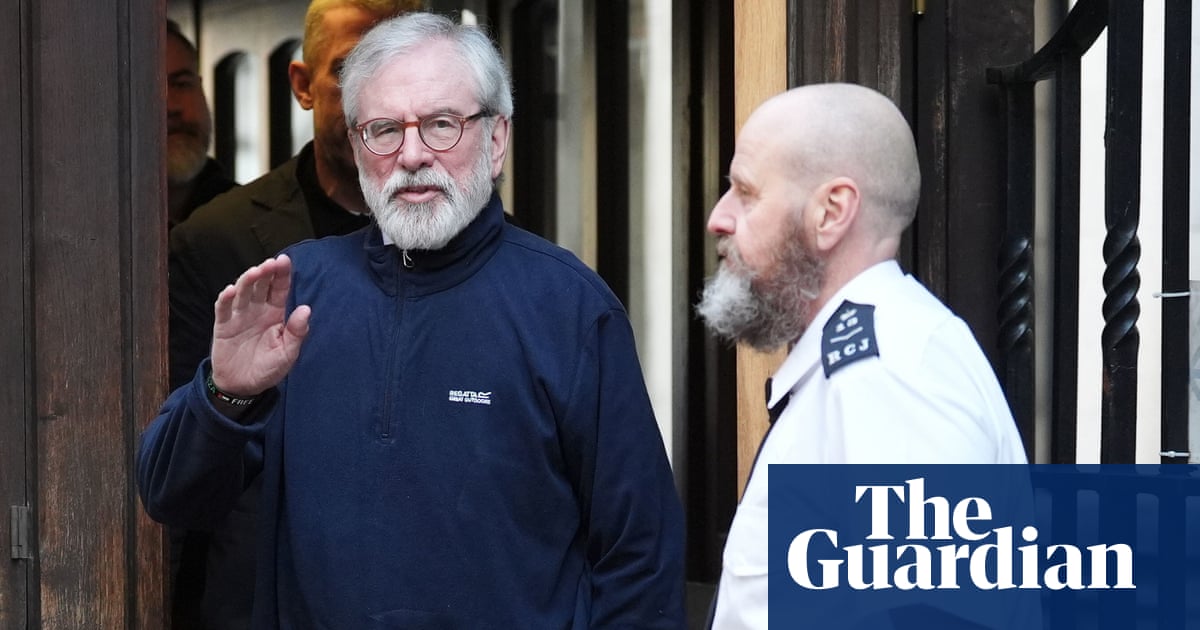
Three people were suing ex-Sinn Féin leader for liability over IRA bombings in UK that left them injured
Three victims of IRA bombings who sued Gerry Adams alleging he was a member of the paramilitary group and culpable for the attacks have withdrawn their lawsuit on the last day of the civil trial.
John Clark, Jonathan Ganesh and Barry Laycock, who were injured respectively in the 1973 Old Bailey bombing , the London Docklands and Manchester bombings in 1996, were seeking symbolic “vindicatory” damages of £1 each.
They alleged that the former Sinn Féin leader, who is credited with helping to bring about the Northern Ireland peace process that ended the Troubles, was a member of the IRA and had sat on its army council.
Adams denied being a member of the IRA or being involved in bombings.
On Friday, the ninth and final day of the trial, the claimants’ lawyer, Anne Studd KC, was expected to finish her closing submissions, but she told the high court that the claim would be discontinued after “proceedings developed overnight”.
Adams, who, for the first time in the trial, was not in court on Friday, welcomed the end of the case.
“I attended the civil case out of respect for them [the victims],” he said.
“This decision brings to an emphatic end a case that should never have been brought.
I contested this case and defended myself against the smears and false accusations being levelled against me.
“I asserted the legitimacy of the republican cause and the right of the people of Ireland to freedom and self-determination.
I do so again.”
He called for a “renewed focus” on the Good Friday agreement.
Studd told the court the reason for the withdrawal of the case related to an argument around “abuse of process”, but was then stopped by the judge, Mr Justice Swift, who said: “Whatever statement your clients may wish to make outside court is entirely a matter for them.”
The judge continued: “I am happy to make an order in the terms the parties have agreed.”
Studd then said: “The claimants’ view is that these proceedings have been affected by unfairness.”
Earlier this week, Swift had invited the parties to make submissions at the end of the trial on whether the case constituted an abuse of process.
Adams’s lawyer, Edward Craven KC, said in written closing submissions on Thursday that Clark, Ganesh and Laycock “have clearly brought this claim for the purpose of seeking to compel the high court to undertake a protracted, wide-ranging public-inquiry-style examination of D’s [the defendant’s] alleged membership of, associations and involvement in the activities of the PIRA [Provisional IRA] over a period of several decades”.
He told the court the evidence suggested the claim had been driven by the claimants’ solicitors, McCue Jury, highlighting a social media post in which the firm explained why “we felt it necessary to bring our case”.
Craven also pointed to an article in the Telegraph this month that said the lawyers had selected the bombings that formed the basis of the case “in an attempt to prove Mr Adam’s influence spanned almost 25 years of the Troubles”.
He said the trial had heard “very little evidence” relating to the three bombings but rather “a sprawling array of allegations” with no direct connection to them.
On Thursday, Studd had told the judge: “My fundamental submission is that this is the wrong time to consider abuse of process … This is not a court of public inquiry and no one is suggesting it is.”
She added: “The claimants have had to widen the evidence before the court because it’s got to be a jigsaw puzzle.”
The 13 witnesses for the claimants included former senior members of the armed forces, police and intelligence officers, a journalist and a convicted IRA bomber.
Related Stories


Source: This article was originally published by The Guardian
Read Full Original Article →
Comments (0)
No comments yet. Be the first to comment!
Leave a Comment