
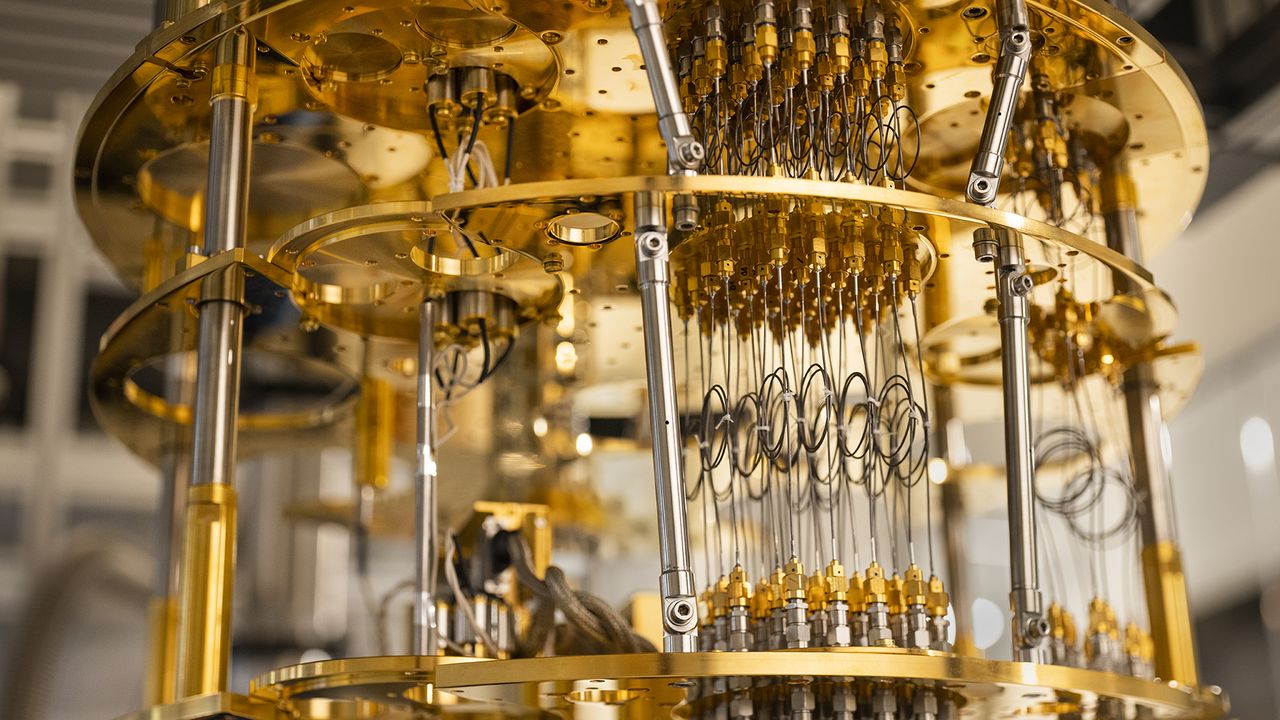
Compact cryogenic cooling systems incoming?
Get Tom's Hardware's best news and in-depth reviews, straight to your inbox.
Scientists from China have developed a new cooling technology based on a rare-earth alloy that can reach temperatures close to absolute zero without relying on helium-3, reports South China Morning Post .
Such an alloy could enable compact, helium-3-free cooling systems for superconducting quantum chips, advanced electronics used by military equipment, and space applications.
The team built a compact, solid-state refrigeration module with no moving parts that reached 106 millikelvin (mK), which is -273°C, a temperature typically achieved using liquid helium.
The cooling module relied on a rare-earth compound consisting of europium, cobalt, and aluminum (EuCo₂Al₉, ECA), which features thermal conductivity comparable to metals, but which can also cool itself and other components efficiently using adiabatic demagnetization (ADR), the method that does all the magic behind the discovery.
The idea behind ADR is relatively straightforward: a magnetic material is placed in a magnetic field, which forces its tiny internal magnetic moments (a tiny magnetic dipole associated with an atom or electron) to align and release heat.
Then, once the system is isolated, the magnetic field is removed, the moments fall back into a disordered state, absorb heat, and reduce temperature.
Because this method relies on solid materials instead of helium-3, it avoids the need for that scarce isotope, which is essential for traditional sub-kelvin cooling systems.
However, there is a catch.
Historically, ADR has had a major weakness: the materials used could get cold themselves, but they were not very good at transferring that cold to other components.
This limited their usefulness in real systems.
Meanwhile, the EuCo₂Al₉ compound developed by the team of scientists does just that: it can cool itself and other components, making helium-3-free cooling systems capable of cooling components to nearly absolute zero temperatures possible.
In practical terms, the compact and lightweight nature of the new cooling module may enable more portable cryogenic systems, which could be valuable for quantum computers, which are about to become the next frontier of international rivalry.
A compact cryogenic cooling system could enable highly scalable quantum computing platforms with performance not achievable today.
The Chinese Academy of Sciences reportedly stated that the alloy has potential for mass production and that a pure-metal refrigeration module based on this material has already been successfully demonstrated.
The development comes amid growing interest in helium-3 alternatives.
On January 27, the U.S.
Defense Advanced Research Projects Agency (DARPA) issued a call for modular refrigeration systems that do not rely on helium-3 for next-generation quantum and defense applications.
Less than two weeks later, Chinese researchers published their results, signalling that they are ahead of DARPA.
Follow Tom's Hardware on Google News , or add us as a preferred source , to get our latest news, analysis, & reviews in your feeds.
Anton Shilov is a contributing writer at Tom’s Hardware.
Over the past couple of decades, he has covered everything from CPUs and GPUs to supercomputers and from modern process technologies and latest fab tools to high-tech industry trends.
coolitic said: I would say that my reason for doubting chiefly stems from the fact that this "discovery" was announced just two weeks after DARPA announced their push.
That's a little too convenient to not be engineered.
chaos215bar2 said: So, do we have a published paper explaining exactly how the cooling process using this new alloy works, or just a news article from a Chinese source specifically calling out DARPA?
TCA_ChinChin said: Here is the article published in Nature: https://www.nature.com/articles/s41586-026-10144-zThe news source is kinda bad for not linking the actual published paper, but it's real research and actually legitimately in one of the most prestigious scientific journals globally.
chaos215bar2 said: Too bad there doesn't seem to be a plain PDF copy available anywhere.
I guess it's a little harder to complain since the research was funded within China, but still, the idea of paying $30+ simply to access a single scientific paper is so counter to the kind of open communication scientific progress thrives on, it's almost insulting.
Related Stories


Source: This article was originally published by Toms Hardware
Read Full Original Article →
Comments (0)
No comments yet. Be the first to comment!
Leave a Comment