
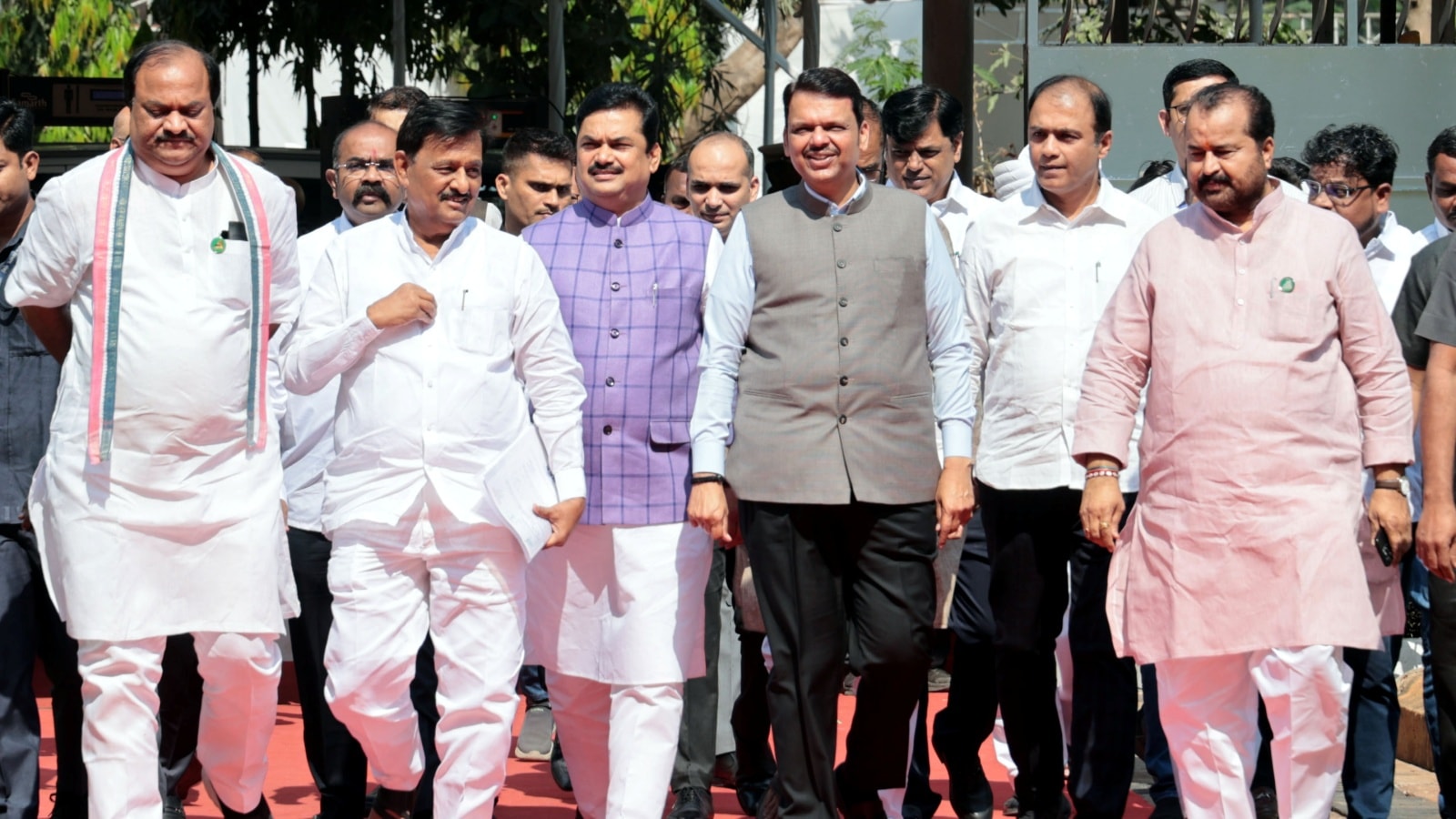
While the ruling Mahayuti backed the anti-conversion law, Shiv Sena (UBT) broke ranks with MVA allies Congress and NCP (SP) to support the legislation introduced by CM Devendra Fadnavis.
Exposing a rare dissonance within the Opposition parties, the Maharashtra Freedom of Religion Bill , 2026 was passed in the state Assembly on Monday, backed by the ruling Mahayuti and Maha Vikas Aghadi (MVA) partner Shiv Sena (UBT).
The Congress, NCP (SP), Samajwadi Party and CPI (M) opposed the Bill.
The Bill will now be tabled in the Legislative Council likely on Tuesday.
Chief Minister Devendra Fadnavis introduced the Bill in the Assembly, saying the proposed law seeks to prevent religious conversions carried out through coercion, inducement, fraud or deception and is not directed against any particular religion.
During the discussion in the House, Sena (UBT) MLA Bhaskar Jadhav supported and welcomed the Bill, while suggesting a correction in one of its clauses pertaining to notice.
Outside the House, Sena (UBT) chief Uddhav Thackeray said freedom of religion must exist for everyone, but conversions carried out through force or exploitation should be opposed.
“If anyone is converting by force or by taking advantage of someone’s helplessness and falsely luring them, we are against it.
We support that Bill fully,” Thackeray said.
However, the Congress, NCP (SP) and the Samajwadi Party opposed the legislation and demanded that it be referred to a joint select committee of both Houses for further scrutiny and public consultation.
Several Opposition legislators termed the Bill unconstitutional and accused the government of targeting a particular community and creating social divisions.
NCP (SP) MLA Jitendra Awhad said the very title of the legislation was misleading.
“This is not Dharma Swatantrya (freedom of religion); this is Dharma Niyantran — controlling religion,” he said.
Congress MLA Amin Patel and SP MLA Abu Azmi also termed the Bill unconstitutional, raising concerns about the safety of individuals wishing to convert and the implications for privacy.
Introducing the Bill, Fadnavis said Maharashtra was not the first state to enact such a legislation, noting that similar laws are already in force in 12 states, including Odisha, Karnataka, Haryana, Rajasthan and Arunachal Pradesh.
“This Bill is not against any particular religion.
It applies to all religions.
It is meant to prevent religious conversions carried out through coercion, inducement, fraud or deception,” he said, adding that the legislation was “100 per cent constitutional”.
Explaining the rationale behind the Bill, Fadnavis said disputes around religious conversions — particularly those linked to interfaith marriages — often lead to law and order situations.
“In cases of interfaith marriages involving individuals from different religious backgrounds, disputes often arise and sometimes lead to law and order situations.
Once such a situation emerges, effective action must be taken to address it,” he said.
Fadnavis added that existing criminal laws such as the Bharatiya Nyaya Sanhita (BNS) do not contain specific provisions dealing with unlawful religious conversions.
“As things stand, the prevailing laws — whether it be the BNS or other statutes — lack explicit provisions specifically addressing this matter.
Consequently, we rely on existing provisions such as fraud,” he said.
“If specific provisions are in place, difficulties related to unlawful conversion or disputes around interfaith marriages will not arise.
To ensure clarity and prevent recurring law and order disturbances, this Bill has been introduced,” he added.
According to the Chief Minister, the legislation clearly defines illegal religious conversion, including conversions carried out through allurement, coercion, fraud, misrepresentation or undue influence, as well as cases involving minors.
Persons or organisations facilitating such conversions would be liable for punishment under the proposed law.
The Bill also empowers the police to take suo motu action in cases of alleged illegal conversion.
Opposition parties, however, strongly criticised the proposed legislation.
Congress MLA Aslam Shaikh said several provisions of the Bill infringed on privacy and personal liberty.
“Religion is a personal matter but the Bill mandates people to give a notice for 60 days before converting.
Why should a person publicly declare that they want to convert?
After that, who will ensure that person’s protection and safety?” he asked.
Shaikh also objected to the provision placing the burden of proof on the accused.
“This Bill will be an injustice to two adults of different faiths who fall in love,” he said.
Samajwadi Party MLA Rais Shaikh termed the Bill “regressive” and alleged that it targeted a particular community.
“The Maharashtra Freedom of Religion Bill presented by the government is a one-sided Bill brought to target a particular community.
There is strong resentment among minority communities,” he said.
Rais Shaikh and Amin Patel also questioned the absence of data to support the government’s claims about large-scale religious conversions in the state.
“If the government claims that a large number of religious conversions are taking place, it should present the relevant data,” Rais said.
He added that while the government had earlier claimed one lakh complaints of “love jihad” had been received, departmental information showed only 402 complaints had actually been recorded.
Rais also demanded that the government place before the House the report of the committee formed in February 2025 under the chairmanship of the then Director General of Police to examine cases of religious conversion in the state.
“The provision requiring a person intending to convert to give 60 days’ prior notice raises questions.
If someone gives such notice, will the government take responsibility for that person’s security?” he asked.
Defending the legislation, Fadnavis said similar laws have existed in several states since 1968 and that the Bill is consistent with the constitutional guarantee of religious freedom.
“Article 25 of the Constitution grants every individual the right to freedom of religion.
This legislation will empower the police and administrative machinery to maintain law and order and deal with unlawful conversions effectively,” he said.
“I request the House to set aside rumours surrounding the Bill.
It is fully constitutional in both letter and spirit,” the Chief Minister added.
Vallabh Ozarkar is a Senior Correspondent with The Indian Express' Mumbai bureau, recognized as an authoritative and deeply knowledgeable voice on the politics, governance, and infrastructure of Maharashtra.
With more than nine years of experience in major news organizations, his reporting delivers high standards of Expertise and Trustworthiness.
Expertise & Authority
Current Role: Senior Correspondent, The Indian Express, Mumbai bureau.
Geographical Specialization: Provides exclusive and detailed coverage of Maharashtra politics and governance, operating at the epicenter of the state's decision-making in Mumbai.
Core Authority: His reporting demonstrates deep Expertise across critical and often complex state matters, including:
Political Dynamics: In-depth analysis of the ruling coalition (Mahayuti) and opposition (MVA), internal party conflicts, and crucial election updates, including local body polls and municipal corporation tussles.
Governance & Policy: Focused coverage on significant state policies, such as the overhaul of Mumbai's 'pagdi system' (rent control for old buildings) and social welfare schemes (e.g., Ladki Bahin Yojana accountability).
Infrastructure & Development: Reports on major urban and regional infrastructure projects, including the Mumbai Water Metro, Uttan-Virar Sea Link, and Thane Metro development.
Administrative Oversight: Follows legislative actions, cabinet decisions, and reports on issues of accountability and alleged fraud within state departments.
Experience
Current Role: His role at The Indian Express—a leading national daily—validates the credibility and standard of his reporting.
Career Foundation: Prior to The Indian Express, Vallabh contributed to other major metropolitan news outlets, including the Mumbai Mirror and DNA - Daily News & Analysis, providing a solid foundation in rigorous urban and political journalism.
Evidence of Impact: His work consistently breaks down complex political developments and administrative failures, such as exposing discrepancies in government welfare schemes, cementing his reputation as a trusted source for ground-level, impactful news from Maharashtra.
He tweets @Ozarkarvallabh ...
Read More
Stay updated with the latest - Click here to follow us on Instagram
Related Stories



Source: This article was originally published by The Indian Express
Read Full Original Article →
Comments (0)
No comments yet. Be the first to comment!
Leave a Comment