
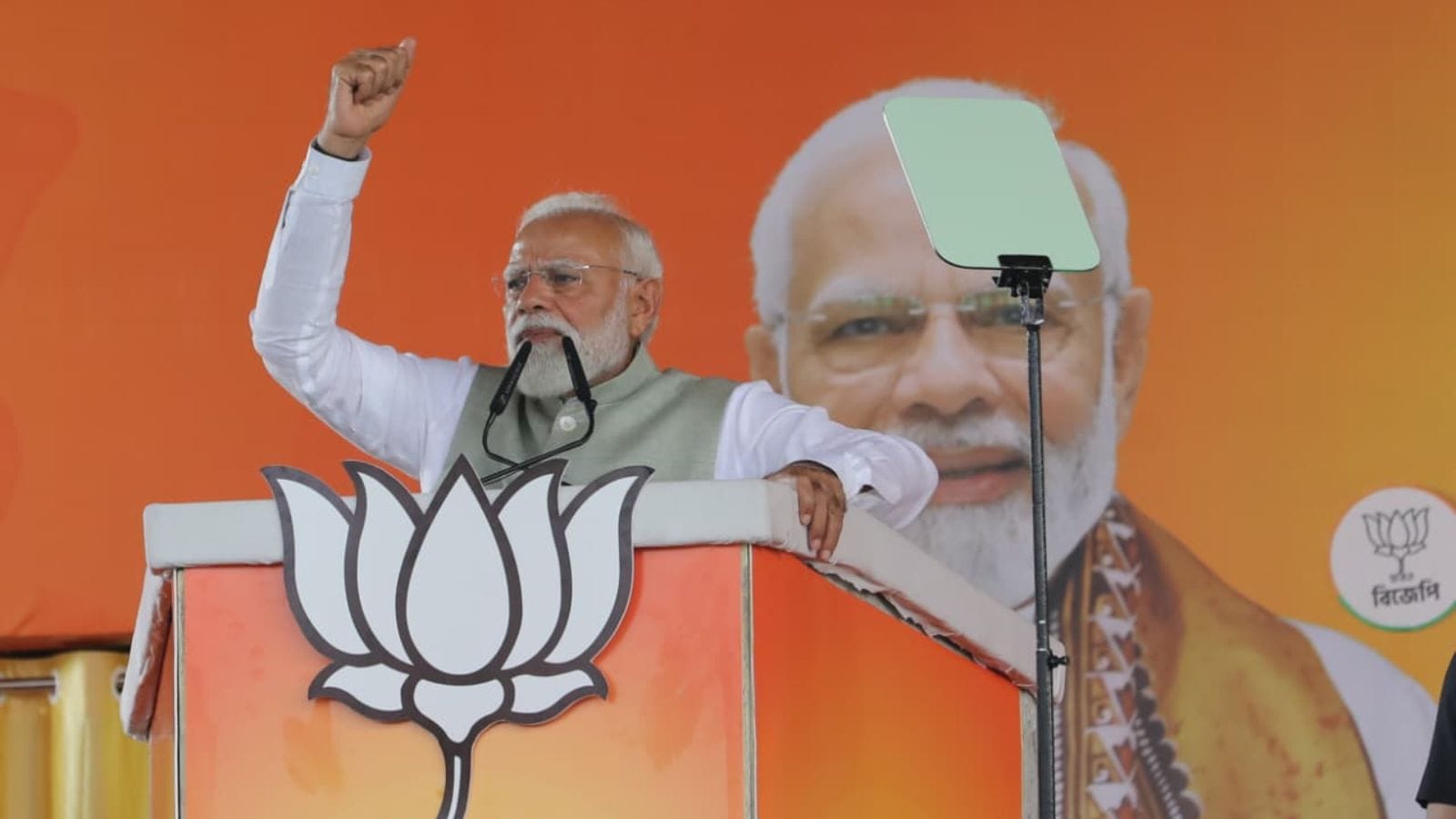
“The countdown has begun,” declared Prime Minister Narendra Modi from the stage at the Brigade Parade Ground in Kolkata during his first visit to West Bengal after the publication of the post-SIR electoral rolls on February 28.
The message was directed at the Trinamool Congress government which the Prime Minister said was a “nirmam sarkar (heartless government)”.
The stage was modelled on the iconic Dakshineswar temple, a spiritual landmark nearKolkata.
Seeing the massive gathering at the ground, Modi said, “Friends, the intellectual people of Bengal have now resolved to stand against this anarchic government.
The sea of people you see here today reflects Bengal’s awakened consciousness.
From the hills to the Sundarbans, there is only one discussion—’we want change’.”
“Today, at this historic Brigade Ground, I can see that confidence.
Remember, this fight is not only to change a government but to save the soul of Bengal.
This fight is for freedom from fear.
I extend advance greetings for this change to the brothers and sisters of Bengal.”
He said the Brigade Parade Ground is a witness to historic events.
“Whenever Bengal has shown direction to the nation, this ground has become its voice.
From this ground, voices were raised against British rule, and that voice turned into a revolution across Hindustan.
It brought an end to British oppression and exploitation… Today, once again from this Parade Ground, the drumbeat of a new revolution for Bengal has begun… The end of the ‘ruthless’ government in Bengal is inevitable.
The era of ‘great jungle raj’ in Bengal will end.
From every corner of Bengal, one voice is rising— ‘we want a BJP government’.”
Accusing the Trinamool Congress government of trying to obstruct the rally, he said: “Even today this government used every possible weapon to stop this massive gathering.
Bridges were closed to prevent you from coming, vehicles were halted, traffic jams were created.
BJP flags were removed and posters were torn down.
But the ruthless government should look carefully — today’s massive tide of people could not be stopped.”
“The countdown has begun for those who are running the ‘great jungle raj’ in Bengal.
That day is not far when the rule of law will once again be established in Bengal,” he said.
The Prime Minister said the ruling party feared the SIR exercise because it would remove the names of illegal voters.
“These people oppose SIR so that the names of infiltrators cannot be removed from the voter list.
They are not even ready to remove the names of those who have died.”
Claiming that infiltration had become a major security and political issue in Bengal, he alleged that the Trinamool Congress government had encouraged the phenomenon for electoral gains.
“Due to unchecked infiltration by the TMC, the demography of Bengal has changed in many areas.
The TMC is deliberately making Hindus a minority in many areas,” Modi said.
He asserted that a BJP government in the state would bring governance based on the principle of “Sabka Saath, Sabka Vikas’.
At the same time, everyone will be held accountable, he said.
“Those who break the law and commit atrocities will not be spared.
Not a single oppressor of the TMC will be spared.
No matter how much force this government applies now, it cannot stop the storm of change.
The BJP and the NDA have the blessings of Mahishasuramardini (Goddess Durga).
The Bengal envisioned by great personalities like Ramakrishna Paramahamsa, Swami Vivekananda, Netaji Subhas Chandra Bose, Rishi Bankim Chandra, Gurudev Rabindranath Tagore… will be built by the BJP government,” said the PM.
He said Bengal’s development under the BJP government will happen with honest intent and correct policies.
“Even though we do not have a government in Bengal today, the BJP through the Central government is working day and night for its development.
Today itself, I have inaugurated and laid the foundation stone for projects worth more than ₹18,000 crore.
Just four days ago, the Cabinet approved multi-tracking railway projects for West Bengal.
Farmers, traders, students and common people will benefit from them.”
On the migration issue of Bengal, he said, “You all know the youth of Bengal are among the most talented and skilled… Your sons and daughters are forced to go to other states in search of jobs.
First Congress, then the Communists, and now the TMC—one after another they came, filled their own pockets, and stalled development in Bengal.
Bengal has fallen behind in infrastructure.
Industries have shut down.
Jobs are openly sold under the TMC government.
Bengal youth’s dream is to find employment within Bengal —fulfilling it is Modi’s guarantee.”
He said the state government has stalled all major welfare projects of the Centre.
“Look at the PM Vishwakarma Yojana, launched to empower artisans… The Centre is giving the money, the Bengal government does not have to do anything, yet the poor are being deprived… We launched the PM Surya Ghar Muft Bijli Yojana to provide free electricity to citizens… But the Bengal government is not allowing it to be implemented.
Tell me—should electricity bills become zero or not?”
“Every poor family outside Bengal is receiving a permanent house (under PM Awas Yojana).
But what has happened here?
The scheme’s name has been changed, beneficiary lists have been manipulated, and those who deserved houses are still waiting… Should such a government remain in power?…The TMC government is not implementing the Ayushman Bharat scheme either due to its selfish politics…”
“The condition of Bengal’s farmers is no secret today.
I have been informed that two or three days ago a potato farmer in Chandrakona killed himself.
From West Midnapore to Hooghly and Bardhaman, farmers face false promises and corruption in government procurement.
Cut money, commissions, and corruption have made people’s lives miserable,” he said.
Promising permanent houses to every poor household, the PM said: “As soon as the TMC government goes, construction of houses for the poor will begin.
Clean water will reach every home.
When TMC goes, the poor will get free medical treatment, artisans will get new opportunities.”
Sharpening his attack on the Mamata Banerjee government, Modi alleged that the state administration is functioning with the support of criminal elements.
“Today criminals roam freely in Bengal.
Atrocities against tribal girls are happening.
The brutality against the girl at RG Kar Hospital has not been forgotten.
Horrific crimes like acid attacks are increasing.
The Bengal that was once the most progressive state of the country—today mothers call their daughters home early once evening falls… I promise the mothers and sisters of Bengal: under a BJP government, women will be safe and criminals will be in jail.
This is Modi’s guarantee.”
Earlier in the day, capping off his two-day visit to Assam, PM Modi performed the ‘bhoomi poojan’ of Rs 22,860-crore Shillong-Silchar Corridor project in Silchar and declared that the BJP-led government is working to make the Barak Valley a centre of trade and connectivity.
In his speech, Modi accused the Congress of leaving Barak Valley – which is contiguous with Bangladesh – “in distress”.
“When the country became independent, Congress allowed boundaries to be drawn that cut off Barak Valley’s access to the sea.
The Barak Valley, once known as a trade route and an industrial centre, was stripped of its strength… We are continuously working to make Barak Valley once again a major hub of trade and commerce… Through this corridor, Silchar, Mizoram, Manipur, and Tripura will all be connected.
Beyond these states lie Bangladesh and Myanmar, and then the vast market of Southeast Asia.
In other words, Barak Valley is today laying the foundation for a very bright future,” he said.
He also laid the foundation stone of a flyover in Silchar, and a College of Agriculture in Karimganj district.
In his address, he also swiped at the Congress, accusing it of “opening a front against the nation itself”.
Atri Mitra is a highly accomplished Special Correspondent for The Indian Express, bringing over 20 years of experience to his reporting.
His work is characterized by deep regional knowledge and a focus on critical administrative and political developments, establishing strong Expertise and Authority in his domain.
Experience
Current Role: Special Correspondent, The Indian Express.
Decades of Experience: Over two decades of extensive reporting experience, primarily covering administration and political news.
Geographical Focus: Holds significant reporting experience from West Bengal, Bihar, and the North-East, providing a comprehensive understanding of the socio-political landscape in these regions.
Key Coverage: Has dedicated more than ten years to covering administration and political news, with a keen focus on political developments in West Bengal.
Electoral Reporting: Demonstrated a commitment to crucial political moments, having covered the 2009 Lok Sabha election and 2010 assembly elections during his time at Anandabazar Patrika, and the 2019 Bihar Lok Sabha election while working with News18-Bangla.
Career Foundation: Began his career at the leading vernacular daily Anandabazar Patrika, where he worked for more than fifteen years, including a three-year stint as the Bihar correspondent.
Advanced Degree: Holds a Master's degree in Economics from Rabindrabharati University, providing an analytical framework for his political and administrative reporting.
Undergraduate Education: Holds a Bachelor's degree from Calcutta University.
Prestigious Alumni: His educational background includes attending esteemed institutions: he is an alumnus of St.
Xavier's, Kolkata and Ramakrishna Mission Asrama, Narendrapur.
Atri Mitra's decades of dedicated reporting, substantial focus on political and administrative beats, and solid academic credentials make him a trusted and authoritative source for news and analysis from Eastern and North-Eastern India....
Read More
Sukrita Baruah is a Principal Correspondent for The Indian Express, based in Guwahati.
From this strategic hub, she provides comprehensive, ground-level coverage of India's North East, a region characterized by its complex ethnic diversity, geopolitical significance, and unique developmental challenges.
Expertise and Experience
Ethnic & Social Dynamics: Deep-dive coverage of regional conflicts (such as the crisis in Manipur) and peace-building efforts.
Border & Geopolitics: Tracking developments along India’s international borders and their impact on local communities.
Governance & Policy: Reporting on state elections, tribal council decisions, and the implementation of central schemes in the North East.
Specialized Education Background: Prior to her current role, Sukrita was a dedicated Education Correspondent for The Indian Express in Delhi.
This experience provided her with a sharp analytical lens for:
Policy Analysis: Evaluating the National Education Policy (NEP) and university-level reforms.
Student Affairs: Covering high-stakes stories regarding campus politics, national entrance exams, and the challenges within the primary and secondary education sectors....
Read More
Stay updated with the latest -Click here to follow us on Instagram
Related Stories



Source: This article was originally published by The Indian Express
Read Full Original Article →
Comments (0)
No comments yet. Be the first to comment!
Leave a Comment