
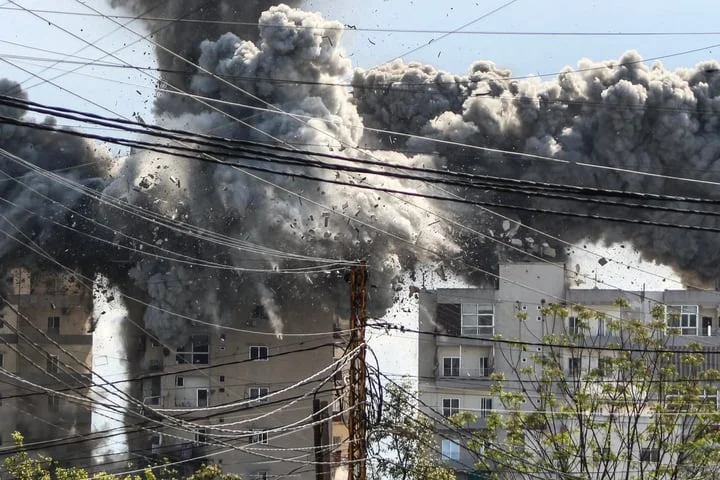
There are fears a ceasefire between Iran and the US could be about to collapse.
President Donald Trump said on Thursday night that Iran was “doing a very poor job” of allowing tankers to pass through the Strait of Hormuz, writing on his Truth Social media account that “that is not the agreement we have”.
Only a few vessels have passed through the all-important waterway, a vital artery for the world’s oil over which Iran has a stranglehold.
When the ceasefire was announced on Tuesday, Trump had said Iran had agreed to a “safe opening” of the strait.
Trump’s post came after Iran’s Supreme Leader had demanded “blood money” from the US and Israel .
The statement, from Ayatollah Mojtaba Khamenei, was read out on Iranian state TV and said: “By the grace of God, we will certainly not let go of the criminal aggressors who attacked our country.
"We will undoubtedly demand compensation for every single damage inflicted, the blood money of the martyrs, and the diyah of the war -wounded."
Khamenei, who has not been seen in public since he took over from his father, said Iran is “Not seeking war”, but “will not forfeit its rights and considers all resistance fronts as a unified entity”.
On Thursday evening, Kuwait condemned what it said were drone attacks by Iran and its proxies on vital facilities and said it undermined the ceasefire.
Iran’s Revolutionary Guards denied launching attacks.
Amid attempts to rescue negotiations, US Vice President JD Vance is set to leave for the Pakistani capital of Islamabad today to lead mediated talks with Iran.
Vance, who has long been sceptical of foreign military interventions, will be joined by Trump’s special envoy Steve Witkoff and his son-in-law Jared Kushner, who took part in three rounds of indirect talks with Iranian negotiators before Trump and Israel began the war at the end of February.
The talks were aimed at settling US concerns about Iran’s nuclear and ballistic weapons programmes and its support for armed proxy groups in the Middle East.
White House spokeswoman Anna Kelly said Vance, Mr Witkoff, Mr Kushner and Secretary of State Marco Rubio “have always been collaborating on these discussions”.
She said Trump was optimistic of a deal being reached during the two-week ceasefire.
Israel and Lebanon set for talks
Iran and Pakistan has stated that the Israeli war in Lebanon was also part of the ceasefire.
Israeli Prime Minister Benjamin Netanyahu and Trump said the truce did not cover Lebanon, however.
Israeli operations have continued since the ceasefire was announced.
Early on Friday, Israel’s military said it had struck 10 launchers in Lebanon that fired rockets towards Israel on Thursday evening.
It said the Hezbollah militant group, which is backed by Iran, had launched a missile at Iran.
Israeli strikes on Wednesday killed at least 203 people and wounded over 1,000, according to Lebanon’s health ministry.
Israel said it targeted Hezbollah sites.
Several of the strikes, however, hit densely packed residential and commercial areas during rush hour, without a warning.
Starmer 'fed up' as he blames actions of Trump and Putin for cost of living crisis
Starmer and Trump discuss need for ‘practical plan’ to reopen Strait of Hormuz
Keir Starmer says post-ceasefire Israeli strikes on Lebanon ‘wrong’
Make 2026 the year of working smarter
Lebanese President Joseph Aoun said the attacks were “barbaric”.
An Israeli official said talks with Lebanon would begin in Washington next week, Reuters reported.
A US State Department official said the US would host a meeting next week to “discuss ongoing ceasefire negotiations”.
In a statement on Thursday, Hezbollah lawmaker Ali Fayyad said the group rejected direct negotiations with Israel and called on the Lebanese government to demand a ceasefire as a precondition to further talks.
Related Stories


Source: This article was originally published by Evening Standard
Read Full Original Article →
Comments (0)
No comments yet. Be the first to comment!
Leave a Comment