
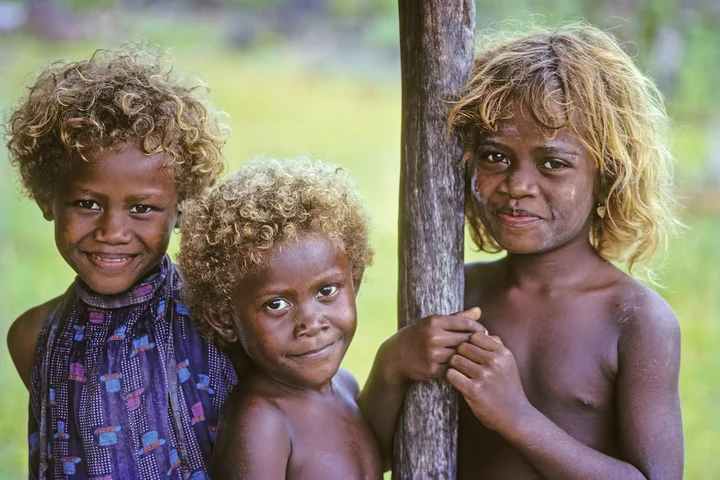
Have you ever seen black people with blond hair?
Melanesians are the black island people in the south Pacific that migrated thousands of years ago.
The original inhabitants of the group of islands now named Melanesia were likely the ancestors of the present-day Papuan people.
They are a sub-region of Oceania, extending from the western end of the Pacific Ocean to the Arafura sea and Eastward to Fiji.
The region comprises the countries of Vanuatu, Solomon Islands, Fiji and Papua New Guinea.
The indigenous Melanesian populations are thus often classified into two main groups based on differences in language, like Papuan-speaking and Austronesian-speaking groups, culture or genetic ancestry.
[ad] The Melanesian people of the Solomon Islands are the point of interest when it comes to their dark skin and blonde hair.
There have been several theories on how they got their blonde hair; from sun and salt whitening, high fish intake to genetic heritage from mixed breeding with Americans/ Europeans who founded the island.
The incidence of Blond Hair in Melanasia
Blond hair evolved independently in Melanesia, where Melanesians of some islands (along with some indigenous Australians) are one of a few groups that did not descend from Europeans who have blond hair.
Therefore, it is rare in native populations outside of Europe and North Africa.
However, as with blond hair that arose in Europe and parts of Asia, the incidence of blond hair is more common in children than in adults, with hair tending to darken as the individual matures and this has been traced back to an allele of TYRP1 unique to these people and is not the same gene that causes blond hair in Europeans.
The Diversification and Differentiation among the Melanesians
Studies found a high rate of genetic differentiation and diversity among the groups living within the Melanesian islands, with the peoples not only distinguished between the islands but also by the languages, topography, and size of an island.
Such diversity developed over the tens of thousands of years since initial settlement, as well as after the recent arrival of Polynesian ancestors at the islands.
Papuan-speaking groups in particular were found to be the most differentiated, while Austronesian-speaking groups along the coastlines were more intermixed.
[ad] Since the late 20th century, further DNA analysis has taken research into new directions, as more Homo erectus races or sub-species have been discovered.
Moreso, the evidence from Melanesia suggests their territory extended into southeast Asia, where ancestors of the Melanesians developed.
The practices of the Melanesians
The Melanesians living in Eastern Indonesia mostly practice Christianity, in contrast to the Malay and Javanese people in the Western part of the archipelago, who mostly practice Islam.
Until recently, the indigenous Melanesian people practised cannibalism, head-hunting, kidnapping and slavery like the Asmat tribe, but with contact with Europeans, the population is now predominantly Christian.
However, some still practice a rural lifestyle.
Evidence suggests that the cultural, linguistic, and political fragmentation that prevailed at the time of European arrival, with a half-dozen languages and cultures often represented on a single island, was partly a product of transformation that had occurred during the previous 2,000 years even though their pre-history of most of island Melanesia has not been fully documented.
However, hierarchical political systems and associated trade networks seem to have broken down during this period and appear to have been accompanied by the increasing separation of language or dialect groups.
[ad] The pressures of Christianisation and Westernisation have caused the indigenous peoples of Melanesia to become part of the world economic system and this has operated for more than a century in some areas.
By the early 21st century, even the most remote regions had become accessible and transformed.
Also, different Christian denominations, and even individual missionaries, have in varying degrees been sympathetic to and knowledgeable about local languages and cultures.
Together, missionary work and the imposition of colonial rule eliminated a variety of cultural traditions, some of which were quite intricate and rich and others of which were violent and exploitative.
Related Stories



Source: This article was originally published by Hacker News
Read Full Original Article →
Comments (0)
No comments yet. Be the first to comment!
Leave a Comment