
Christopher M.
Hartshorn is in the National Center for Advancing Translational Sciences, National Institutes of Health, Bethesda, Maryland 20892, USA.
Search author on: PubMed Google Scholar
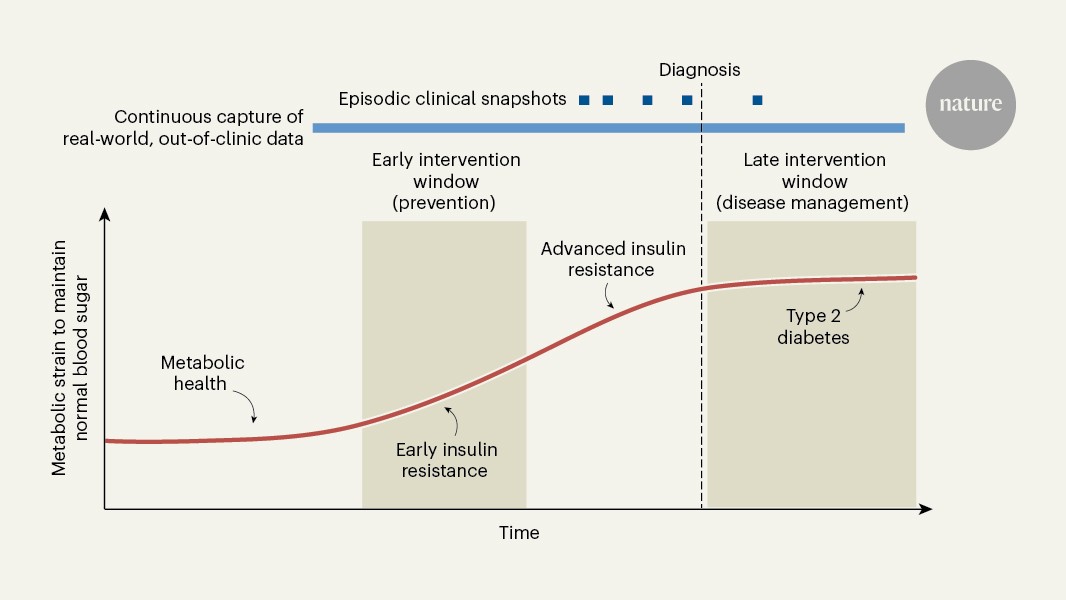
Many chronic diseases unfold slowly as continuous biological processes, yet they are typically detected through brief clinical snapshots — at annual visits to a physician or from isolated laboratory tests, for instance.
Insulin resistance, a condition in which the body must work harder to regulate blood sugar, can develop for years before it becomes visible in routine diagnostics.
Writing in Nature , Metwally et al .
1 show that patterns in everyday-lifestyle data, collected outside the clinic from consumer wearable devices, can reveal this hidden phase earlier.
Rather than a snapshot, this offers something closer to a ‘movie’ of metabolic health.
By drawing on continuous signals from daily life, the authors’ approach highlights physiological strain that is invisible to episodic testing.
The work raises the possibility that identifying insulin resistance — a key early feature of type 2 diabetes — earlier could enable simpler interventions and, ultimately, reduce the downstream burden of metabolic disease.
Access Nature and 54 other Nature Portfolio journals
Get Nature+, our best-value online-access subscription
Receive 51 print issues and online access
Prices may be subject to local taxes which are calculated during checkout
doi: https://doi.org/10.1038/d41586-026-00380-8
Metwally, A.
A.
et al.
Nature https://doi.org/10.1038/s41586-026-10179-2 (2026).
Reaven, G.
M.
Diabetes 37 , 1595–1607 (1988).
The author declares no competing interests.
Read the paper: Insulin resistance prediction from wearables and routine blood biomarkers
Diabetes prevention programme put to the test
How to reduce the environmental impact of wearable health-care devices
Autism in older adults: the health system must recognize its effects
Why the crisis in official statistics matters — and how it can be fixed
‘Baked, not fried’: five highlights from nutrition research
Do obesity drugs treat addiction?
Huge study hints at their promise
Are obesity drugs causing a severe complication?
What the science says
The ‘astounding’ rise of semaglutide — and what’s next for weight-loss drugs
AI and the PhD student: friend or foe?
China approves brain chip to treat paralysis — a world first
China intensifies push to become world leader in tech and AI
CeMM is recruiting two scientists to join as Starting Principal Investigators within a new research program on pain and aging/healthy.
Research Center for Molecular Medicine (CeMM), ÖAW
Profile the cellular components of tissue microenvironments (TME) in healthy and inflamed sites.
Dortmund, Nordrhein-Westfalen (DE)
Leibniz-Institut für Analytische Wissenschaften – ISAS – e.V.
Postdoctoral positions exploring microbiota–stem cell interactions in development, disease & cancer using gnotobiotic models, organoids & multi-omics.
The Chinese Institutes for Medical Research (CIMR), Beijing
Join Huazhong Agricultural University
No.1 Shizishan Street, Hongshan District, Wuhan, Hubei Province, China
Huazhong Agricultural University (HZAU)
SUSTech School of Medicine offers equal opportunities and welcome applicants from the world with all ethnic backgrounds.
Southern University of Science and Technology, School of Medicine
Related Stories



Source: This article was originally published by Nature News
Read Full Original Article →
Comments (0)
No comments yet. Be the first to comment!
Leave a Comment