
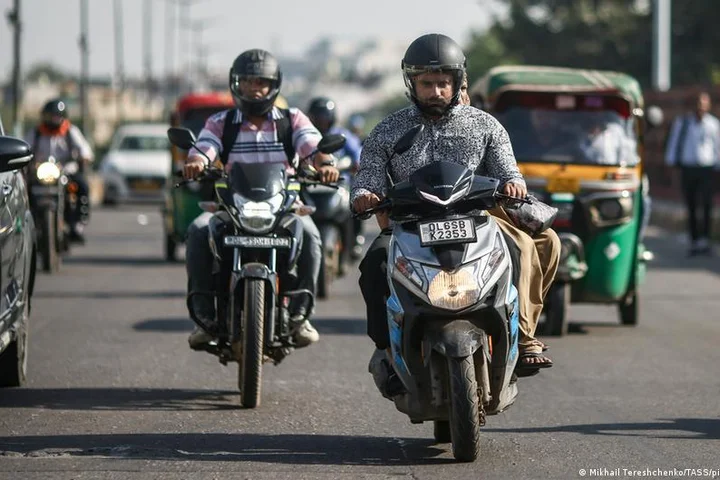
India's capital is gearing up to ban non-electric two-wheelers as it looks to tackle chronic smog and high pollution.
In other news, PM Modi is campaigning in West Bengal ahead of high-stake elections.
This blog is now closed.
Below is a roundup of the news from India on Saturday, April 11:
That's where we will leave things for today.
I will be back tomorrow with more top stories and anything else of interest taking place in India, until then!
Delhi looks to ban new non-electric two-wheelers from 2028, to rein in pollution
A new draft policy released by the Delhi government proposes to ban new two-wheelers run on fossil fuels from 2028, in an effort to manage emissions in one of the world's most polluted cities.
It cites a recent report identifying vehicular emissions as the largest contributor to air pollution in the National Capital Region of Delhi (Delhi NCR), about 23% in winters.
"Two-wheelers constitute approximately 67% of the total vehicle stock in Delhi, making their rapid electrification critical for achieving meaningful reductions in vehicular emissions," the policy said.
Delhi is regularly cited as one of India's most polluted cities with thick smog , filled with pollutants , settling over the capital every winter.
It has caused lasting health issues in residents and leads to political rows every year.
The draft Delhi Electric Vehicle (EV) Policy 2026-2030 was uploaded on Saturday for feedback.
It will remain available for comments for 30 days after which a final policy will be notified and implemented till 2030.
The policy offers purchase incentives for electric two-wheelers, three-wheelers and goods vehicles.
It also proposes tax breaks for those buying electric vehicles, including cars.
EV retrofits, a cost-cutting solution to Delhi air pollution
To view this video please enable JavaScript, and consider upgrading to a web browser that supports HTML5 video
How fish became a flashpoint in West Bengal elections
For the coastal state of West Bengal, fish is more than just food.
It's culture, routine and the lifeblood for many communities.
But ahead of the 2026 assembly elections, it has also turned into a political symbol.
As the local Trinamool Congress (TMC) defends its rule against the Hindu nationalist Bharatiya Janata Party (BJP), speculation over the state's future access to fish has led to odd sights.
West Bengal's current Chief Minister Mamata Banerjee, at a recent rally, warned the BJP would "ban fish, meat and even eggs," if elected to power.
At another event, she said: "They are not aware of the traditions and culture of West Bengal...
It's a party of outsiders."
The BJP has previously promoted vegetarianism in parts of the country and banned beef in several states.
It argues that the cow is a holy animal for Hindus, often referred to as a 'mother,' and its slaughter can offend religious sentiments.
The BJP has denied plans to ban fish in the state.
India's 'vegetarian nationalism' targets Muslims
Modi pledges to drive out 'infiltrators' in West Bengal rally
Prime Minister Narendra Modi on Saturday said his Bharatiya Janata Party (BJP) would speed up the implementation of the Citizenship (Amendment) Act if elected in West Bengal, ahead of high-stakes elections.
He warned "infiltrators" to "pack up their bags" while addressing a rally in the Purba Bardhaman district of West Bengal.
He simultaneously reassured politically influential refugee communities in the south of the state that their future would be protected.
"I have come to give a guarantee to the Matua, Namasudra and all refugee families of West Bengal.
You are not here by the grace of any TMC leader.
You are here under the protection of India's Constitution," Modi said.
The CAA is a controversial Citizenship law passed by the Modi Government in 2019 despite nationwide protests and criticism.
It fast-tracks Indian citizenship applications of Hindu, Sikh, Buddhist, Jain, Parsi and Christian immigrants who escaped to India from religious persecution in Muslim-majority Pakistan, Bangladesh and Afghanistan.
The law excludes Muslim immigrants from these countries, marking the first time that India had set religious criteria for citizenship.
Opposition parties, Muslim groups and rights activists say the CAA discriminates against Muslims and undermines India's secular constitution.
The law comes into play in West Bengal's pending election as the state sees significant number of immigrants illegally entering from its porous border with Muslim-majority Bangladesh .
While Modi and Shah were referring here to irregular immigrants as "infiltrators", they have both been accused of using the same term for Indian Muslims in previous election speeches.
India forces Bengali-speaking Muslims into Bangladesh
Capsized boat in Mathura kills 10, several missing
At least 10 people have died and another five remain missing in Mathura, India, after a boat capsized on the river Yamuna, officials said.
The accident occurred on Friday, prompting search and rescue operations by local authorities.
There are conflicting reports about the total number of people on the boat.
In a tweet offering condolences, Punjab Chief Minister Bhagwant Mann said there were 32 people on board.
However, most media reports reported 10 killed, 22 injured and another five missing, suggesting 37 people were on board.
The boat was retrieved on Saturday morning after rescue operations, but none of the missing persons were found.
"For the past four hours, we had been trying to remove the boat, which had overturned and got trapped in a deep swamp area," news outlet The Hindu quoted Deputy Inspector General of Police Shailesh Kumar Pandey saying.
Pandey acknowledged the possibility that some of the missing may have drowed in the major river, but added that rescue efforts would continue till everyone was found.
Other reports by Indian media said most of those dead were tourists from the northern state of Punjab.
Officials said the accident occurred when the boat carrying over two dozen people moved into deeper waters and hit a floating pontoon.
Local eyewitnesses said the boat began to sway violently due to strong winds, picked up speed and then crashed into a pontoon bridge, causing it to overturn.
Why are Indians bitter about Pakistan's peace mediation?
India has long used its influence to try to isolate Pakistan diplomatically.
Relations between the nations hit rock bottom in May 2025 after an attack on civilians in Indian administered Kashmir led to cross-border drone and missile attacks.
India has long blamed Pakistan's government for supporting cross-border terrorism, an allegation Islamabad has denied on several occasions.
Moreover, Indian Foreign Minister S.
Jaishankar blamed Pakistani Army Chief Field Marshal Asim Munir's religious outlook as the key reason for the 2025 attack in India.
Munir has now emerged as a "very important guy" for US President Donald Trump.
How Pakistan is forging new geopolitical relationships
Opposition slams Modi government as Pakistan hosts US-Iran peace talks
As leaders from the US and Iran gather in Pakistan to attempt negotiating a truce, many Indians are watching with narrowed eyes.
Indian Prime Minister Narendra Modi has spent over a decade carefully crafting India's image as a global leader, at least domestically.
For those who bought into that narrative, archrival Pakistan's emergence as an influential mediator is difficult to swallow.
Even those who might dismiss the ' Vishwaguru ' label, translating to 'teacher of the world,' Islamabad's diplomatic emergence registers as a failure of India's foreign policy.
India's largest national opposition party, the Indian National Congress (INC), is pointing the finger of blame squarely at Modi.
"The government's incompetence has allowed Pakistan to claim a pivotal role in the great-power competition in Asia, which will also give it leverage over India on crucial bilateral matters through third parties, effectively internationalizing India-Pakistan matters," the INC said in a statement.
Akhilesh Yadav, another key opposition leader and Modi critic, said the BJP had "ruined our foreign policy."
"There was a time when it seemed like India would become the world guru, but Pakistan is strengthening its foreign policy at the international level.
India appears weak in foreign policy," he said after Washington and Tehran agreed to a temporary ceasefire.
The peace talks in Islamabad come after a difficult year for US-India relations.
While both remain close partners in trade, security, defense and technology, a string of diplomatic rows — US trade tariffs , Trump's insistence that he brokered peace between India and Pakistan, and New Delhi's ties with Russia — have hit India's image as a diplomatic champion within the country.
What is the government's stance?
Indian Foreign Minister Subrahmanyam Jaishankar previously defended the government when opposition Leaders raised this issue in an all-party meet over the Middle East conflict .
Jaishankar had called Pakistan a ' dalal ,' a word which means 'broker' but has negative connotations.
More recently, Foreign Ministry spokesperson Randhir Jaiswal said India welcomed the ceasefire between the US and Iran.
"As we have continuously advocated earlier, deescalation, dialogue and diplomacy are essential to bring an early end to the ongoing Conflict," he said, without commenting on Pakistan's role as the mediator.
Will India step in to mediate amid Iran-Israel escalation?
To play this audio please enable JavaScript, and consider upgrading to a web browser that supports HTML5 audio
Good morning!
And welcome to DW's India news blog.
This is Mahima Kapoor from the New Delhi bureau where the mercury is starting to rise after a month of exceptionally pleasant weather.
Indians are used to hot summers, but a western disturbance has kept temperatures in check through March and the first week of April.
That lucky spell now seems to be coming to an end.
The heat is also rising in Indian politics with two key states gearing up for assembly elections later in April.
Prime Minister Narendra Modi is attending three rallies in West Bengal , where his Hindu nationalist party has never won an election in the eastern state’s history.
His Bharatiya Janata Party (BJP) and the local Trinamool Congress (TMC) regularly lock horns over topics like irregular immigration, corruption, jobs and even fish.
More on that last one later.
But the country's focus remains on the US-Iran peace talks in Islamabad .
Opposition leaders are expressing dissatisfaction with the Modi government's foreign policy, which they believe has given its archrival the space to emerge as a mediator on the global diplomatic platform.
Stay tuned as we bring you these angles and plenty more besides in our blog.
Related Stories



Source: This article was originally published by Deutsche Welle (DW)
Read Full Original Article →
Comments (0)
No comments yet. Be the first to comment!
Leave a Comment