
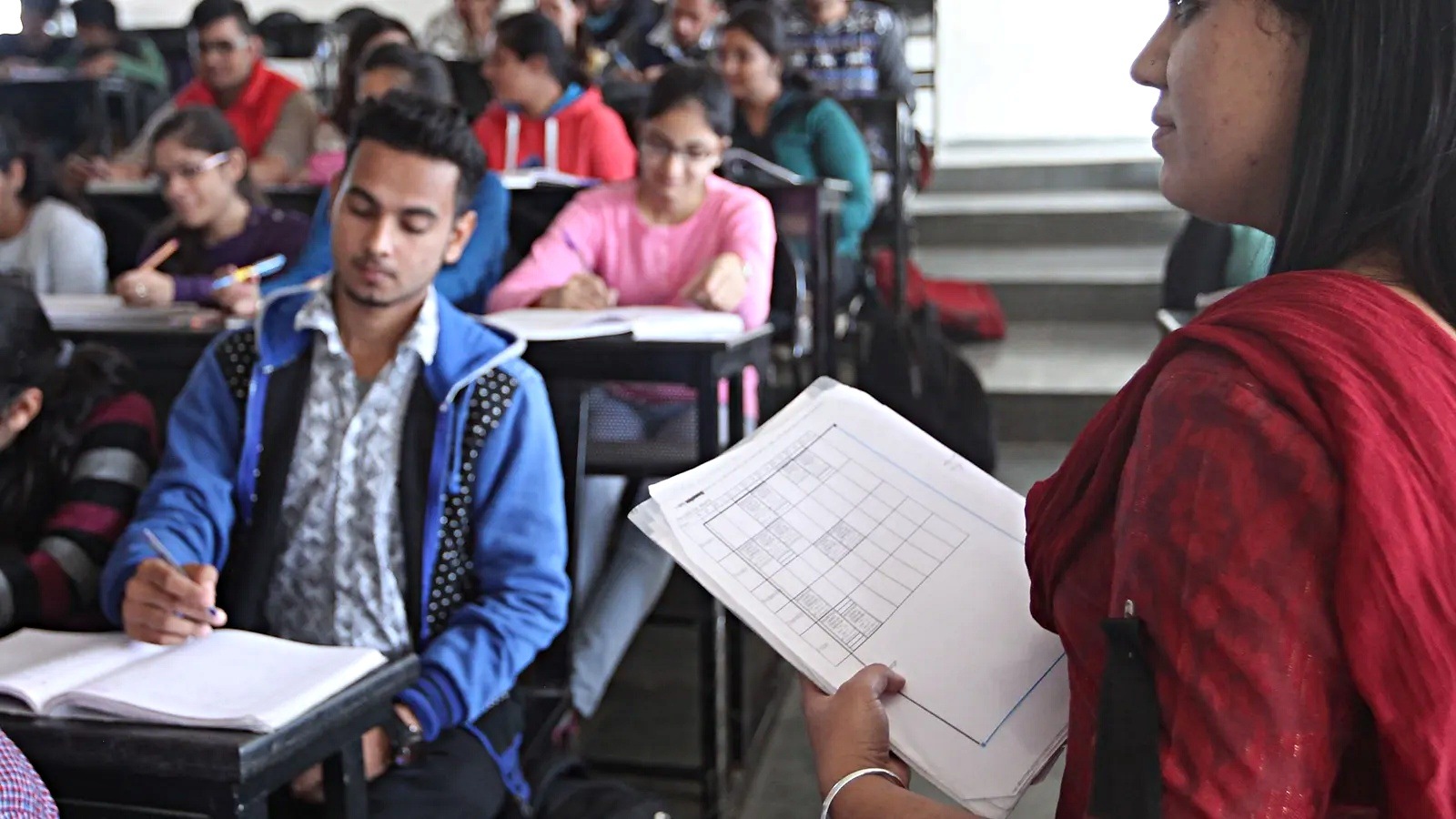
Stating that internal disputes between a state university and the University Grants Commission (UGC) over the funding or grants is not an appropriate excuse to deny payment to a teacher, the Gujarat High Court held that the Maharaja Krishnakumarsinhji Bhavnagar University (MKBU) is in “legal obligation” to reimburse a salary of Rs 12.45 lakh to a female assistant professor for the service between 2013 and 2016.
The bench of Justice M J Shelat of the Gujarat High Court was hearing a petition of a former assistant professor of the Maharaja Krishnakumarsinhji Bhavnagar University seeking directions to the university to release the unpaid salary for the period December 2013 to November 2016, which had been withheld citing that the UGC had not released the promised grant.
The petitioner had originally also challenged an April 2016 order of the university terminating her service, but subsequently decided to only press the petition seeking salary.
The HC noted in the judgment delivered on March 10 and made available on Friday that the December 2013 appointment of the petitioner by the university was in pursuance of a scheme floated by the UGC and as per the agreement between the university and the UGC, the necessary expenditure pertaining to the salary and other expenses was to be reimbursed by the UGC to the university.
The court noted that records had shown that the grant was not released in favour of the university for “some breach of the condition / scheme by (the university)”.
Stating that the university cannot arbitrarily refuse to make payment of salary to the petitioner after availing service, the judgment states, “This court is not concerned about the… internal dispute between… university and the UGC.
The fact remains that the petitioner had served the university for the period between December 27, 2013 to November 6, 2016, and has not received any salary for the said period from the university…”
The judgment further states, “Once the service of the petitioner is availed of by the university, it would not be appropriate on the part of the university, being a State under Article 12 of the Constitution of India, to act arbitrarily whereby it refused to make payment of salary to the petitioner, being a teacher appointed by the university.
There is no justifiable reason forthcoming from the side of the respondent-university which would appeal to this court to take any other view than the view as aforesaid…”
Advocate Nikunt Raval, appearing for the university requested the court to not entertain the petition and submitted that the programme under which the appointment of the petitioner was made was to be financed and run from the grant received from the UGC and due to non-receipt of the grant, the “university is not in a position to make the payment of salary to the petitioner”.
Holding that the university has been unable to “deny the legitimate claims of the petitioner” from the facts placed on record, the court said it would be “a legal obligation on the part of the university, being an employer, to pay salary to its employee”.
Allowing the petition filed by the assistant professor, the HC directed the university to pay a salary of Rs 12.45 lakh to the petitioner on or before June 15, 2026, failing which, the petitioner would be “entitled to receive the arrears of salary for the said period with 6% per annum interest till its realisation” from the university.
Aditi Raja is an Assistant Editor with The Indian Express, stationed in Vadodara, Gujarat, with over 20 years in the field.
She has been reporting from the region of Central Gujarat and Narmada district for this newspaper since 2013, which establishes her as a highly Authoritative and Trustworthy source on regional politics, administration, and critical socio-economic and environmental issues.
Expertise:
Core Authority & Specialization: Her reporting is characterized by a comprehensive grasp of the complex factors shaping Central Gujarat, which comprises a vast tribal population, including:
Politics and Administration: In-depth analysis of dynamics within factions of political parties and how it affects the affairs in the region, visits of national leaders making prominent statements, and government policy decisions impacting the population on ground.
Crucial Regional Projects: She consistently reports on the socio-economic and political impact of infrastructure projects in the region, especially the Statue of Unity, the Sardar Sarovar Project on the Narmada River, the Mumbai-Ahmedabad High Speed Rail bullet train project as well as the National Highway infrastructure.
Social Justice and Human Rights: Her reporting offers deep coverage of sensitive human-interest topics, including gender, crime, and tribal issues.
Her reports cover legal proceedings from various district courts as well as the Gujarat High Court (e.g., the Bilkis Bano case remission, POCSO court orders, Public Interest Litigations), the plight of tribal communities, and broader social conflicts (e.g., Kheda flogging case).
Local Impact & Disaster Reporting: Excels in documenting the immediate impact of events on communities, such as the political and civic fallout of the Vadodara floods, the subsequent public anger, and the long-delayed river redevelopment projects, Harni Boat Tragedy, Air India crash, bringing out a blend of stories from the investigations as well as human emotions.
Special Interest Beat: She tracks incidents concerning Non-Resident Gujaratis (NRIs) including crime and legal battles abroad, issues of illegal immigration and deportations, as well as social events connecting the local Gujarati experience to the global diaspora....
Read More
Related Stories


Source: This article was originally published by The Indian Express
Read Full Original Article →
Comments (0)
No comments yet. Be the first to comment!
Leave a Comment