
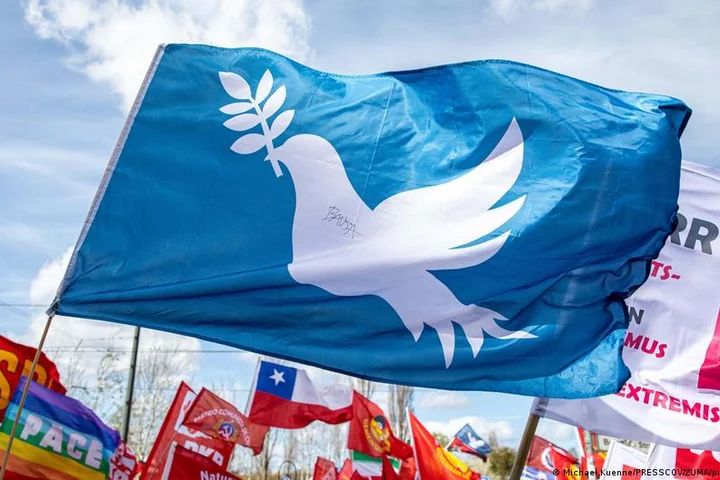
Germans are celebrating Easter Sunday with church services and traditional peace marches.
DW has the latest.
Welcome to our roundup of headlines from and about Germany on the Easter weekend:
22-year-old shot dead fleeing police in car
Prosecutors in the southwestern German city of Saarbrücken say police there shot a 22-year-old man dead early Sunday when he attempted to outrun them in his car.
Two other men, aged 23 and 19, were in the car at the time of the incident.
Prosecutors say the 19-year-old backseat passenger was injured during a chase that unfolded when the driver sought to evade a police check northeast of the city around 1:00 a.m.
local time (2300 Saturday UTC/GMT).
Prosecutors say a female officer was injured during the driver's attempt to escape after he maneuvered himself into a dead-end street.
Officers reportedly shot the driver dead as he was trying to wheel around the cul-de-sac, bringing the vehicle to a stop.
Multiple police officers were deployed to the area and an investigation is underway.
Andreas Rinnert, chairman of GdP police union, said, "It is always tragic when someone is killed during a police operation.
In that context, we expressly call for calm and ask that people refrain from making premature assumptions or assigning blame, both in person and online."
"We all have the greatest possible interest in transparently investigating this incident," said Rinnert, "devoid of hate, vitriol and predetermined guilt."
The state of Saarland, where Saarbrücken is located, closely regulates police use of firearms , saying they may only be discharged against people "to render them incapable of attack or escape, provided that this objective cannot be achieved by using firearms against property."
A potentially lethal shot is only permissible if it is the last means of averting an immediate threat to life or serious injury.
Three killed by falling tree in northern Germany Easter egg hunt
Police say at least three people were killed on Sunday when a tree fell on them while they were hunting for Easter eggs.
Police said a 21-year-old mother and her 10-month-old child were among the dead as well as 16-year-old girl.
An 18-year-old woman was flown to a hospital in serious condition and other people were injured.
The accident reportedly occurred in a wooded area in Satrupholm, outside the northern German city of Flensburg, around 11 a.m.
local time (0900 GMT).
A group of about 50 people had gathered for the Easter egg hunt.
Police say the victims were killed when high winds sent a 30-meter (98-foot) tall tree crashing down upon them.
Others in the party were injured.
Germany's DWD weather service had previously issued high-wind warnings for the area, forecasting sustained winds of between 55 and 65 kph (34-40 mph) and gusts of up to 80 kph (50 mph) across the state of Schleswig-Holstein.
Police open probe after clashing fans invade pitch during Dynamo-Hertha match
The Bundesliga 2 soccer match between Dynamo Dresden and Hertha Berlin on Saturday night was marred by crowd trouble and rioting.
Police in the eastern German city are probing alleged breaches of the peace, dangerous bodily harm, criminal damage and ticket fraud.
It was unclear if both sets of fans were being investigated.
The German Football Federation (DFB) told news agency DPA that it would open its own probe into the clashes next week.
What happened during the match between Dynamo Dresden and Hertha Berlin?
Fans from both teams initially set off fireworks during Saturday evening's second division match at the Rudolf Harbig Stadion in Dresden.
Supporters climbed over fences, with masked Dresden fans running along the side of the pitch towards the Berlin fans.
The two sets of supporters then fired pyrotechnics at each other as they clashed.
The referee halted the game and sent the two teams to the changing rooms, while riot police tried to push Dynamo fans back away from the visiting Hertha supporters.
Hertha prevailed with a 1-0 win, despite having had a man sent off.
IN DEPTH — Easter peace marches in shadow of war
More than 100 peace marches and related events have been planned around Germany over the course of the Easter weekend.
The weekend has always had a strong geopolitical flavor, whether it was during the threat of nuclear war in the Cold War, or this year in the shadow of war in Ukraine, Iran, the Middle East, Sudan and beyond.
But very often there's a domestic tint to proceedings too.
DW's Ben Knight caught up with the Network of the German Peace Movement that coordinates the events.
More than 20 speakers have registered their intention to discuss the government's plans to partially reintroduce military service .
Berlin remembers victims of Berlin disco bombing on 40th anniversary of attack
In Berlin, residents and officials are commemorating the 40th anniversary of one of the worst international terror attacks ever to target Germany.
Wreaths and flowers were placed at the site of the "La Belle" nightclub in West Berlin — now an upscale supermarket and co-working space — where a bomb attack killed three people and injured over 200 more in the early morning hours of April 5, 1986.
A bomb planted under a table at the known hangout for US service members destroyed large parts of the building and killed one US soldier and a Turkish woman immediately.
Another US soldier soon died from his injuries.
The attack shocked the world, with US President Ronald Reagan blaming Libyan dictator Moammar Gadhafi for the crime and ordering US missile strikes on Tripoli and Benghazi just days later.
Libya never admitted direct involvement and extradited the man thought to have been behind the attack in 1996.
The case went to trial in November 1997.
In 2000, one of five defendants on trial said the bombing had been in response to previous US attacks on Libya.
He also testified that he had informed the East German Stasi before acting.
In November 2001, four of the five defendants were given prison sentences of between 12 and 14 years for their participation.
In 2004, the case was reviewed on appeal at Germany's highest criminal court, the Bundesgerichtshof (BGH), where judges upheld the convictions handed down by the lower court.
In its ruling, the BGH also made clear that Libya's intelligence agencies and operatives at the Libyan Embassy in East Berlin had planned the attack.
Good morning from the DW newsroom and Happy Easter Sunday to our readers, or for those looking to flex their German skills, Guten Morgen und Frohe Ostern!
We are resuming our coverage with a look at ongoing Easter peace marches across the country as well as commemorations for the victims of a 1986 terror attack at the La Belle nightclub in what was West Berlin at the time.
Several US service members were among those killed and injured.
Here's the latest from Germany this Sunday, April 5.
We're pausing our updates of the top headlines out of Germany for the night.
But we'll be back again tomorrow with more news from Easter Sunday in Germany.
Thousands join Easter peace marches across Germany
Several thousand people took part in the traditional Easter peace marches across Germany on Saturday.
People rallied in some 70 towns and cities, according to the Network of the German Peace Movement.
These included Berlin, Bremen, Munich, Duisburg, Leipzig and Stuttgart.
The number of participants varied but remained limited.
Some 3,000 were counted in Stuttgart, 1,600 in Berlin and 300 in Duisburg, according to the police.
Marches took place on Thursday and Friday, but Saturday is traditionally the main day.
Some actions are also planned for Sunday and Monday.
This year's event focused on the return of conscription in Germany as well as military buildup.
The organizers spoke of a higher participation of young people thanks to the topic of conscription, which has already triggered repeated protests and school walk-outs.
"It is important that so many people are taking to the streets for peace," Kristian Golla of the Network said.
"In almost 40 years of Easter peace marches, I have never experienced an Easter that was so full of crises around the world."
AfD is Germany's strongest party nationwide in the poll
Germany's far-right Alternative for Germany , or AfD, is now the strongest political force in the country, a new survey showed.
The party’s support currently stands at 26%, according to the Sunday trend poll conducted by market research firm INSA for Bild am Sonntag newspaper.
The figure remains unchanged from past week.
Support for Chancellor Friedrich Merz’s CDU/CSU parties dropped 1% , to 25%, while his coalition partner — the Social Democratic Party (SPD) — was at 13%.
Numbers for other opposition parties, the Greens and the Left, remained unchanged at 12% and 11% respectively.
The AfD is currently the second-largest party in Germany's parliament.
The party has been capitalizing on growing public discontent and concerns over a raft of issues, including economic stagnation, increasing job losses in the industrial sector and high energy prices.
Diesel prices hit another record high
Diesel prices in Germany have spiked to another record high as the Easter weekend began.
The daily average price for a liter of diesel reached €2.391 ($2.75 per liter — $10.45 per gallon) on Friday, a new all-time high, according to ADAC, an automobile association.
On Thursday, diesel prices had already surpassed Wednesday’s previous record, at €2.346.
In a bid to ensure transparency and control price increases, the German government has changed rules since Wednesday, allowing gas stations to hike fuel prices only once a day at noon.
The measure was modeled after Austria, where this practice has long been in place.
But there have been significant price jumps at gas stations since then.
The price hikes "show that the Austrian model certainly does not deserve the name 'price brake' and that it actually has a counterproductive effect," the ADAC stated.
WATCH: Germany rehearses mass evacuations for a NATO war
Russia's threat has pushed Germany to carry out the biggest war drill of its kind in decades — testing its readiness for mass evacuations of wounded allied soldiers from NATO's eastern border in Lithuania.
To view this video please enable JavaScript, and consider upgrading to a web browser that supports HTML5 video
Calls grow louder for scrapping VAT on food
Amid soaring fuel prices, pressure is mounting on the German government to abolish the value-added tax (VAT) on food, especially on healthy food items.
The business wing of the Social Democratic Party (SPD) , the junior partner in the current government, has called for scrapping the tax on items such as fruits, vegetables, dairy products, meat, bread, pasta, rice and eggs.
German policymakers cannot control global oil prices, "but we can ensure that rising energy and food costs don’t hit Germans' wallets unchecked," Esra-Leon Limbacher, an MP and head of the business wing, told the Bild newspaper.
"Whether a child eats a healthy diet should not depend on the parents' bank balance," he added.
The head of the German Trade Union Confederation (DGB), Yasmin Fahimi, echoed the call.
She said scrapping the levy — which currently stands at 19% on most goods, and 7% on select food items — would particularly help low-income households far more than a cut in income tax.
To finance the measure, Fahimi told the Tagesspiegel daily: "Germany could introduce a much higher VAT on luxury goods, such as extremely expensive watches, yachts, jewelry or luxury cars."
The calls came after Jens Spahn, the parliamentary leader of Chancellor Friedrich Merz's Christian Democrats (CDU), also recently spoke in favor of such a measure, saying that it would "allow us to do something" to control soaring prices in the wake of the Iran war.
How Germans feel about daily fuel price freeze
German finance minister urges windfall tax on energy firms
German Finance Minister Lars Klingbeil, along with his counterparts from Austria, Italy, Portugal and Spain, has called for a tax on windfall profits of energy companies in response to surging fuel prices due to the Middle East conflict.
Such a measure would "send a clear message that those who profit from the consequences of the war must do their part to ease the burden on the general public," the ministers wrote in a letter to the European Commission .
It would also send a signal that "we stand united and are able to take action," they added.
The letter gave no details as to how much the tax should be and which companies would be asked to pay.
Despite massively expanding its renewable energy capacity, the EU remains heavily reliant on imported fossil fuels.
The surging oil and gas prices since the outbreak of the Iran — European gas prices, for instance, have risen over 70% since February 28 — have made affordable energy a top priority for European policymakers.
Iran war exposes global dependence on Middle East energy
Oil price spike: Minister rejects gasoline rebate, speed limit
Germany’s Economy Minister Katherina Reiche has rejected calls for tax breaks and speed limits on the nation’s motorways amid spiking fuel costs due to the conflict in the Middle East.
The minister, from Chancellor Friedrich Merz’s Christian Democratic Union (CDU) party, has cast doubt on the effectiveness of a tax rebate.
She pointed out that in Italy and Austria, which have reduced taxes, gasoline and diesel have not become cheaper.
The same thing happened with Germany’s 2022 fuel rebate.
"Billions were spent, but the intended effect fizzled out," Reiche told the Augsburger Allgemeine newspaper.
Reiche also rejected imposing speed limits on the country’s famed autobahn network.
She believes it would not have any effect on the prices.
"The price of gasoline and diesel isn’t determined on German highways, but on the global market.
Speed limits and car-free Sundays would have no noticeable impact on that," she said.
The surge in gasoline and diesel prices has sparked a public debate in the country about how to ease the impact on consumers.
Easter peace marches held in several German cities
Traditional Easter marches are being held across Germany this weekend.
They began on Friday as people took to the streets in several towns to call for peace.
The Saturday preceding Easter Sunday is traditionally the main day of the marches, with thousands expected to participate in rallies nationwide.
The gatherings are organized locally by trade unions, left-wing, Christian and peace groups.
Over 100 events are planned across Germany this year, said Friedenskooperative, a network of the German Peace Movement.
The marches this year are being held in the shadow of the wars in Ukraine and the Middle East .
Related Stories

Source: This article was originally published by Deutsche Welle (DW)
Read Full Original Article →
Comments (0)
No comments yet. Be the first to comment!
Leave a Comment