
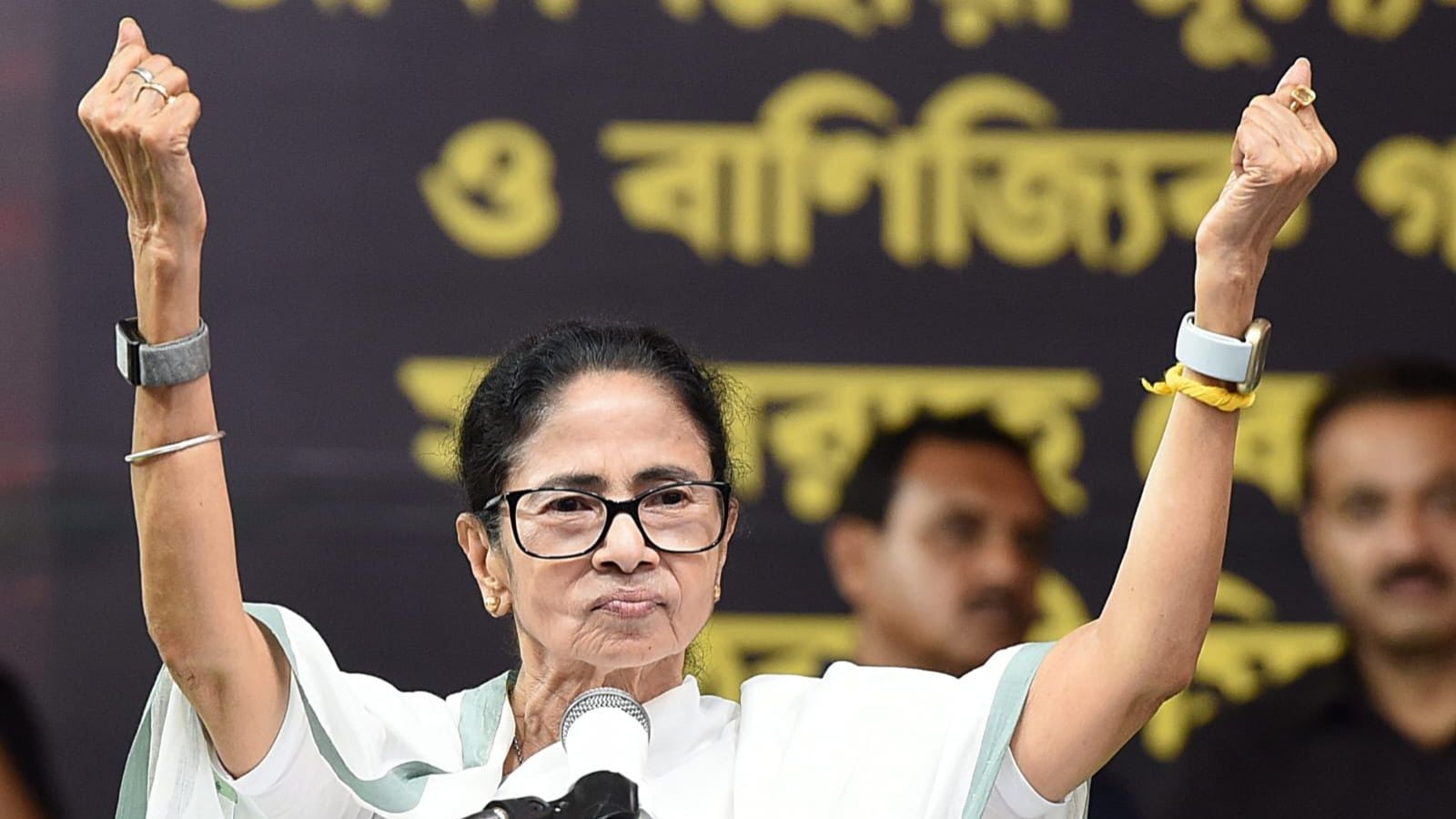
The court is hearing the ED’s plea under Article 32 seeking directions to the CBI to probe the alleged obstruction by the CM and some top officials of the state.
Stating that West Bengal Chief Minister Mamata Banerjee allegedly barging in during raids carried out by the Enforcement Directorate (ED) “is not a happy situation” and is an “unusual happening”, the Supreme Court on Tuesday said a Central body cannot be left without a remedy when its functioning is interrupted.
A bench of Justices P K Mishra and N V Anjaria wondered if there can be no legal remedy to stop repeat of such situations as Senior Advocates Shyam Divan and Kapil Sibal appearing for the state of West Bengal and Banerjee, respectively, contended that the ED has no power to file a writ petition.
The court is hearing the ED’s plea under Article 32 seeking directions to the CBI to probe the alleged obstruction by the CM and some top officials of the state, while its personnel were carrying out searches at the office of Indian Political Action Committee (I-PAC) Consulting Pvt Ltd and the residence of its founder Pratik Jain in Kolkata on January 8, 2026.
Justice Mishra said, “If we say that Article 32 petition is not maintainable, whether in a situation like this, ED which is not a body corporate according to you, can move (the High Court) under Article 226 or cannot move?
… Because you see, here is a situation that some Chief Minister unusually barges in, according to them, to some government office controlled or handled by the Central government, and whether in a situation like this, 226 is not maintainable, 32 is also not maintainable, then who will decide?
… some day some other Chief Minister … enter into some other office.
And this is not a happy situation, it is a very unusual happening.”
“We decide matters and questions when a new situation is created.
Because … the development of law is organic … this has not happened earlier,” the judge added.
Solicitor General Tushar Mehta said, “The real question is that the Central agency … exercising our jurisdiction and discharging our duty for people at large is being prevented by a head of state and we are arguing federal structure.”
Divan contended that the ED is only a department of the Central government and cannot file writ petitions under Article 32 or Article 226 which are meant to enforce fundamental rights, as it’s not a juristic or natural person.
“ED is neither a juridical person nor a natural person.
It does not have any right to sue and it cannot claim any violation of fundamental rights to maintain Article 32 petition,” Divan told the Bench.
He said the Prevention of Money Laundering Act-2002 does not confer any juristic personality on the ED or grant it any right to sue.
He said that if investigating officers are going to be given authority to draft and file such writ petitions, “there is a considerable possibility of danger not just of burdening of court but a danger to the federal structure”.
The senior counsel referred to the Supreme Court Rules and said there is a structure, form, and manner in which proceedings under Article 32 are required to be instituted.
“These types of petitions, if permitted, can jeopardise the constitutional structure,” he said.
On the court’s query whether accepting his argument would not lead to a situation where there is no remedy to such situations, Divan said the Constitution does provide a remedy, which is that the Centre itself can initiate appropriate proceedings.
Divan said the matter raises questions of constitutional significance and should ideally be dealt with by a five-judge bench.
He said that allowing the plea can lead to a situation where Article 32 is being used by one department against another or between two states or between Centre or and the states.
To arguments that no fundamental right is violated, the bench pointed out that the ED’s argument is that the security of its officials was threatened.
Sibal then said that the remedy lies in Section 221 of the Bharatiya Nyaya Sanhita-2023 (obstructing public servant in discharge of public functions).
“That is the answer … ED cannot ask the CBI to investigate.
Unless there is a predicate offence, ED cannot come into the picture, cannot file a writ petition for the fundamental right to have the CBI lodge an FIR,” he added.
The hearing will continue next week.
At the start of the hearing, Divan sought adjournment saying the state needed more time to respond to the ED’s rejoinder affidavit.
Mehta opposed this saying it was a tactic to delay the hearing.
Divan said the state had no problem if the court would ignore the rejoinder and proceed.
But this did not go down well with the bench.
“Why should we ignore anything?
You cannot dictate.
We will consider everything which is on record,” Justice Mishra said.
“A battle for adjournment is going on,” Justice Mishra said, rejecting the state’s prayer.
Ananthakrishnan G.
is a Senior Assistant Editor with The Indian Express.
He has been in the field for over 23 years, kicking off his journalism career as a freelancer in the late nineties with bylines in The Hindu.
A graduate in law, he practised in the District judiciary in Kerala for about two years before switching to journalism.
His first permanent assignment was with The Press Trust of India in Delhi where he was assigned to cover the lower courts and various commissions of inquiry.
He reported from the Delhi High Court and the Supreme Court of India during his first stint with The Indian Express in 2005-2006.
Currently, in his second stint with The Indian Express, he reports from the Supreme Court and writes on topics related to law and the administration of justice.
Legal reporting is his forte though he has extensive experience in political and community reporting too, having spent a decade as Kerala state correspondent, The Times of India and The Telegraph.
He is a stickler for facts and has several impactful stories to his credit.
...
Read More
Related Stories


Source: This article was originally published by The Indian Express
Read Full Original Article →
Comments (0)
No comments yet. Be the first to comment!
Leave a Comment