
Robert Holt is in the Basic and Translational Research Department, BC Cancer Research Institute, Vancouver V5Z1L3, Canada, in the Department of Medical Genetics, University of British Columbia, Vancouver, and in the Department of Molecular Biology and Biochemistry, Simon Fraser University, Burnaby.
Search author on: PubMed Google Scholar
Laura Evgin is in the Basic and Translational Research Department, BC Cancer Research Institute, Vancouver V5Z1L3, Canada, and in the Department of Medical Genetics, University of British Columbia, Vancouver.
The use of genetically modified immune cells called chimeric antigen receptor (CAR) T cells is a standard therapy for certain relapsed or treatment-resistant cancers 1 , including leukaemia, lymphoma and myeloma.
The approach, a type of immunotherapy, is also under evaluation for some difficult-to-treat autoimmune diseases 2 .
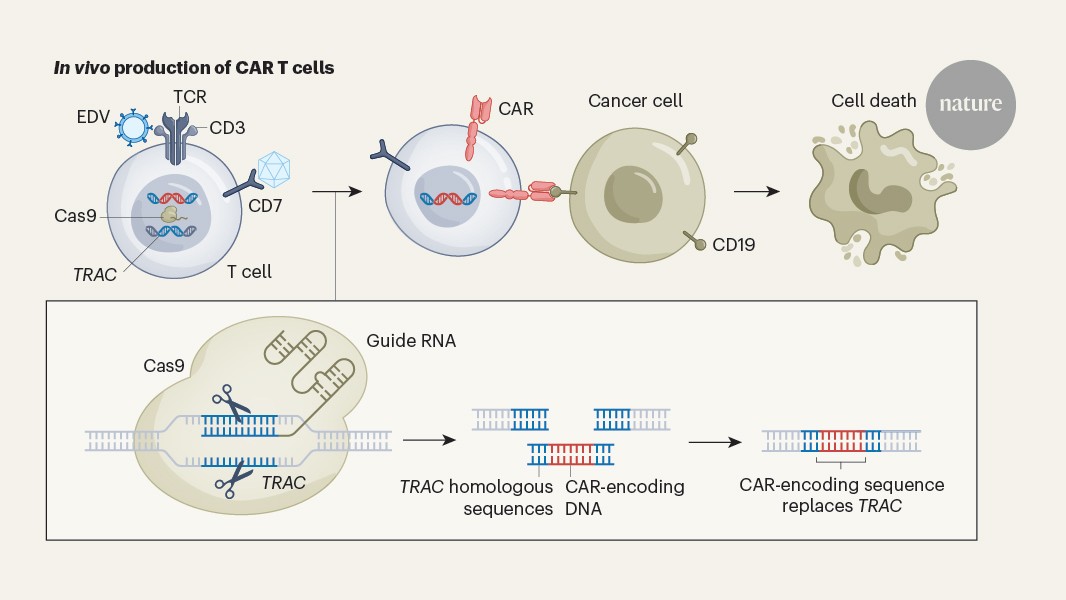
Writing in Nature , Nyberg et al .
3 present a gene-editing strategy that can create CAR T cells directly in the bodies of mice ( in vivo ), circumventing the production hurdles that currently limit their clinical use.
Access Nature and 54 other Nature Portfolio journals
Get Nature+, our best-value online-access subscription
Receive 51 print issues and online access
Prices may be subject to local taxes which are calculated during checkout
doi: https://doi.org/10.1038/d41586-026-00634-5
Cappell, K.
M.
& Kochenderfer, J.
N.
Nature Rev.
Clin.
Oncol.
20 , 359–371 (2023).
Müller, F.
et al.
N.
Engl.
J.
Med.
390 , 687–700 (2024).
Nyberg, W.
A.
et al.
Nature https://doi.org/10.1038/s41586-026-10235-x (2026).
Bot, A.
et al.
Nature Rev.
Drug Discov.
25 , 116–137 (2026).
Short, L., Holt, R.
A., Cullis, P.
R.
& Evgin, L.
Trends Pharmacol.
Sci.
45 , 406–418 (2024).
Ruella, M.
et al.
Nature Med.
24 , 1499–1503 (2018).
Eyquem, J.
et al.
Nature 543 , 113–117 (2017).
Tix, T.
et al.
Clin Cancer Res.
30 , 4690–4700 (2024).
Hamilton, J.
R.
et al.
Nature Biotechnol.
42 , 1684–1692 (2024).
Lickefett, B.
et al.
Front.
Immunol.
14 , 1303935 (2023).
L.E.
reports consulting activities and has received in-kind reagents from NanoVation Therapeutics.
L.E.
reports intellectual-property applications describing in vivo CAR-T-cell therapies.
Read the paper: In vivo site-specific engineering to reprogram T cells
Boosting immune cells to combat cancer using CRISPR engineering and large-scale in vivo testing
Immunotherapy using CAR T cells shows promising long-term outcomes for people with the blood cancer myeloma
Stress can cause eczema to flare up – now we know why
Thymus health is a predictor of lifelong well-being and immunotherapy effectiveness
Proteasome-guided haem signalling axis contributes to T cell exhaustion
Masked mitochondria slip into cells to treat disease in mice
Can weight-loss pills replace injectables?
What the science says
Join HZAU's global faculty team to advance research with competitive benefits.
Huazhong Agricultural University (HZAU)
The Stomatology Hospital, School of Stomatology, Zhejiang University School of Medicine(ZJUSS)
IRB Barcelona invites applications for Group Leader positions in Chemical Biology (one) and Structural Biology (one).
Barcelona (Provincia), Cataluña (ES)
Fundació Institut de Recerca Biomèdica (IRB Barcelona)
The Paris Brain Institute invites expressions of interest from internationally recognized senior and mid-career researchers.
Full Professorship (W3) for ‚Clinical Epidemiology of Early Cancer Detection’ (f/m/d) We are looking for a highly distinguished physician scientist...
Heidelberg, Baden-Württemberg (DE)
Medizinische Fakultät Mannheim der Universität Heidelberg
Related Stories



Source: This article was originally published by Nature News
Read Full Original Article →
Comments (0)
No comments yet. Be the first to comment!
Leave a Comment