
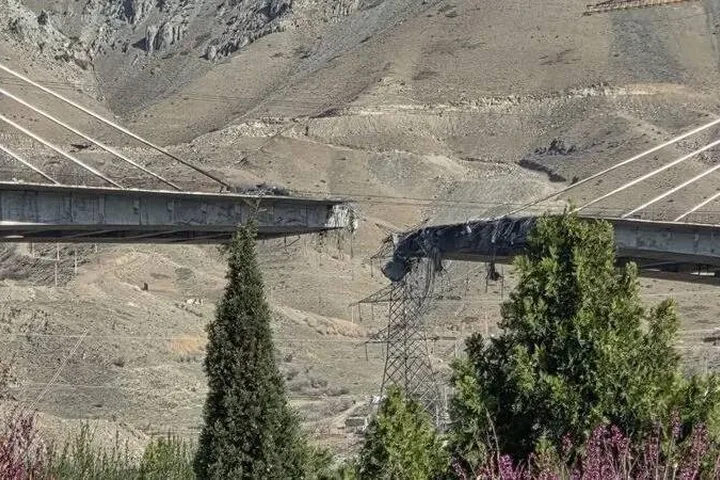
US President Donald Trump has said the tallest bridge in Iran had been destroyed, hours after threatening to bomb the country "back to the Stone Ages".
Ghodratollah Seif, the deputy governor of Alborz province, where the B1 bridge is located, said the strike killed eight people and wounded 95 others, according to state TV and Fars news agency.
Due to reporting restrictions, AFP was not able to access the sites of strikes nor to independently verify tolls in Iran.
Mr Trump posted footage on social media of smoke rising from the B1 bridge in Karaj, around 35km southwest of Tehran - and warned that there would be further destruction unless Iran comes to the table to end the five-week war.
"The biggest bridge in Iran comes tumbling down, never to be used again - Much more to follow!
IT IS TIME FOR IRAN TO MAKE A DEAL BEFORE IT IS TOO LATE, AND THERE IS NOTHING LEFT OF WHAT STILL COULD BECOME A GREAT COUNTRY!" Mr Trump said.
Iranian Foreign Minister Abbas Araghchi said in a post on X: "Striking civilian structures, including unfinished bridges, will not compel Iranians to surrender.
"It only conveys the defeat and moral collapse of an enemy in disarray."
Striking civilian structures, including unfinished bridges, will not compel Iranians to surrender.
It only conveys the defeat and moral collapse of an enemy in disarray.
Every bridge and building will be built back stronger.
What will never recover: damage to America's standing.
pic.twitter.com/872zuE36qD — Seyed Abbas Araghchi (@araghchi) April 2, 2026
Iranian state television had earlier reported two US-Israeli strikes on the bridge.
"A few minutes ago, the American-Zionist enemy once again targeted the B1 bridge in Karaj," state TV said, adding that an initial strike had caused two civilian casualties.
It said the later attack took place as emergency teams were deployed to the site to help victims of the first strike.
The B1 bridge, which was still under construction, is the Middle East's tallest according to Fars/Iranian media, with a 136-meter column.
Mr Trump delivered a speech yesterday in which he argued that the war launched by the United States and Israel on 28 February was almost over - even as he threatened to bomb Iran "extremely hard" if it did not bow to his demands.
"Over the next two to three weeks, we are going to bring them back to the Stone Ages, where they belong," he said in his first prime-time address to the nation on the war.
Earlier, the secretary-general of the Gulf Cooperation Council (GCC) called for the UN Security Council to authorise the use of force to protect the Strait of Hormuz from Iranian attacks.
Iran has placed a stranglehold on the key shipping lane - threatening fuel supplies and buckling the global economy - in retaliation to US-Israeli strikes that triggered the month-old Middle East war.
"Iran has closed the Strait of Hormuz, prevented commercial vessels and oil tankers from transiting, and imposed conditions on some to pass through the Strait," said Jassem al-Budaiwi, head of the GCC.
He spoke in New York at the first Security Council meeting on cooperation with the GCC, which comprises Saudi Arabia, the United Arab Emirates, Bahrain, Qatar, Kuwait and Oman.
"We call upon the Security Council to assume its full responsibility and take all necessary measures to protect maritime routes and ensure the safe continuation of international navigation," Mr al-Budaiwi said.
Bahrain has proposed a draft resolution that would greenlight states to use "all necessary measures" to assure free transit through the Strait of Hormuz.
However, the measure has divided the 15-member Security Council.
According to diplomatic sources, Russia, China and France - who each hold veto privileges - have voiced strong objections despite several modifications to the text.
"We want a Security Council decision that addresses the situation comprehensively with the root causes, and not one-sided and unbalanced," Anna Evstigneeva, deputy representative of Iran-allied Russia, said yesterday.
French President Emmanuel Macron has said that a military operation to free the Strait is "unrealistic".
A fifth version of the draft text was distributed to member states today.
Around a fifth of the world's oil and liquefied natural gas passes through the Strait of Hormuz in peacetime.
Its near-total closure is impacting global supplies of important commodities including oil, liquid natural gas, and fertilizer.
That has led to a sharp rise in energy prices.
Britain says 40 countries discuss reopening Strait
Around 40 countries have discussed joint action to reopen the Strait of Hormuz and stop Iran holding "the global economy hostage," Britain said, after US President Donald Trump said securing the waterway was for others to resolve.
British foreign minister Yvette Cooper said Iran's "recklessness" in blockading the waterway was "hitting households and businesses in every corner of the world" as she chaired the virtual meeting, which included France, Germany, Canada, the United Arab Emirates and India.
"We have seen Iran hijack an international shipping route to hold the global economy hostage," Ms Cooper said in opening remarks broadcast to the media before the rest of the meeting took place behind closed doors.
The discussions took place after Mr Trump said yesterday evening that the Strait could open "naturally" and it was the responsibility of countries that rely on the waterway to ensure it was open.
European officials said todays initial meeting focused on which countries were prepared to participate in the proposed coalition and the diplomatic and economic options available to persuade Iran to open the Strait.
Although the meeting ended without any specific agreements, there was a consensus Iran should not be able to introduce transit fees on ships using the waterway and all nations should be able to use it freely, one of the officials said.
The next stage of talks will be when military planners meet next week to discuss options including potential mine-clearing work and providing a reassurance force for commercial shipping.
Iran has effectively shut down the key waterway, which carries about a fifth of the world's total oil consumption, in retaliation for US-Israeli strikes which began in late February.
Reopening it has become a priority for governments around the world as energy prices soar.
European countries initially refused Mr Trump's demand to send their navies to the area because of fears about being dragged into the conflict.
But concerns about the impact of the rising cost of energy on the global economy have prompted them to try to form a coalition to see how they can defend their own interests.
European diplomats said putting the coalition together was at an early stage, with Britain and France leading.
The United States was not involved.
France's Armed Forces spokesperson Guillaume Vernet told a news conference that the process would be multi-phased and could not happen until hostilities had ended.
A focus of the talks would be how to ensure ship-owners could feel confident enough for vessels to resume travelling through the area and to bring down insurance premiums.
There would also eventually need to be coordination with Iran to ensure that there will be security guarantees for ships, Mr Vernet said, something that is unlikely for now.
Talks had also started on what military assets could be provided, he said.
Mr Trump said yesterday evening that other countries who use the Strait of Hormuz should "build up some delayed courage" and "just grab it".
"Just take it, protect it, use it for yourselves," he said.
But France's President Emmanuel Macron speaking in South Korea said seizing the Strait militarily was an "unrealistic" option.
"It would take an indefinite amount of time, and it would expose all those who venture through this Strait to coastal risks from the Revolutionary Guards, as well as ballistic missiles," he said.
UN chief Antonio Guterres has warned that the Middle East conflict risked spiraling into a wider war, as he called for an immediate halt to US-Israeli strikes on Iran and Iranian attacks on its neighbours.
"We are on the edge of a wider war that would engulf the Middle East with dramatic impacts around the globe," the secretary-general told reporters in New York.
Fears are growing that the conflict may leave Iran with a stranglehold over Middle East energy supplies now that it has shown that it can block the vital Strait of Hormuz by targeting oil tankers and attacking Gulf countries hosting US troops.
Gulf states say they reserve the right to self-defence but have refrained from responding militarily to repeated Iranian attacks over the past month, seeking to avoid escalation into a far more devastating all-out Middle East war.
Iran's parliament was reviewing a bill that would formalise the blocking of vessels from hostile countries passing through the strait and the charging of tolls for others wishing to pass, spokesperson Abbas Goodarzi said.
Thousands of people have been killed across the Middle East since 28 February when the US and Israel began air strikes on Iran, triggering Iranian attacks on Israel, US bases and the Gulf states, while opening a new front in Lebanon.
Iran said several people were likely injured when a bridge linking Tehran and the western city of Karaj was hit by airstrikes.
Some of its largest steel producers and Tehran's Pasteur Institute of Iran medical research centre had sustained serious damage in the conflict, it said.
The country's Revolutionary Guards said they had targeted US-linked steel and aluminium facilities in Gulf states and would step up such attacks if Iranian industries were hit again.
Read more Uncertainty about end to Iran war persists after address 5 takeaways from Donald Trump's televised address
Fuel shortages have already caused economic strains across Asia and they are expected to bite in Europe soon.
Italy's foreign minister said migration flows would increase if the conflict drags on.
Benchmark Brent crude prices jumped by about 7% to around $108 per barrel, with Mr Trump's address offering little reassurance on how the strait would reopen.
"The key question in all investors' minds is 'When is this going to be over?'" said Russel Chesler, Head of Investments and Capital Markets at Van Eck Australia.
The International Monetary Fund, World Bank and International Energy Agency warned yesterday that the war was having "substantial, global and highly asymmetric" effects and said they would coordinate their response, including through potential financial support to those countries hit hardest.
Related Stories

Source: This article was originally published by RTÉ News
Read Full Original Article →
Comments (0)
No comments yet. Be the first to comment!
Leave a Comment