
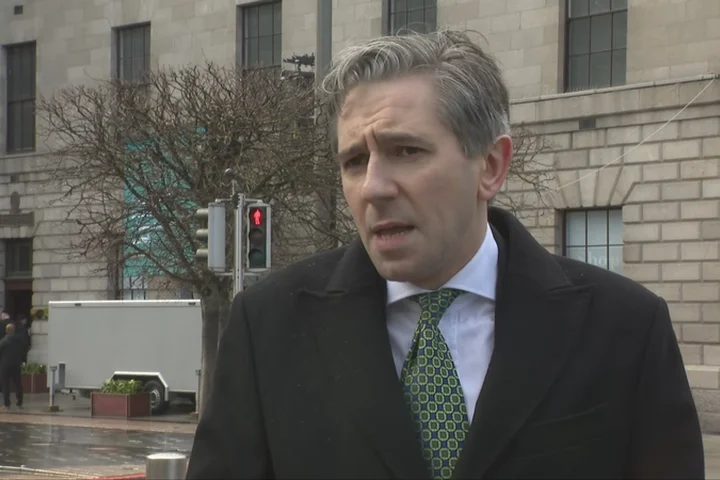
Tánaiste Simon Harris has said the energy crisis we are living through now "is the worst the world has ever seen".
Diesel and petrol prices have soared in the wake of the US-Israeli war on Iran.
Recent Government measures on excise duties have lead to some price decreases at the pump.
However, prices have surged to around €2.14 per litre for diesel and roughly €1.91 per litre for petrol, with higher prices in some places.
Speaking outside the GPO following a 1916 Easter Rising commemoration, Mr Harris said he will hold a specific leaders' meeting, along with the Taoiseach Micheál Martin and Minister Seán Canney, dedicated to the issue of energy.
He said it is "really important that day in, day out, hour in, hour out, Government works intensively with colleagues across Government and State agencies and across the world as we seek to navigate this".
He said the leaders' meeting will be "a really important opportunity for us to be briefed and take stock on where we are at from an energy supply, energy security point-of-view".
Read more: Calls for Dáil to be recalled to address fuel crisis
When asked if Ireland plans to implement fuel rations as an emergency measure like in several other countries, Mr Harris said the advice to Government has been that there is not a particular concern around supply.
"However, we have got to context that by saying that the situation is obviously fast-evolving.
We are continuing to see this war evolve.
We are continuing to see damage to energy infrastructure," he said.
He said it is also prudent that advice be issued to households and businesses on conserving energy.
"It is a very different crisis in the summer months than it can be in the winter months.
"So, obviously, we hope to see this war end.
It is true to say there is an economic challenge no matter what happens.
"The economic challenge is easier to manage if the war comes to an end," he said.
Mr Harris said it was an unfortunate statement of fact that there is no Government in the world that can absorb the economic impact of the Iran war.
"But the Irish Government is well placed to assist our citizens," he said.
"We stand ready to consider further measures in the time ahead.
"But I have got to be honest with people, we have to prepare, not just for the days ahead, but for the months ahead, for the year ahead," he said.
Difficult to change people's behaviour around energy consumption - ESRI
Meanwhile, the head of the Economic and Social Research Institute's behavioural research unit said it is difficult to get people to change their behaviour to conserve fuel amid rising costs brought on by the Iran war.
It comes as the Government is expected to launch a public information campaign in the coming weeks to encourage people to conserve energy in response to spiking fuel prices and fears over supply shortages.
Practical steps such as using public transport and washing clothes in the night are likely to be among the suggestions.
Measures such as reducing speed limits and limiting car journeys are also reportedly in the mix.
Speaking on RTÉ's This Week programme, Professor Pete Lunn said it may be difficult for people to change habits when there are no "obvious substitutes".
"If you are using vehicles for work or are in a situation where you have no alternative but to drive, it is very difficult to change your behaviour or respond," he said.
However, Prof Lunn said there are some opportunities to conserve energy, such as carrying out some errands at the same time instead of on separate car journeys.
He said people would drive a lot less if every time they had to travel, they had to hand over cash, showing directly how much it costs.
"Driving is a buy now, pay later decision," he said, adding that people’s behaviour does not adjust when it comes to driving their cars.
He said if there were reductions in public transport fares, it would be far more likely to change people’s behaviour.
Chief Economist with the Institute of International and European Affairs Dan O'Brien has said the Middle East crisis would "have to get a lot worse" before the world gets "anywhere close to the possibility of a recession".
It comes as The Sunday Independent reported that the country is braced for a recession due to the fallout from the Iran war.
When asked if the media are out of step with how it is covering the Iran war and its fallout, Mr O'Brien said there is a big fear that there will be a repeat of what happened four years ago with a really significant bout of inflation.
Speaking on the same programme, Mr O’Brien said: "A lot of it is to do with what they call a recency bias.
"The last time there was a major war and energy prices went up, it also coincided with a big rise in inflation.
"It was mostly to do with the pandemic, the war in Ukraine made it worse … there is a fear that is happening again."
Mr O’Brien said economists have not changed their forecasts much for inflation or growth.
Related Stories


Source: This article was originally published by RTÉ News
Read Full Original Article →
Comments (0)
No comments yet. Be the first to comment!
Leave a Comment