
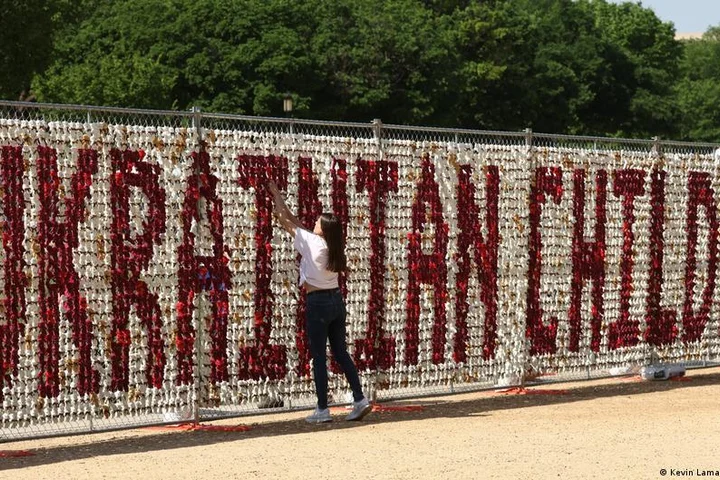
The EU is sanctioning 16 individuals and seven entities over alleged child abductions.
The UK also issued fresh sanctions, and Germany's defense minister visited Kyiv amid a shaky ceasefire.
DW has the latest.
This blog is now closed.
Read below for the top headlines about Russia's invasion of Ukraine on Monday, May 11.
Zelenskyy's ex-chief of staff named in corruption inquiry
The powerful former chief of staff to President Volodymyr Zelenskyy has been formally accused of involvement in a major corruption probe.
Ukraine's anti-graft agencies said Andrii Yermak is suspected of participating in a criminal group that laundered around $10.5 million through an elite housing development outside Kyiv.
The agencies did not name Yermak, in line with Ukrainian law, but he was widely identified by local media.
Speaking to Radio Liberty, he denied owning real estate in the development but did not comment further.
The announcement opens a new chapter in a monthlong scandal that burst into view in November, when anti-graft investigators said government officials siphoned $100 million from a state-run energy company.
That spurred a drive to root out corruption and led to the dismissals of ministers within Zelenskyy's inner circle.
Andrii Yermak resigned later in November too after anti-graft investigators searched his apartment.
Yermak had been a confidant and a friend of Zelenkyy's before he entered politics.
Ukrainian anti-graft agency investigates top Zelenskyy aide
To view this video please enable JavaScript, and consider upgrading to a web browser that supports HTML5 video
Zelenskyy says 'no silence' on front lines despite announced ceasefire
Ukrainian President Volodymyr Zelenskyy said fighting with Russia was ongoing despite their three-day ceasefire that began May 9.
The pause in hostilities was announced by US President Donald Trump last week on Friday, with Ukraine confirming the news shortly after.
The temporary ceasefire coincided with Russia's annual Victory Day.
But both Russia and Ukraine have accused each other of violating the ceasefire.
"Today there was no silence at the front, there was fighting.
We have recorded all of this," Zelenskyy said in his daily address in the final hours of the truce.
"We also see that Russia has no intention of ending this war; unfortunately, it is preparing new attacks," he added.
The White House has tried to finalize a deal to end the war since Trump took office in 2025.
But peace negotiations between Russia and Ukraine have paused, eclipsed by the conflict between US, Israel and Iran.
Ukraine war: Will the Victory Day ceasefire hold?
Zelenskyy speaks on the phone with UAE counterpart
President Volodymyr Zelenskyy spoke on the phone with his UAE counterpart Sheikh Mohammed bin Zayed Al Nahyan and discussed the UAE's assistance in bringing Ukrainians back from Russian captivity and the war in Iran.
Since the start of the Iran war, several Gulf countries like Qatar and the UAE have sought Ukraine's expertise in drone warfare.
Zelenskyy signed defense cooperation deals during his tour of Gulf Arab states in March, including with the UAE.
"I was glad to hear that Ukrainian expertise is truly helping to build reliable protection for lives.
We discussed continuing this work," Zelenskyy said on X.
"I am grateful to the UAE that our agreements are being implemented on the basis of reciprocity and that Ukraine is also receiving the support it needs, including in the energy sector," Zelenskyy added.
EU's Kallas: 'Dynamics of the war are changing'
The EU's foreign policy chief Kaja Kallas said leaders had started discussing their next major package of sanctions against Russia.
She also issued an optimistic appraisal of recent developments in the war, citing Russian casualty figures and Ukrainian long-range strikes on its oil facilities in particular.
"Moscow's record battlefield losses, Ukraine deep strikes into Russia and Moscow's shrinking military parade , these things all show that the dynamics of the war are changing," Kallas said.
"Ukraine is in a much better position than a year ago."
Kallas said she believed that the "overall understanding" was that Russian President Vladimir Putin "is in a weaker position than he has ever been before."
Kallas also told reporters in Brussels that work had begun on the next, 21st package of EU sanctions on Russia.
"We are targeting the military industrial complex of Russia and of course member states can put forward ideas on the shadow fleet as well," she said.
The EU approved its 20th sanctions package last month, along with its overdue €90 billion (roughly $105 billion) loan program for Ukraine .
No tanks: What V-Day parade says about Russia's military
Zelenskyy says talks continue with US, prisoner exchange with Russia still pending
Ukraine's President Volodymyr Zelenskyy has said that "nearly daily" communication with US representatives continue.
He said that his national security council head Rustem Umerov on Monday briefed him on recent talks with Donald Trump 's negotiators Steve Witkoff and Jared Kushner.
"Importantly, America remains engaged in diplomacy and, in particular, has acted as a mediator on the issue of a prisoner exchange," Zelenskyy said, referring to one part of the truce announced by Trump — a swap of 1,000 prisoners of war each by Russia and Ukraine — that is yet to materialize on day 3.
"Contacts are ongoing at the appropriate level to hammer out the configuration of the exchange.
The lists have been handed over, and we expect the American side to play an active role in ensuring the realization of this agreement," he said.
While the truce seems to have reduced the intensity of fighting and aerial bombardment, both sides have nevertheless reported violations nearer the front lines, including on Monday.
Trump had initially announced a 3-day ceasefire .
It would be set to expire at the end of the day if the duration stands.
Finland's President Stubb says it's time for Europe to try to talk to Putin
European leaders, including Finnish President Alexander Stubb, may have laughed off Russia's proposal of Gerhard Schröder as negotiator, but at the same time they are continuing to imply that the time for direct talks with Moscow might have come.
Europe has largely eschewed direct formal communication with Putin, except for a very occasional phone call , since soon after the 2022 full-scale invasion of Ukraine.
"It's time to start speaking with Russia.
When that will be, I don't know," Stubb said in an interview with major Italian newspaper Corriere della Sera published on Monday.
He said that in his opinion, US policy towards Russia and Ukraine no longer fully aligned with European interests, which necessitated direct European involvement.
"We have spoken with European leaders about who should establish contact," he said, albeit adding no decision had been reached.
"Whether this will be a special envoy or a group of leaders, we will see," he said.
However, Stubb also said he did not believe that a peace deal was realistically on the table yet, "at least not for this year."
The EU's Antonio Costa made similar tentative noises last week, and Ukraine's Foreign Minister Andrii Sybiha addressed the prospect at Monday's meeting in Brussels.
He said he could picture the EU being involved in "complementary" talks to those the US is trying to broker.
"We could talks about [a] new role of Europe," Sybiha told reporters.
"We have mainstream peace talks under the leadership of the USA and we need this track ...
but Europe could also play its role."
Austrian Foreign Minister Beate Meinl-Reisinger said it was time for the EU to become more actively involved in talks with Russia.
Former Ukraine PM: Russia-Ukraine peace talks a 'sham'
UK imposes new sanctions amid Russia's 'information warfare'
The UK government on Monday announced new sanctions targeting 85 Russian individuals or institutions.
They related to Russia's "information warfare campaigns," and to the alleged forced deportation and indoctrination of children.
Two-thirds of them were related to Russian propaganda operations, including alleged attempts to interfere in the upcoming Armenian elections .
This included 49 individuals working for the state-funded Social Design Agency, including writers, translators and video makers responsible for what the British government termed "deceptive Kremlin propaganda."
Armenia's balancing act between Europe and Russia
"The SDA has been tasked and funded by the Kremlin to deliver a series of interference operations designed to undermine democracy and weaken support for Ukraine," Britain's Foreign Office said in a statement .
Around a third of the individuals and entities targeted were allegedly linked to the forced deportation and indoctrination of Ukrainian children, in line with similar EU sanctions imposed on Monday.
Foreign Secretary Yvette Cooper vowed Britain "will continue to work alongside our allies to support every effort to identify and trace the children that have been cruelly taken."
Sweden arrests 2 accused of helping procure advanced engineering kit for Russia
Sweden 's SAPO security service on Monday said that two people had been detained on suspicion of helping Russia procure advanced engineering products that could be used in the war against Ukraine.
Agents suspected the equipment reached Russia in violation of EU sanctions, SAPO's Deputy Head of Operations Christoffer Wedelin told the Reuters news agency.
"The Russian war industry depends on technology, including from Sweden, to continue its war of aggression in Ukraine," Wedelin said.
Officers searched several sites in Stockholm and in southern and western Sweden amid the operation.
Court documents identified the suspects as two men, a Swedish and a Turkish national.
One was formally detained at a Stockholm court on Friday, the other faced a detention hearing on Monday.
Several of the EU sanctions on Russia relate to so-called "dual-use goods," items that are not weaponry and have civilian uses but can also be put to use on the battlefield.
Swedish defense minister explains how Russia is testing NATO
Germany's Defense Minister Boris Pistorius visits Kyiv
For the lowdown on German Defense Minister Boris Pistorius arriving in Kyiv this morning, not to mention all the other major news in Germany this Monday, look no further than our daily updates .
Pistorius met his counterpart Mykhailo Fedorov, and described Germany and Ukraine as "strategic partners."
"On the one hand, we continue to support you in your defensive struggle, but on the other, we are increasingly building a structured, long-term partnership to be reckoned with," Pistorius said.
He said the focus would be on "state of the art unmanned systems," particularly long-range ones.
Pistorius and Fedorov signed a declaration of intent on a new "Brave One" platform, a project that seeks to support developers who demonstrate promising defense innovations.
He was skeptical about Putin's weekend comments about the war nearing its end, saying the ball was ultimately in the Kremlin's court.
"If he sees the end of this war approaching, he could simply end this war," Pistorius said.
EU sanctions Russians allegedly linked to child abductions
The European Council has announced new sanctions targeting 16 Russian individuals and seven entities "responsible for the systematic unlawful deportation, forced transfer, forced assimilation, including indoctrination and militarized education, of Ukrainian minors."
It said they were also involved in "their unlawful adoption and removal to the Russian Federation and within temporarily occupied territories," in reference to the areas internationally recognized as part of Ukraine under Russian control.
According to the Council, Russia is estimated to have deported and forcibly transported nearly 20,500 Ukrainian children .
"These actions constitute grave breaches of international law and a violation of the fundamental rights of the child and aim to erase Ukrainian identity and undermine the preservation of its future generations," the European Council said .
This topic of child abduction also underpins the longstanding International Criminal Court arrest warrant issued against Russian President Vladimir Putin .
The EU listed several entities tied to the Russian Ministry of Education and individuals, including some working in occupied Ukrainian regions.
It said those listed were subject to asset freezes — and travel bans in the case of individuals — and that EU citizens and companies were forbidden from doing business with or providing funds to them.
The European Council is the arm of the EU that brings together all 27 heads of state or government of the member states.
It needs to sign off on major foreign policy issues like bloc-wide sanctions.
Ukrainian families face difficult search for missing kids
EU politicians reject Russia's Gerhard Schröder negotiation jab
European governments on Monday rejected Russian President Vladimir Putin's suggestion that former German Chancellor Gerhard Schröder could represent them in potential future talks with Moscow on the war in Ukraine and European security.
Putin said on Saturday, amid Moscow's celebrations of the 81st anniversary of Nazi Germany's surrender at the end of World War II in Europe, that he believed the war in Ukraine was coming to an end.
European leaders said it was clear why Putin had floated Schröder, who took high-paying corporate jobs with Russian energy companies after his 1998-2005 tenure as chancellor, as his preferred negotiating partner.
"It's clear why Putin wants him to be the person — so that actually ...
he would be sitting on both sides of the table," EU foreign policy chief Kaja Kallas told reporters in Brussels.
"If we give the right to Russia to appoint a negotiator on our behalf ...
that would not be very wise."
"He is, and certainly has been, heavily influenced by Mr.
Putin," Krichbaum said.
"Close relationships may be legitimate anywhere in the world, but they do not help one to be perceived as an impartial mediator."
Why Putin turned to ex‑German chancellor as a peace broker
Hello and welcome to our updates on the war in Ukraine, amid a tense ceasefire that began on May 9 at the declaration of US President Donald Trump and was set to run for three days.
It was a charged week in Russia and Ukraine amid the 81st anniversary of the end of World War II in Europe and the arguments over whether and when to halt fighting amid the dates.
President Vladimir Putin gave a speech over the weekend in which he seemed to suggest that the war could be "coming to an end."
However, Putin also used the speech to make some fanciful suggestions like charging former German Chancellor Gerhard Schröder — also a former Gazprom executive with an at-best tarnished reputation in Germany and with a far less positive image in eastern Europe and Ukraine — with negotiating between the warring factions.
This was seen by some, including in Berlin, as an indication that the Russian leader's comments were not entirely sincere or serious.
Related Stories

Source: This article was originally published by Deutsche Welle (DW)
Read Full Original Article →
Comments (0)
No comments yet. Be the first to comment!
Leave a Comment