
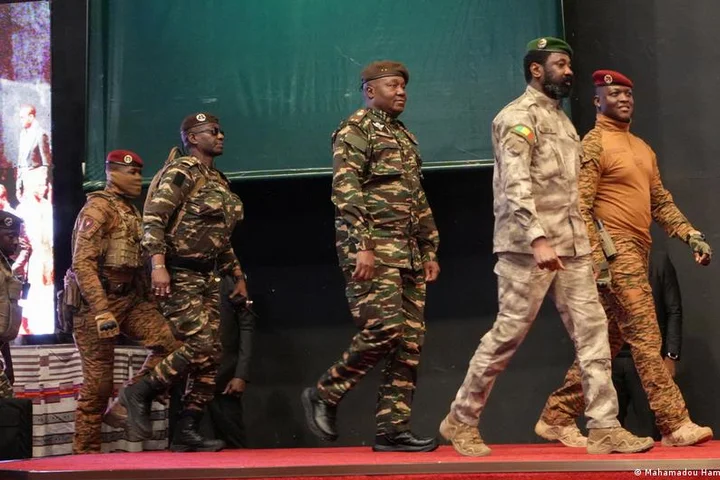
Following the 2022-2023 coups in Mali, Niger and Burkina Faso, the junta regimes turned to Russia, China and even the US.
Now, the EU wants to invest more in West Africa's security and growth to forge closer ties.
Between 2020 and 2023, military coups in Mali , Burkina Faso and Niger led to ruptures in foreign policy — and to Europe's gradual withdrawal .
Instead, Russia, China and, under Donald Trump , the United States also stepped up their presence and cooperation with the juntas.
However, this has not made the area more stable or secure.
On the contrary, the region is marked by jihadist violence and cross-border tensions , according to the study "European Sahel Policy: Back to Square One" by the German Institute for International and Security Affairs (SWP) .
The study analyzes the situation in the Sahel region and the EU's options for action.
To prevent further escalation in the region, Europe must, despite its limited influence, find a new strategy, the study states.
And that is precisely what the European Union (EU) is attempting to do.
To redefine its role in Africa in terms of security partnerships, economic development, and critical resources and energy.
Kaja Kallas: EU seeks stronger partnership with Africa
To view this video please enable JavaScript, and consider upgrading to a web browser that supports HTML5 video
It included the delivery of defense equipment to support Ghana, such as motorcycles, vehicles, drones and anti-drone systems.
The agreement is part of an EU program launched in 2023 with a budget of €50 million ($57 million).
However, security is not limited to military means, according to Kallas.
"We are also supporting the different approach when it comes to the economy, because it's important that we also deal with the root causes of instability, which are stemming from the economy," she stressed.
As part of the Global Gateway Initiative, the EU recently unveiled an investment package for Nigeria , a country that borders Niger.
With €290 million, Europe aims to strengthen its commitment to Nigeria.
The funds are primarily intended for the expansion of fiber-optic networks, local pharmaceutical production, agriculture and migration programs.
"We have not been the ‘transactionalists,'" Kallas emphasized.
Transactionalism is a term used to describe the Trump administration's deal-oriented policy.
This approach focuses primarily on give-and-take — a kind of exchange principle.
" We have been trying to help African countries because they are our neighbors," Kallas told DW.
"And our neighbors' problems today are our problems tomorrow.
So that's very much interlinked."
The EU and Africa's critical raw materials
The EU's top official underscored that "balanced partnerships" are crucial to the EU, particularly in energy and critical raw materials .
"We are interested in the support that African countries could give in this relationship so that we are providing the technologies, but the jobs will remain here."
Even though Kallas did not mention the US , China or Russia by name, her statements clearly highlight the distinction the EU seeks to draw from those three major powers.
"We are interested in a different way.
We don't want to abuse the resources," Kallas stated.
The Sahel as a migration route to Europe
"There are two main migration routes from sub-Saharan Africa through the Sahel countries.
One runs from Mali through Mauritania to the Canary Islands , and another from Niger through Libya toward Italy," Ulf Laessing, director of the Sahel Program at the Mali office of the Konrad Adenauer Foundation (KAS) — an organization affiliated with Germany's conservative government party CDU, said.
"That's why we really can't afford to do nothing here," he told DW.
"Traditionally, France was the dominant force in the Sahel .
The rest of the EU simply followed," Laessing said.
"Now that French dominance is coming to an end, others are finding it difficult to get involved."
For Laessing, the EU lacks a proper strategy for the Sahel : "There has been a position paper of this kind since last year, but it is very general in nature."
In addition, a planned €195 million development cooperation fund for the three Sahel countries is on hold.
"France is resisting this because the French still hope that they might make some kind of comeback."
Laessing described the planned development fund as "practically the only way for the EU to exert even a little influence." But most other EU countries, with the exception of Italy, are "not willing to argue with France over the Sahel—and so nothing happens at all."
The EU's plan to become Africa's closest partner
By creating local value chains, the EU aims to become Africa's preferred partner .
Whether this can succeed in the Sahel region, however, is questionable.
Other methods seem to have worked better here so far.
"The US has adopted a pragmatic approach to dealing with Mali, Niger, and Burkina Faso," Laessing said.
"They want to help in the fight against jihadists and may also be hoping for economic opportunities.
At the very least, this approach shows that the US takes the military governments in the Sahel seriously."
Can the EU's new Sahel strategy win back trust?
The EU should also demonstrate that it takes the juntas seriously, according to the study on European Sahel policy by the German Institute for International and Security Affairs (SWP).
The main goal is "to resume diplomatic and social dialogue — which has been kept to a minimum for about two years — in order to reduce mutual mistrust," study author Lisa Tschörner told DW.
"If these dialogue efforts prove fruitful, then a pragmatic, selective engagement by the EU in the region — aiming for cooperation in clearly defined areas — would be conceivable," Tschörner said.
Isaac Kaledzi and Nafissa Amadou contributed to this article.
This article was originally published in German.
Related Stories

Source: This article was originally published by Deutsche Welle (DW)
Read Full Original Article →
Comments (0)
No comments yet. Be the first to comment!
Leave a Comment