
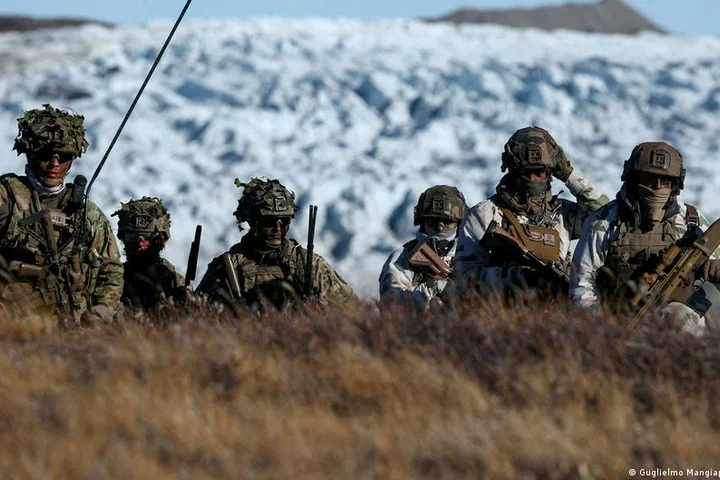
European NATO members and Canada increased their defense spending by an aggregate of 19.6% in 2025, the second consecutive year at that rate.
German defense spending, famously sluggish to rise, reached 2.4% of GDP.
NATO Secretary General Mark Rutte presented his annual report on the alliance's activities at its headquarters in Brussels on Thursday, lauding a one-fifth real-terms increase in defense spending in Europe and Canada in 2025.
"Between 2014 and 2025, NATO Europe and Canada have more than doubled their annual defense expenditure, with a real-term increase of 106%.
In 2025 alone, NATO Allies in Europe and Canada invested a total of $574 billion (rougly €500 billion) in defense, a 20% increase in real terms compared to 2024," Rutte wrote in the foreword to the report.
He said that all allies reported meeting the annual target of spending 2% of GDP on defense, with three saying they had met the new 3.5% objective set for 2035.
"This shows that NATO Allies recognize our changed security environment, and the need to meet our collective obligations," Rutte said.
US defense spending falls slightly, but still greater than rest of NATO combined
Some of the core defense spending statistics from the report follow here:
Drive towards spending 5% of GDP on either defense or related issues by 2035
Rutte, a former Dutch prime minister, spoke repeatedly of the "historic" NATO summit in The Hague last June, calling it a "defining moment for our Alliance."
At that summit, amid criticism from US President Donald Trump , the Alliance's other members pledged to spending 5% of GDP annually in defense by 2035 — 3.5% to "fund core defense" and another 1.5% for "defense- and security-related investments" like civil preparedness, innovation, critical infrastructure and strengthening defense industries.
Rutte said this plan was "making NATO fairer and rebalancing the burden of our security for the better."
He said he hoped NATO would "build on our achievements" at this year's summit in Ankara in July, saying there was "no room for complacency and no time to waste."
He warned how Russia "continued to test the Alliance," and remained "the most significant and direct threat to peace and stability in the Euro-Atlantic area." In particular, Rutte cited the invasion of Ukraine , now entering its fifth year, which he said was backed by China, North Korea, Iran and Belarus.
"A strong transatlantic bond remains essential in an age of global uncertainty," Rutte wrote, amid Trump's dissatisfaction with NATO allies reticent to get involved in the US-Israeli attacks on Iran.
"North America and Europe have always been stronger together in NATO and that is how we will continue to stay safe in a more dangerous world."
Rheinmetall boosts NATO defenses with Baltic weapons plant
To view this video please enable JavaScript, and consider upgrading to a web browser that supports HTML5 video
Related Stories
Source: This article was originally published by Deutsche Welle (DW)
Read Full Original Article →
Comments (0)
No comments yet. Be the first to comment!
Leave a Comment